Buy, delay, improvise, or skip
Is a Food-Container Lid Organizer Worth It?
A lid organizer is worth considering when a stable collection of reusable lids repeatedly gets buried, falls over, or takes too long to match—and a measured rack fits without stealing more useful space. If matching, discarding, or nesting the pieces fixes the problem, another organizer is usually unnecessary.
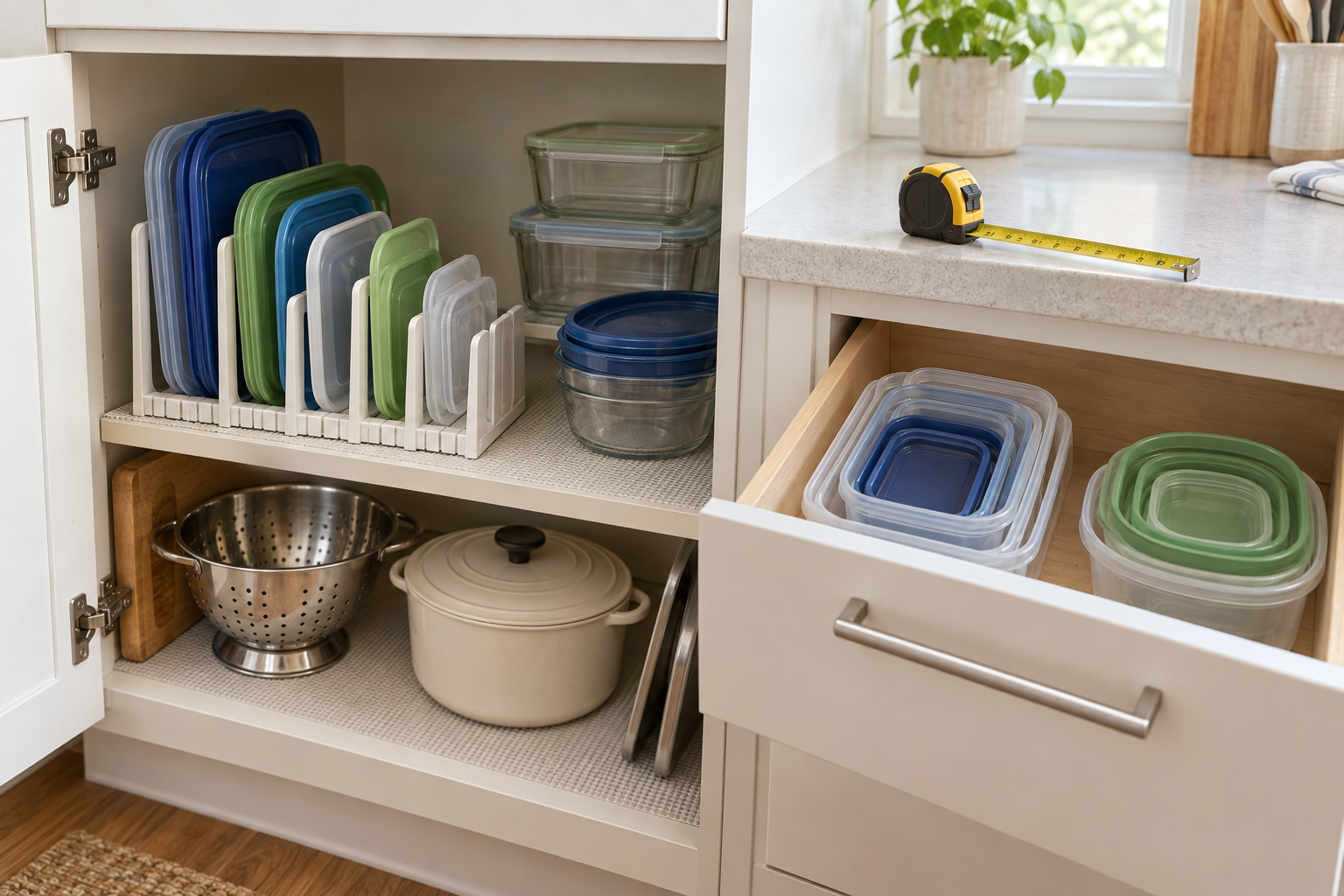
The quick decision
- Buy: the same usable lids create a recurring access problem, their measured rims fit the organizer, and the loaded unit fits the cabinet or drawer with clearance.
- Delay: you have not yet matched every lid to a base, measured the storage space, or tested a box or existing bin for a week.
- Choose an alternative: nest lids with their bases, use a small existing bin, add simple drawer dividers, or reduce incompatible container systems.
- Skip: the collection is small, changes often, already nests well, or would require giving up more useful cabinet space than the organizer saves.
- Escalate: ask the cabinet owner, landlord, or manufacturer before drilling, using adhesive, or hanging a loaded organizer on a door.
Start with a ten-minute lid audit
Put every reusable container lid and base together. Match pairs, remove broken pieces from use, and separate orphaned lids while you check whether replacements exist. Count only the lids that remain in regular rotation. This distinguishes an organization problem from a missing-part or over-collection problem.
If a base is still useful but its lid is missing or damaged, use the replacement-lid guide. Buying a rack cannot restore a seal or make incompatible pieces match.
Measure the collection and the storage zone
Measure the tallest and widest lids, including locking tabs and thick rims. Measure a typical stack thickness rather than assuming each slot holds one lid. Then record the cabinet or drawer's usable width, depth, and height with hinges, shelf lips, handles, door swing, and drawer closure included.
A product's outside dimensions and advertised capacity are not enough. Look for usable slot widths, divider locations, base footprint, and removal clearance. A rack can fit on a shelf yet still be awkward if the largest lid cannot come out without tipping the whole unit.
Cost, setup, and maintenance tradeoffs
- Purchase cost: compare the full delivered cost with a box or divider you already own. Avoid paying for a large system when only five or six lids need a home.
- Setup: adjustable racks take sorting and divider placement; fixed slots take less setup but tolerate fewer lid shapes. Door-mounted formats add attachment and clearance checks.
- Space cost: upright storage may improve scanning but can consume a wide rectangle of shelf or drawer space. Measure the loaded footprint, not an empty marketing photo.
- Upkeep: crumbs and cabinet dust collect around dividers. Favor a unit you can empty and wipe without dismantling the kitchen.
- Collection changes: a tightly fitted rack may stop working when a container breaks or a different set replaces it. Adjustable dividers reduce that risk but do not guarantee universal fit.
Red flags on the listing
- “Universal” or “fits all lids” without usable slot and lid dimensions.
- Capacity claims shown only with thin, flat lids while your collection has thick rims or locking tabs.
- Door-mounted designs without clear mounting, surface, loaded-weight, hinge, and removal instructions.
- Photos that hide the organizer's outside footprint or the space dividers occupy.
- No cleaning guidance, unclear assembly, or return terms that make a measured-fit mistake expensive.
- Claims that the product will permanently eliminate clutter or save a precise amount of space without describing the tested collection.
Who should skip it
Skip a dedicated organizer when all usable lids fit on their bases, a small bin already keeps them visible, or the household frequently changes container types. Skip a tall rack in a shallow drawer, a wide rack in a cabinet needed for cookware, and any mounted design that conflicts with hinges, shelves, rental rules, or the cabinet maker's instructions.
Also skip the purchase when other household members will not return lids to narrow slots. The system has to match the real put-away routine, not just look orderly on setup day.
When the organizer is probably worth it
The strongest case is a medium-sized, stable collection with several lid shapes that are hard to scan when stacked. The organizer should fit the measured space, keep commonly used lids reachable, remain stable as one lid is removed, and be simple enough for everyone using the kitchen to maintain.
If that test supports buying, the container-organizer comparison explains the tradeoffs among adjustable racks, bins, fixed slots, drawer dividers, and door-mounted formats. For the broader rule—buy tools only when they remove a recurring routine bottleneck—see the routine-support tools guide.
Bottom line
A food-container lid organizer is worth it only after matching and reducing the collection fails to solve a repeated access problem. Audit first, test an existing bin, measure lids and clearance, then buy the smallest maintainable format that fits. Otherwise, delay or skip it.