Visible vs private routine planning
Dry-Erase Board vs Paper Planner for Habit Routines
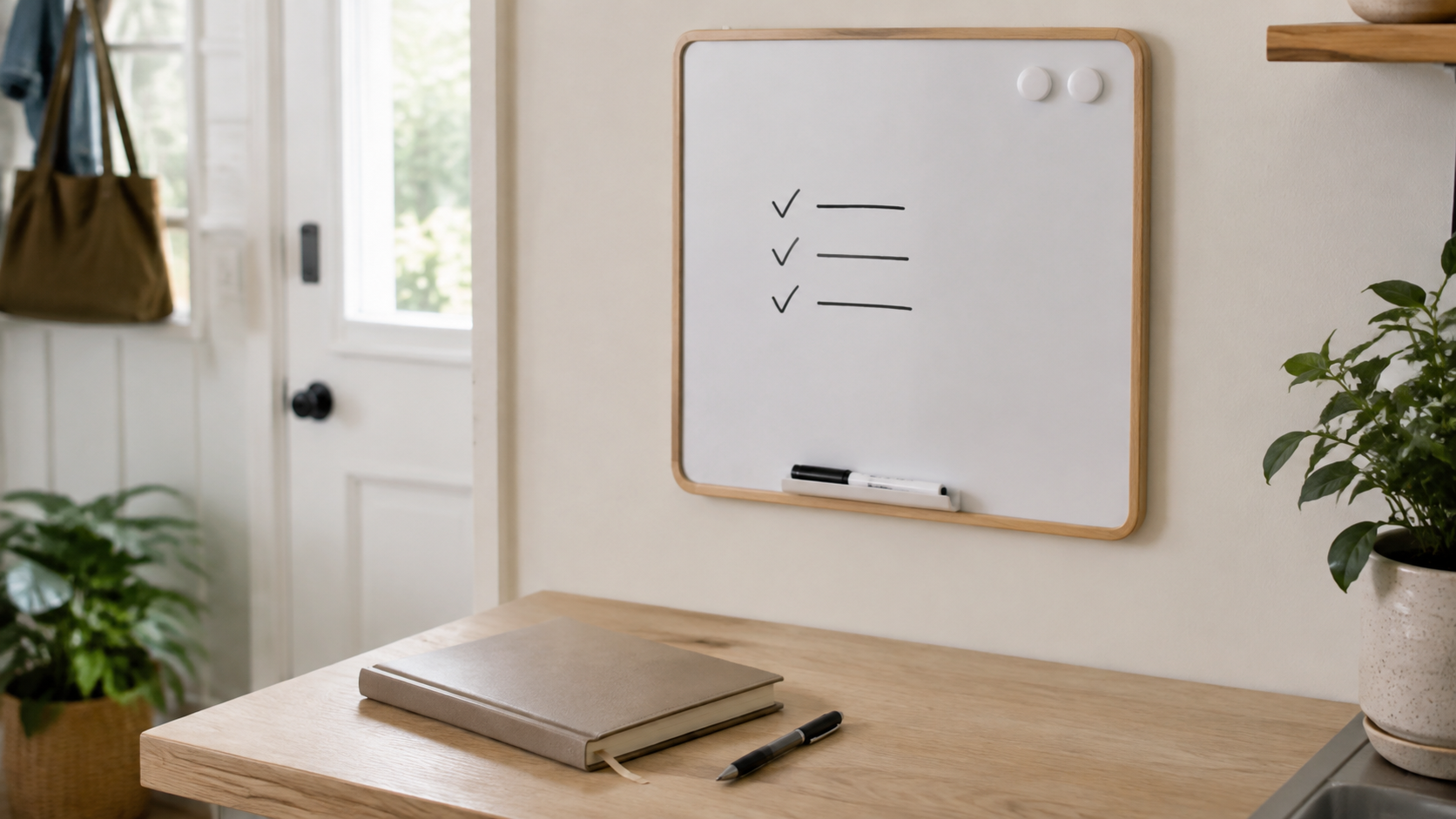
A dry-erase board can make a shared routine hard to overlook. A paper planner can keep the same notes portable and private. Neither format creates weight loss; the useful choice is the one that puts a calm reminder where it belongs without making your routine public, rigid, or harder to maintain.
As an Amazon Associate, GoodWeighFinds earns from qualifying purchases.
Quick answer
Choose a dry-erase board when the routine happens in one place, several people need the same cue, and visible notes are welcome. Choose a paper planner when the routine moves with you, the notes are personal, or you want more room for context. Choose neither when a calendar mark, reusable scrap sheet, phone reminder, or note you already own solves the problem.
How the formats differ
| Decision point | Dry-erase board | Paper planner |
|---|---|---|
| Best cue | Visible at a fixed routine location. | Opened intentionally or carried to where the routine happens. |
| Privacy | Anyone passing the board may see it. | Can stay closed, stored, or carried privately. |
| Household use | Offers one shared surface for reminders and handoffs. | Better for one person's notes unless the book is deliberately shared. |
| Portability | Usually stays mounted or propped in one place. | Moves between home, work, appointments, and errands. |
| Editing | Quick to erase, but little history remains. | Preserves earlier pages; changes may need crossing out. |
| Upkeep | Needs working markers, an eraser, and occasional surface cleaning. | Needs a pen, page space, and a habit of reopening it. |
| Space | Uses wall, fridge, cabinet, or counter area. | Uses drawer, shelf, bag, or desktop space. |
Choose the location before the product
Start with the moment when the reminder must be seen. A board near the door may suit walking-gear reminders. One near a meal-prep area may hold a short household task list. A planner makes more sense when you need to add notes away from home, compare several days, or bring questions to an appointment.
A product that lives in the wrong place becomes storage. Before buying, tape a blank sheet of paper where a board would go and use it for a week. Then carry a small notebook for a week. Notice which format you actually consult, who can see it, and whether updating it feels proportionate to the routine.
Privacy and shared-household tradeoffs
A visible board works best for information everyone is comfortable sharing: grocery reminders, packed-lunch supplies, walking times, or who will refill a water bottle station. Do not put body weight, calorie totals, medical details, symptoms, or another person's routine on a shared board without clear agreement.
A closed planner offers more privacy, but it can still be misplaced or read. Decide what information genuinely helps. A neutral note such as “pack lunch container” usually needs less sensitive detail than a food log or body measurement. If multiple people use the same planner, agree on where it stays and who updates it.
Mounting, page, and accessibility checks
- Measure the real space: Check the board's full dimensions, writing area, door or cabinet clearance, and whether glare will obscure the surface.
- Check the mounting method: Confirm whether the product is magnetic, adhesive, freestanding, or drilled. Renters should follow their lease and surface instructions instead of assuming an adhesive is damage-free.
- Inspect the planner layout: Look for readable contrast, enough writing room, a binding that stays open, and undated pages if missed weeks would otherwise feel wasteful.
- Plan the tools: A board needs compatible markers and an eraser within reach. A planner needs a pen and a storage spot that keeps it available.
- Test reach and readability: Consider mounting height, print size, grip, color contrast, lighting, and whether seated users can comfortably write on the board.
Pressure checks for either format
Skip layouts built around body countdowns, moral labels for food, mandatory daily weigh-ins, punishment language, or rigid streaks. A blank square is not a verdict. Useful formats make it easy to pause, rename a goal, mark a task not applicable, and restart without filling in a false record.
If visible tracking creates household conflict, surveillance, guilt, compulsive checking, or pressure to disclose personal information, remove the board or keep the routine off it. If a private planner encourages the same kind of distress or rigid restriction, stopping is a valid decision. A planning tool is not a medical device or treatment.
Cost and skip criteria
Include the whole setup: mounting hardware, markers, erasers, replacement pens, paper, and storage. A cheap board with an unsuitable mount or a detailed planner you avoid opening is not better value than plain paper. Current product listings should provide dimensions and materials, but seller statements are not independent proof of long-term performance.
Skip a board when there is no suitable surface, the notes should remain private, glare or reach makes it impractical, or household members do not want shared tracking. Skip a planner when portability is irrelevant, pages create clutter, the layout is too rigid, or a calendar you already use provides the same cue.
Useful next reads
This comparison maps to the non-shaming habit-tracking pillar. Use the dry-erase board buying guide for board-size and mounting criteria, or the meal-planning notebook guide for planner layouts. If the real choice is digital versus paper, see the app versus printable habit tracker comparison.
Bottom line
A dry-erase board is the stronger fit for a welcome, fixed, shared cue. A paper planner is the stronger fit for portable, private, or more detailed notes. Test both locations with tools you already own, then buy only if the dedicated format removes a specific friction without adding pressure.