Container ID or whole-freezer view
Freezer Labels vs Freezer Inventory Board for Batch Cooking
Choose freezer labels when the main problem is identifying an individual container after it moves. Choose an inventory board when the problem is seeing the whole freezer without shifting everything. Many busy freezers benefit from simple labels first and a short central list only if someone will reliably update it.
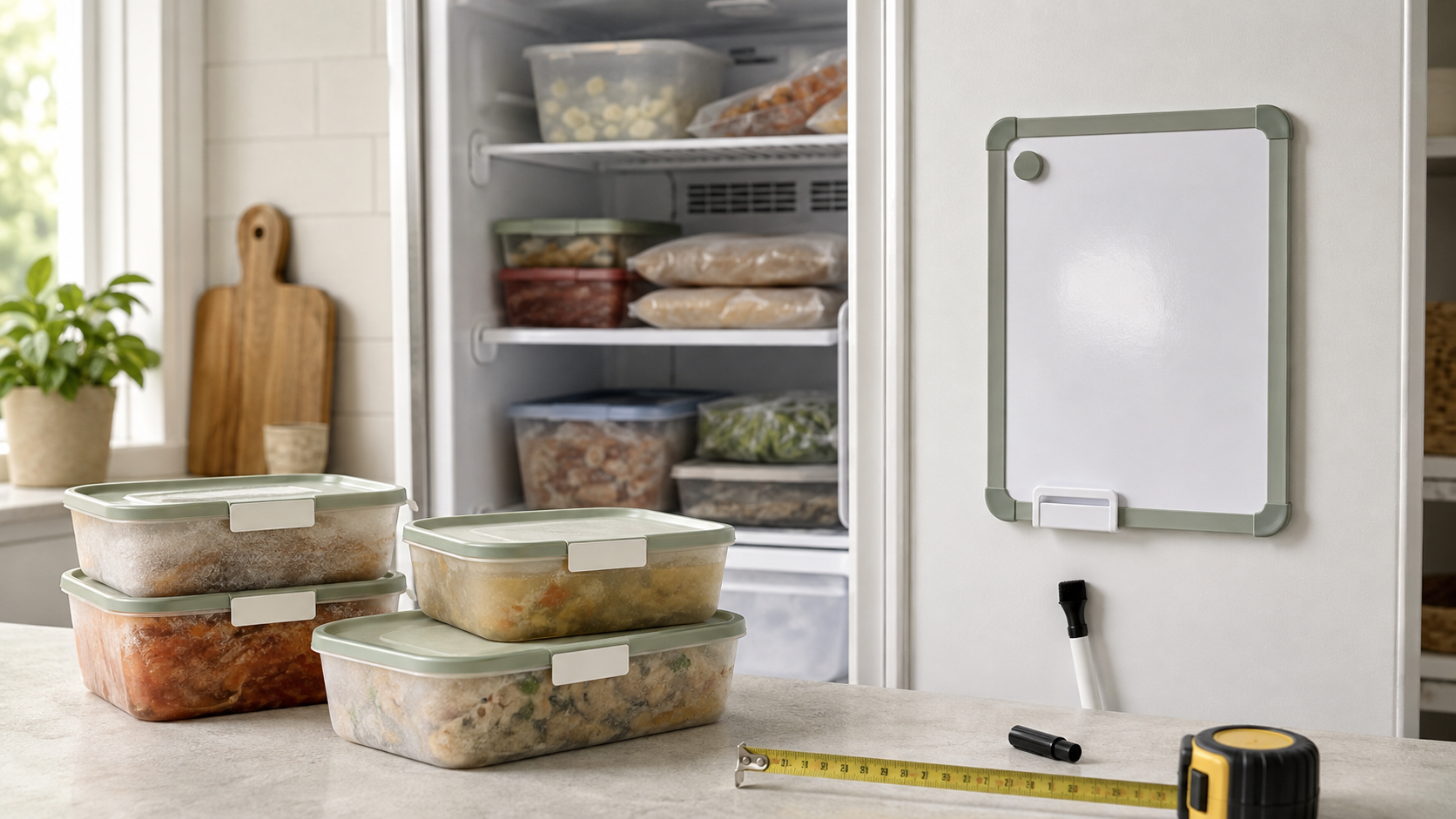
As an Amazon Associate, GoodWeighFinds earns from qualifying purchases.
Quick comparison
| Decision point | Freezer labels | Inventory board |
|---|---|---|
| Best at | Keeping an item name and date attached to its container | Showing a shared snapshot of what is in the freezer |
| Update moment | When a container is filled or repacked | Whenever an item enters, leaves, or changes quantity |
| When food moves | The record moves with it | The board stays put and must be corrected |
| Space needed | A suitable area on every container or bag | One readable mounting location plus writing clearance |
| Common failure | Label is vague, hard to read, or unsuitable for the surface | List falls out of date and looks more certain than it is |
Start with the missing answer
Open the freezer and ask two different questions: “What is in this container?” and “What meals or ingredients are available overall?” If the first question is difficult, labels address the immediate gap. If every container is identifiable but items disappear behind one another, a central inventory may add a useful second view.
Neither format establishes whether food is safe or how long it should be stored. Follow applicable food-handling guidance and the container maker's instructions; do not use an incomplete label or board entry to guess an unknown handling history.
Freezer labels: strongest for identity
A label remains useful when a container changes shelves, moves to another freezer, or leaves the house. Keep the fields limited to what your household will actually record, such as a plain item name and date. The system can work across containers, bags, and wrapped items if the chosen label is intended for each surface and use.
The tradeoff is repetition: every item needs its own readable label. Check whether the surface must be clean, dry, or at room temperature before application, and follow removal directions. Claims such as freezer-safe, residue-free, waterproof, or reusable need verification on the exact listing.
Inventory board: strongest for overview
A board can reduce the need to open the freezer just to review a list, and one visible location may work well for a household that plans together. It is most useful when entries are short and everyone agrees when to update quantities.
Its weakness is synchronization. A container can leave while its line remains, or food can enter without being recorded. Confirm the appliance surface accepts the stated mounting method, measure around handles and controls, and check appliance instructions before adding adhesive. A stainless-look door is not necessarily magnetic.
When using both is reasonable
A light combination can work without duplicating every detail: identify each container with its name and date, then keep only a brief category or quantity overview on the board. The board might show that several prepared lunches exist while the containers carry their individual descriptions.
Run the system on paper for one week before buying anything. Use removable notes on containers and one sheet near the freezer. If one part stays current and the other is repeatedly ignored, keep the part that survived the routine.
Measure and verify before buying
- For labels: note the smallest usable writing area, container and bag surfaces, application conditions, writing tool, and removal method.
- For a board: measure the clear door or wall area, writing height, handle clearance, door swing, and a place for the marker.
- For shared use: agree on the few fields that matter and who updates them.
- For either: reject listings that omit use directions, dimensions, surface compatibility, or return terms needed for your decision.
Choose the next guide by format
If attached identification fits, use the freezer-safe label tape guide to compare writing space, application, removal, and surface claims. If a shared overview wins, use the freezer inventory board guide to compare mounting, layout, marker storage, and cleaning. Still unsure whether a board will be maintained? Run the test in the freezer inventory board worth-it guide.
Bottom line
Freezer labels answer “what is this?” at the container. An inventory board answers “what do we have?” from one visible spot. Begin with the unanswered question, test the update habit cheaply, and add a second system only if it supplies a genuinely different view. For more measure-first tools, see the routine-support tools guide.