Kitchen-tool buy-or-skip guide
Is a Manual Jar Opener Worth It for Everyday Meal Prep?
A manual jar opener can be worth buying when sealed jars are a frequent, specific obstacle and one measured mechanism fits the lids, counter space, and hand clearance involved. Delay or skip it when a grip pad, different packaging, or occasional help already solves the task.
As an Amazon Associate, GoodWeighFinds earns from qualifying purchases.
The short decision
| Decision | When it fits |
|---|---|
| Buy | You open sealed jars repeatedly, can identify the part of the task that is difficult, and a measured opener addresses it without an awkward setup. |
| Delay | You have not listed common lid diameters, tested a grip pad, or checked the mounting and hand-clearance needs. |
| Choose an alternative | A rubber grip pad, a different container format, or help from another person handles the occasional task. |
| Skip | The tool misses your lid sizes, needs a surface you cannot use, duplicates a tool you own, or still requires unstable force. |
| Get individual guidance | Opening jars causes persistent pain, numbness, weakness, or a sudden change in hand function; a product page cannot identify the cause or best response. |
Start with a one-week jar audit
Write down each jar you try to open for a week. Measure the outside diameter of the lids and note whether the problem is breaking the initial seal, maintaining grip, holding the jar steady, or clearing enough space to turn a handle. A dedicated tool is easier to justify when the same problem appears often across jars within one supported size range.
Try the least specialized option first. Dry the lid and hands, place the jar on a stable counter, and test a basic rubber grip pad if that is comfortable and appropriate for you. Do not strike, puncture, heat, or pry a container unless its manufacturer specifically instructs that method.
Match the mechanism to the task
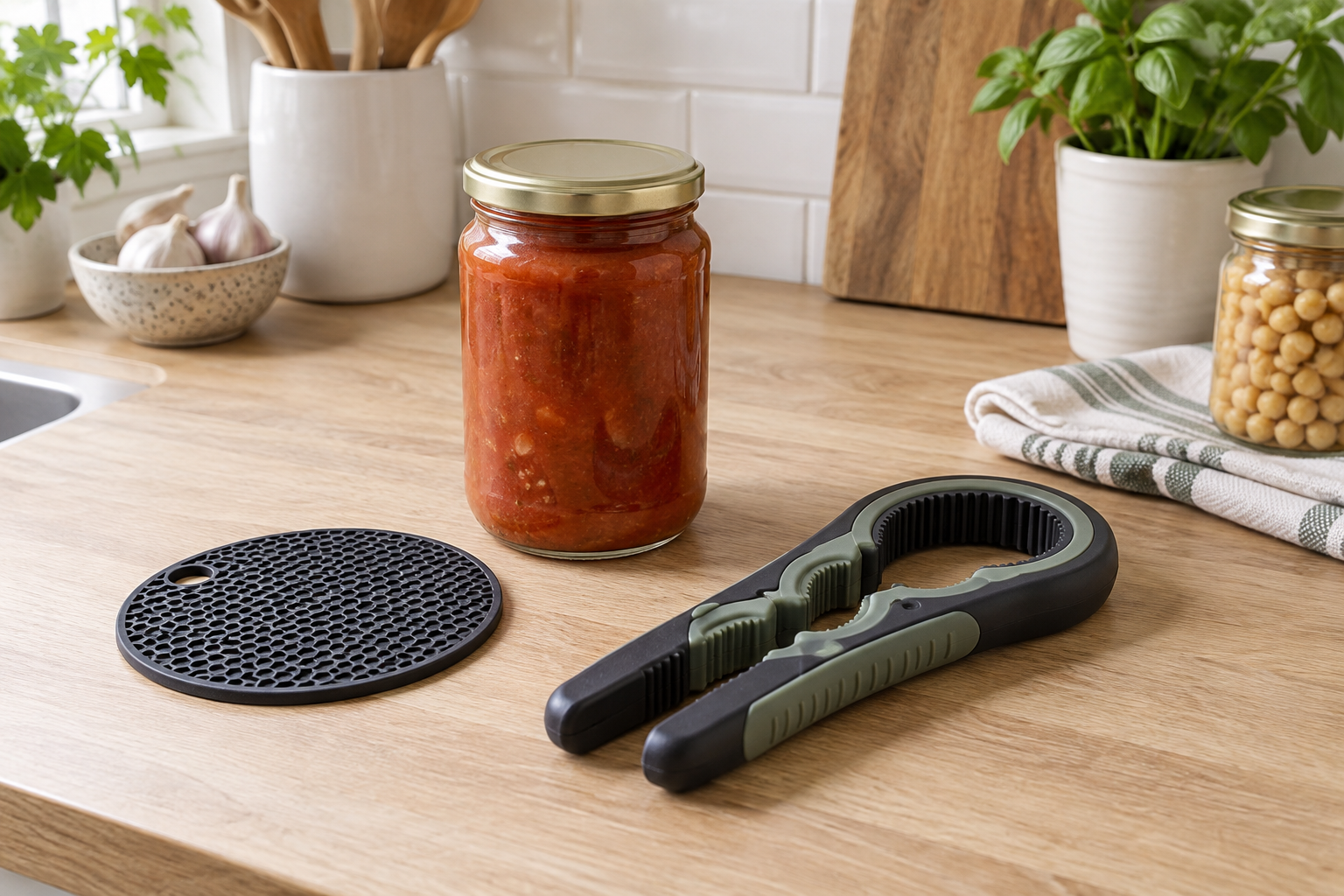
- Handheld clamp or ring: Check the maker-stated lid range, handle clearance, direction of use, and how much squeezing and turning it still requires.
- Under-cabinet opener: Verify cabinet material, permitted mounting method, fastener clearance, installation instructions, and whether the position leaves a stable working area.
- Counter-braced tool: Check the footprint, base contact, jar-height clearance, and where both hands must be placed.
- Grip pad: This inexpensive option may be enough when the only recurring problem is a smooth lid or jar surface.
“Easy,” “ergonomic,” and “one hand” are marketing descriptions, not proof that a design will fit an individual user or every jar. Check instructions and return terms before treating any mechanism as a solution.
Cost, storage, and upkeep
Include mounting hardware, replacement grip material, cleaning, and return shipping in the ownership cost. A mounted opener preserves drawer space but becomes a fixed installation. A larger handheld tool avoids installation but must fit a drawer and remain easy to retrieve. Food residue can collect around teeth, pads, or hinges, so follow the maker's cleaning and drying directions.
Before buying, decide where the tool will live and whether everyone who uses the kitchen can operate or avoid it safely. A rarely used opener buried in a drawer adds clutter without removing much routine friction.
Listing red flags
- No stated lid-size range or clear operating instructions.
- “Universal” compatibility without dimensional limits.
- Pain-relief, rehabilitation, restored-function, or injury-prevention promises for an ordinary kitchen tool.
- Mounted designs with vague surface, hardware, load, or installation requirements.
- Demonstrations that rely on an unsecured jar, extreme force, striking, puncturing, or hidden assistance.
- No cleaning guidance, seller identity, or practical return terms.
Who should skip one?
Skip a dedicated opener if sealed jars are rare, a grip pad already works, you can choose packaging that is easier for you to manage, or no available design fits your jars and kitchen setup. Also skip any model whose use still feels unstable or requires a grip, reach, or force that does not work for you.
If difficulty opening containers is new, worsening, painful, or paired with numbness or weakness, the useful next step is qualified individual guidance rather than stronger leverage or repeated attempts.
Bottom line
A manual jar opener is worth it when a repeated jar-opening task, measured lid range, suitable mechanism, stable setup, storage, and realistic upkeep all line up. Test a simpler grip aid first and skip tools with vague fit or medical-style promises. If the ownership case is clear, use the manual jar-opener buying guide to compare formats. For broader kitchen-tool decisions, continue with the routine-support tools pillar.