Routine-support buying guide
Best Manual Jar Openers for Everyday Meal Prep
A manual jar opener can reduce the friction of one recurring kitchen task without taking up space like a powered appliance. The useful choice depends on the lid sizes you actually open, where the tool gets its leverage, and whether its setup is practical in your kitchen.
As an Amazon Associate, GoodWeighFinds earns from qualifying purchases.
Who this guide is for
This guide is for adults comparing unpowered aids for ordinary twist-top pantry jars. It is task-focused: it does not assume a diagnosis, promise pain relief, or establish that one format will suit every grip or mobility need.
For the broader approach, start with the routine-support tools guide. If the bigger problem is limited prep space, compare compact cutting-board criteria or stackable mixing bowls.
Useful formats—not unsupported winners
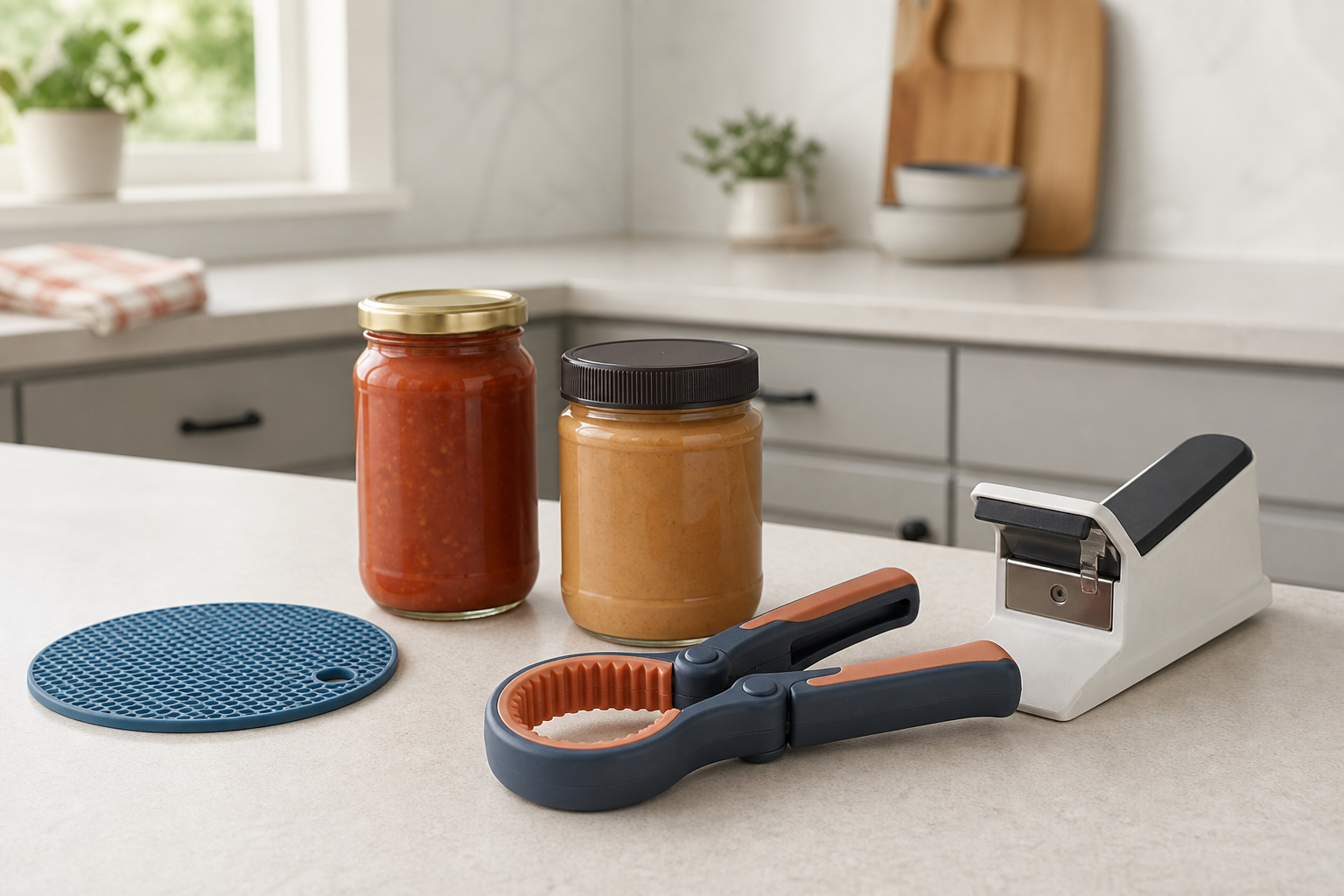
- Flat rubber or silicone grip pads: Simple to wash and store, but they add friction rather than leverage and depend on a usable grasp.
- Handheld clamp or ring openers: Adjustable jaws or rings can fit several lid sizes; handle length, adjustment steps, and required hand positions matter.
- V-shaped wedge openers: The lid pushes into a narrowing grip surface. Some mount under a cabinet, so installation and clearance are part of the purchase.
- Counter-contact leverage openers: A base or body supports the jar-opening motion, but footprint, stability, and jar-height limits need checking.
Selection criteria that matter
- Measured lid range: Measure the outside diameter of the smallest and largest lids you regularly open; reject vague “all sizes” claims without dimensions.
- Mechanism: Identify whether the opener adds friction, increases leverage, clamps the lid, or needs a fixed surface.
- Required movement: Read the directions and note every grip, squeeze, push, twist, and stabilizing action instead of relying on “easy” language.
- Mounting and clearance: For mounted designs, verify cabinet material, fasteners, edge clearance, jar height, installation terms, and removal consequences.
- Contact surfaces: Check how the jar and lid are held and whether hard teeth could mark certain lids.
- Cleaning: Look for removable grip parts, food-contact guidance where relevant, and specific hand-wash or dishwasher directions.
- Storage: Compare actual length, width, height, hanging holes, drawer fit, and whether an installed tool blocks usable space.
- Returns: Verify seller identity and the return window before testing fit beyond clean, ordinary use.
A practical comparison framework
Mark each candidate yes, no, or unclear:
- Is the supported lid-diameter range stated and suitable for your jars?
- Does the mechanism reduce the specific motion that makes the task awkward?
- Can the jar remain stable without unsafe force or an improvised surface?
- Are setup, adjustment, and use directions clear before purchase?
- Will a mounted format fit the cabinet and jars without obstructing the counter?
- Can every grip and contact surface be cleaned as directed?
- Does the tool fit its planned drawer, hook, cabinet, or counter location?
- Are limitations, seller identity, and return terms visible?
Claims and setup limits
“Opens any jar,” “effortless,” and similar wording should be treated as marketing unless the listing defines the lid range, mechanism, and required actions. Lid vacuum, dried residue, jar shape, surface stability, tool wear, and setup can all change the result.
Follow the maker’s instructions on a stable surface. Do not strike, heat, puncture, or force a glass jar as a workaround. Stop if the glass is chipped or cracked, the lid or tool slips, or the setup requires uncontrolled force.
Who should skip this purchase
Skip a manual opener if the lids you use fall outside its measured range, the required mounting is not permitted, or the same grip and twisting motion remains necessary. Skip listings that omit dimensions, directions, cleaning guidance, or a clear view of the mechanism.
A generic marketplace tool is not a substitute for individualized accessibility or medical guidance. If opening containers is persistently difficult or unsafe because of pain, weakness, tremor, or another health concern, a qualified healthcare or occupational-therapy professional may be a more useful next step than guessing at a tool.
Bottom line
The best-fit manual jar opener is the format whose measured lid range covers your pantry jars, whose mechanism addresses the awkward part of the task, and whose mounting, cleaning, and storage needs work in your kitchen. Compare those facts—not broad ease claims—and skip any tool that still requires an unsafe setup. If you are not sure a dedicated tool earns its space, first decide whether a manual jar opener is worth buying for your routine.