Buy, reuse, or skip
Is an Over-the-Sink Cutting Board Worth It in a Small Kitchen?
An over-the-sink cutting board can be worth buying when counter space is the real bottleneck, the board has measured support on both sink rims, and blocking part of the sink does not disrupt the rest of prep. It is usually a poor fit when the sink must stay available or the board would be awkward to wash, dry, and store.
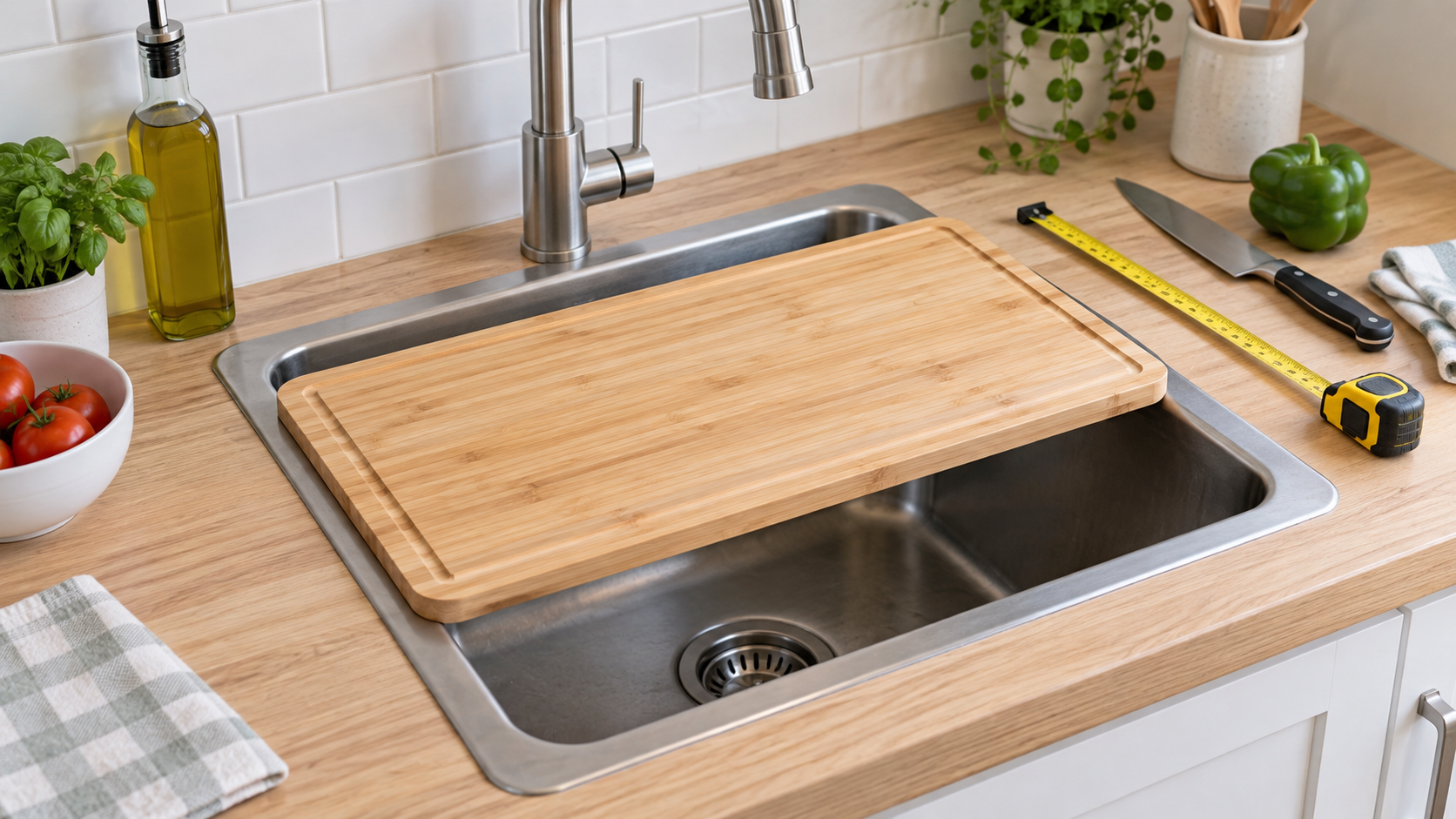
The quick answer
- Likely worth it: a regular board repeatedly consumes your only useful counter, the sink has stable parallel support areas, and enough basin access remains.
- Measure first: record the opening, outside rim-to-rim span, flat rim depth, faucet position, and maximum board size you can wash and store.
- Probably skip it: the sink is needed throughout prep, its edges do not provide dependable support, or a regular board already fits elsewhere.
Start with the sink, not the listing
“Fits most sinks” is not a useful measurement. Sink shapes, raised lips, dividers, faucets, accessories, and counter seams vary. Measure the clear opening and the solid surface available on each side, then compare those numbers with the maker's stated supported span and complete dimensions.
Do not count a curved corner or narrow strip as full support without product-specific instructions. If a board uses extending rails, check their contact length and how the maker says they lock. If the supported range is missing, there is too much guesswork for a fit-dependent purchase.
Map the whole prep sequence
A board can add temporary work area while removing sink access. Walk through washing ingredients, placing the board, cutting, moving scraps, rinsing tools, and clearing the board. If it must be lifted several times, decide where wet ingredients and the board will wait.
- Supported overlap: compare board contact surfaces with the flat rim available on both sides.
- Usable area: subtract rails, handles, colanders, grooves, and any portion beneath the faucet.
- Movement: look for specific details about grips, stops, or locks; “secure” is a claim, not proof of fit.
- Sink access: confirm whether the faucet, drain, or one basin remains usable when positioned as directed.
Count washing, drying, and storage
Compare the board's full diagonal with the sink or dishwasher space available for cleaning, then follow the maker's material-specific care directions. Measure the cabinet, rack, or wall slot where the dry board would live. Attached rails and baskets can make expandable formats thicker than expected.
Try a no-buy layout test
Mark the proposed outline on cardboard and place it across the sink without using it for food prep. Check faucet movement, your normal approach, nearby handles, and where washed items would go. This tests geometry only; cardboard is not a cutting surface or load-bearing substitute.
If a standard board fits your counter, compare regular cutting boards for small kitchens. They leave the basin available and do not depend on sink compatibility.
When to move from deciding to shopping
If the layout test reveals useful space and the workflow still works, use the over-the-sink cutting-board comparison guide to compare fixed, extending, and colander-equipped formats. Match candidates to measurements rather than “small kitchen” wording.
Reasons to skip or delay
- The listing omits complete dimensions, supported sink range, material, or care directions.
- The rim is curved, uneven, narrow, or interrupted where contact is needed.
- You need the faucet and full basin during most of the task.
- The board cannot be washed, dried, or stored in your space.
- A regular board you own solves the problem with fewer setup steps.
Bottom line
An over-the-sink cutting board is worth considering only when measured support and a realistic prep sequence turn the sink into useful temporary workspace. If fit, sink access, or storage remains uncertain, keep the simpler board you already use. For the wider framework, see the routine-support tools guide.