Buying guide
Best Over-the-Sink Cutting Boards for Small Kitchens
An over-the-sink cutting board can turn an unused sink opening into temporary prep space, but only when the board, supports, sink rim, and working load fit together. Start with measurements and stability—not a listing's “universal” label.
Not sure this format belongs in your kitchen? Start with the over-the-sink cutting-board buy-or-skip test before comparing models.
Who this guide is for
This guide is for adults with limited counter space who want a temporary prep surface across a compatible sink. It focuses on sink fit, stable support, usable work area, drainage accessories, cleanup, and storage. It does not claim that a board changes nutrition, portion needs, or weight-loss outcomes.
For broader low-hype kitchen-tool decisions, start with the routine-support tools pillar. If you have enough counter space and mainly need a general board, use the standard cutting-board guide. If draining is the main task, compare collapsible colanders instead.
Best-fit formats, not unsupported winners
No board was purchased, load-tested, cut on, or durability-ranked for this guide. These are formats to compare against your actual sink and prep routine.
- Best format for changing sink widths: An extending board whose documented rail range lands securely on both sides of the measured rim.
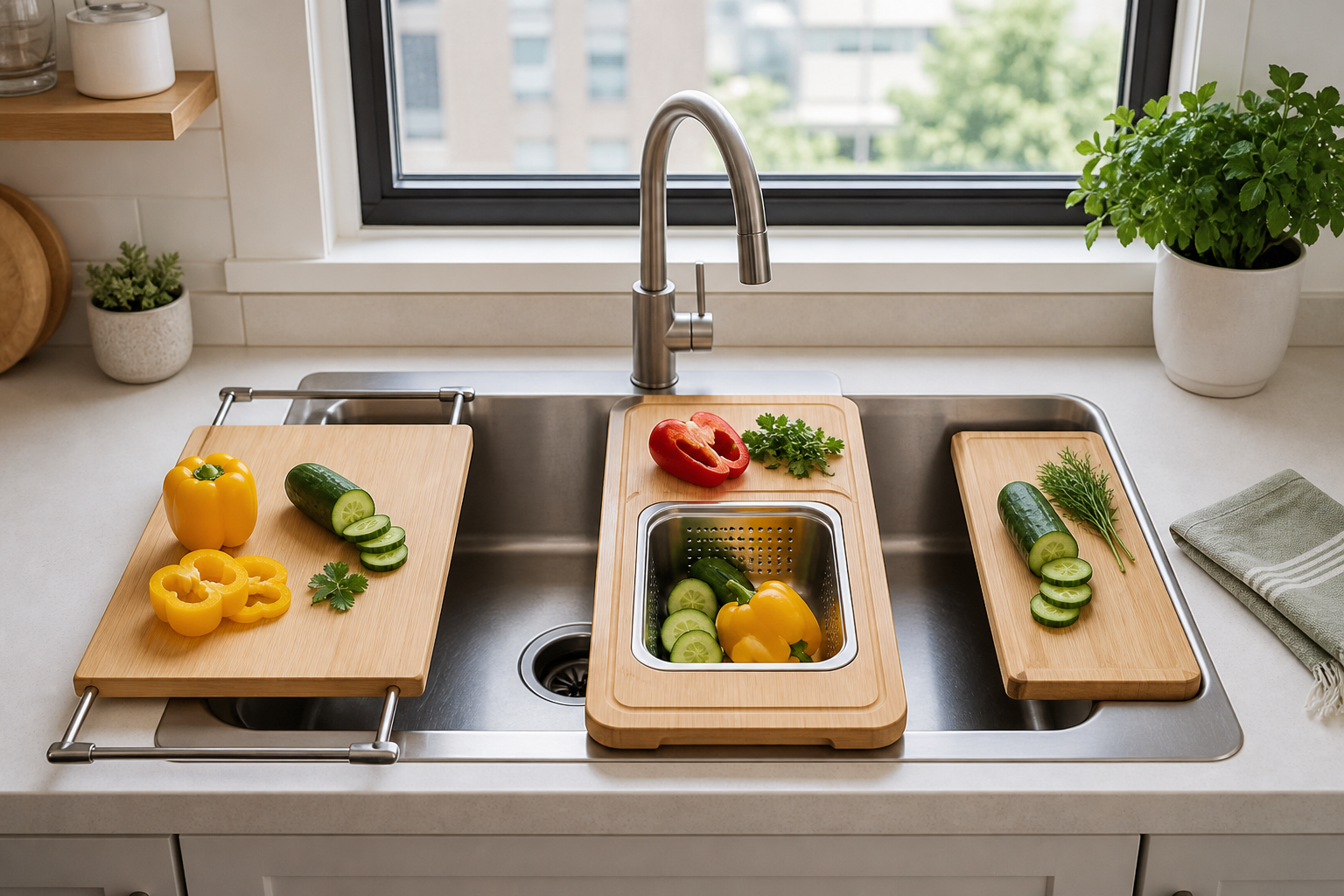
- Best format for rinse-and-transfer tasks: A board with a removable colander whose bowl clears the sink basin and does not reduce the needed cutting area.
- Best format for fewer moving parts: A fixed board long enough to span the sink with the maker's required support overlap at both ends.
- Best format for occasional use: A lighter board that fits a measured storage location and can be set up without awkward lifting.
- Best format for an unusual sink rim: Often no purchase until a listing documents compatibility with that exact rim, divider, faucet, and mounting arrangement.
Measure the sink before comparing boards
- Clear span: Measure the outside-to-outside distance between the two support points the board will rest on.
- Support ledge: Measure the flat rim available at each end. Rounded, raised, narrow, undermount, or uneven edges may not provide the support a listing assumes.
- Basin clearance: Note faucet reach, sprayer hoses, sink dividers, drain hardware, and the depth available for a hanging colander.
- Working height: Add the board thickness to the rim height and consider whether that position is comfortable for the intended task.
- Storage opening: Measure the cabinet, drawer, or upright slot where the complete board and any insert will dry and live.
Selection criteria that matter
- Full and usable dimensions: Separate the complete footprint from the unobstructed surface left after rails, handles, grooves, or colanders.
- Supported range: For adjustable rails, confirm both minimum and maximum positions and how the extension locks or stops.
- Grip and contact: Look for clearly placed feet or pads and instructions about dry, clean support surfaces. A “non-slip” label is not a guarantee.
- Load guidance: Prefer a documented limit and intended use. Do not assume a sink-spanning board can support heavy appliances, cookware, or body weight.
- Material and care: Check the maker's material label, hand-wash or dishwasher directions, drying instructions, and restrictions on heat or soaking.
- Drainage features: Grooves and removable colanders add cleanup surfaces. Confirm where liquid drains and whether that path suits the sink setup.
- Knife surface: Check whether the maker identifies the worktop as a cutting surface rather than a serving tray or sink cover.
- Return terms: Fit depends on geometry that photos can hide, so verify the current seller and return route before ordering.
A simple comparison framework
Record each listing as yes, no, or unclear. Treat an unclear fit or support detail as unresolved rather than filling the gap with a guess.
- Does the documented span fit the measured sink with adequate support at both ends?
- Do all feet or rails sit on flat, compatible surfaces without rocking?
- Does the usable work area fit the recurring prep task?
- Are the extension, grip, and load instructions specific?
- Will an insert clear the basin, divider, drain, and stored dishes?
- Can every piece be washed and dried as directed?
- Does the complete setup fit its planned storage spot?
Use limits and practical handling
Set the board on clean, dry support points and follow the maker's setup and load directions. Check stability before placing food or a knife on it. Keep the sink below clear of dishes and sharp objects, and avoid running water where it can make the support points slippery unless the product directions specifically account for that use.
A board spanning open space can behave differently from one lying flat on a counter. Do not lean on it, sit on it, use it as a shelf for heavy cookware, or assume decorative sink-cover language means it is intended for cutting. Stop using a board with loose rails, damaged feet, deep warping, cracks, or a fit that shifts during ordinary prep.
Who should skip this purchase
Skip an over-the-sink board if the sink has too little flat rim support, the faucet or divider blocks a stable position, the listing omits the extension range or load guidance, or losing sink access would make prep harder. A standard board on a counter, table, or stable cart may be simpler.
Also skip it if lifting a wide board across the sink is uncomfortable, if you need the basin continuously while cutting, or if there is no practical place to wash and dry the full board. An integrated colander is not automatically useful when it removes too much work surface or adds a part you will not use.
Bottom line
The best over-the-sink cutting board is the format that spans your measured support points, stays stable within its documented use, leaves enough clear prep area, and can be cleaned, dried, and stored without creating a new problem. If those facts are missing, “universal fit” is not enough information to buy.