Shared grocery-list buy-or-skip guide
Is a Reusable Fridge Board Worth It for a Shared Grocery List?
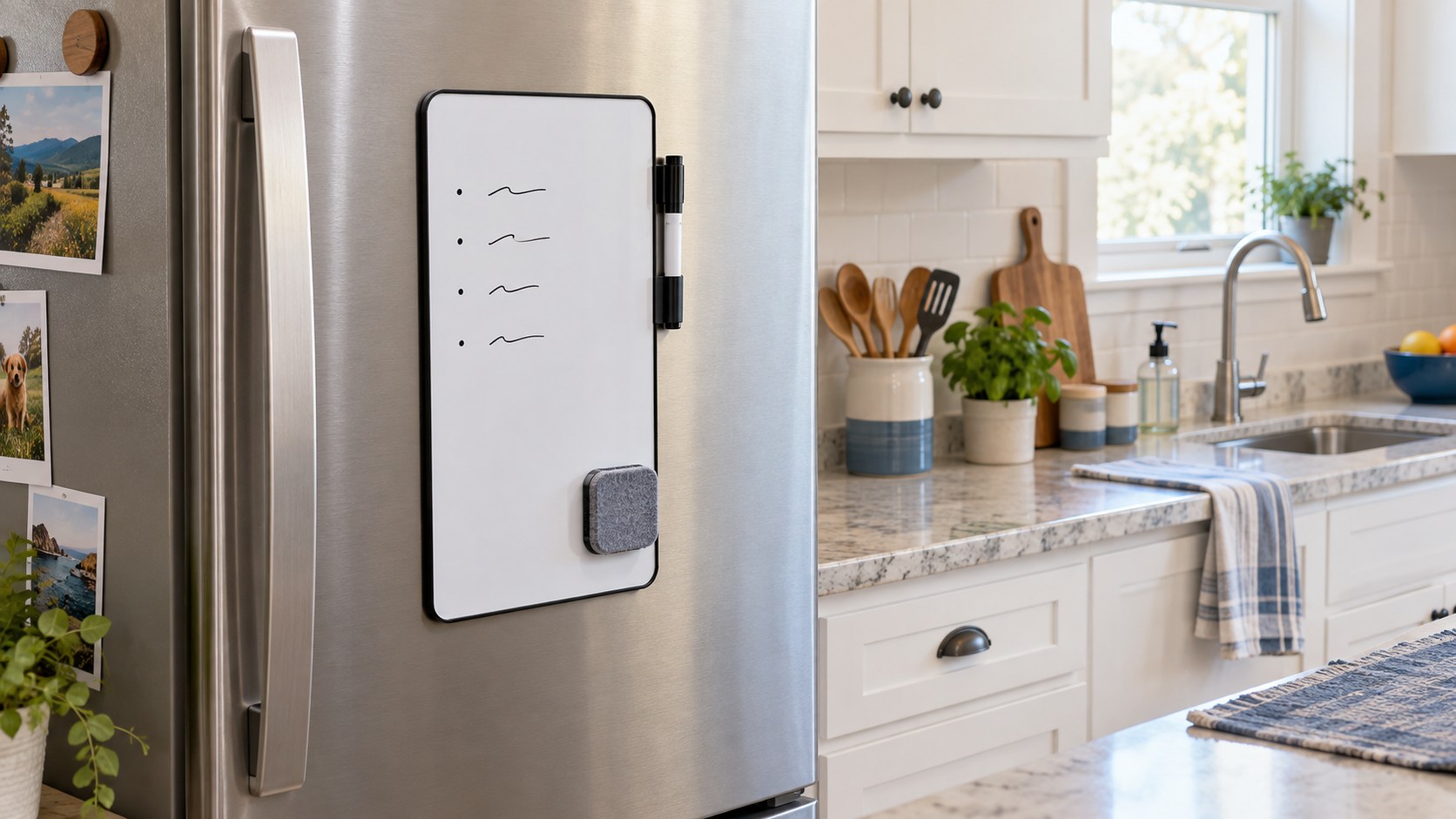
A reusable fridge board is worth considering when several people will add items in one visible place and someone already has a dependable way to take the finished list shopping. Delay the purchase until a one-week paper test proves the household will update it. Skip it when a shared phone note, magnetic paper pad, or ordinary scrap already works.
As an Amazon Associate, GoodWeighFinds earns from qualifying purchases.
The quick decision
- Buy: multiple household members need one visible capture point, the exact refrigerator surface is compatible, and the list-to-store handoff already works.
- Delay and test: tape plain paper in the proposed location for one ordinary week and use the same update rule the board would require.
- Choose an alternative: use a magnetic paper pad when the finished list needs to tear off and travel, or a shared phone note when people add items away from home.
- Skip: one person handles the list, the board would expose private notes, nobody wants marker upkeep, or an existing method is reliable.
- Escalate: ask the appliance maker or landlord before using adhesive or hardware when the surface instructions, finish, or rental rules are unclear.
Test household adoption before buying
The board does not create participation. Pick one narrow job—recording grocery items that have run out—and test it with paper at the intended refrigerator location. Agree on one trigger, such as writing an item when the last package is opened. Do not add meal plans, personal tracking, and chores during the test; extra jobs make it harder to see whether grocery capture works.
At the end of the week, check whether everyone could reach the list, a writing tool stayed nearby, entries remained readable, and the shopper remembered to take a photo or copy the list. If the paper stayed blank or stale, a polished reusable surface will probably become clutter.
Measure the surface and writing area
Test the exact refrigerator panel with a magnet you already own. A stainless-looking door is not necessarily magnetic, and side panels may behave differently from the front. Measure around handles, dispensers, hinges, vents, door edges, and the sweep of nearby cabinets. Cut paper to the product's listed outside dimensions and open everything around it before ordering.
Compare usable writing space, not just overall size. Subtract the frame, headings, marker holder, and eraser dock. Check line height against the largest regular handwriting in the household and place the mock-up where the shortest regular user can comfortably see and write on it.
Plan the shopping handoff
A board stays on the refrigerator. The grocery list must leave. Decide whether the shopper will take a clear photo, copy it into a phone, or rewrite it on paper. Test that exact handoff on a rushed shopping day. A reusable board is a poor fit when the transfer step is routinely forgotten.
If the same piece of writing needs to go directly into a pocket or tote, a paper pad has the simpler workflow. The existing magnetic notepad versus dry-erase board comparison covers that format choice in detail. This page answers the earlier question: whether the household will maintain any fixed reusable board.
Cost, setup, and maintenance tradeoffs
| Tradeoff | What to check |
|---|---|
| Initial setup | Board, compatible mount, marker holder, eraser, placement, and one household update rule. |
| Ongoing supplies | Compatible replacement markers, cleaning materials allowed by the maker, and replacement accessories if offered. |
| Routine upkeep | Erase bought items, remove stale entries, clean only as directed, recap markers, and keep the writing tool attached. |
| Space cost | Full mounted footprint plus room for hands, marker access, handles, doors, drawers, and appliance controls. |
| Handoff cost | The extra time and attention needed to photograph or copy the list before shopping. |
| Exit cost | Return terms and maker instructions for removing magnets, adhesive, or hardware without assuming damage-free removal. |
Red flags in product listings
- No complete outside dimensions or a product photo that hides the frame and accessory holders.
- “Works on every fridge,” “extra strong,” “stain-proof,” or “residue-free” language without defined surfaces, materials, tests, or care conditions.
- No clear explanation of whether mounting is magnetic, adhesive, suction-based, or drilled.
- No marker type, cleaning directions, usable writing-area measurement, or return path.
- Claims that a board reduces food waste, saves money, improves eating habits, or supports weight loss without appropriate evidence.
- Images that show the board blocking an appliance handle, dispenser, control, seal, hinge, or vent.
Who should skip it
Skip a reusable fridge board when household members do not agree to a shared list, notes could expose private routines, glare or mounting height makes writing difficult, or the refrigerator surface is unsuitable. It is also a poor fit when markers are easily misplaced, cleaning feels like another unwanted task, or the shopper needs a physical list that travels without copying.
Choose a shared phone note when updates happen from several locations or shoppers change often. Choose a magnetic paper pad when fridge-side visibility matters but the final sheet needs to leave the house. Use ordinary paper when the routine is still being tested. If fixed public tracking creates pressure or household conflict, keeping the list private—or using no formal system—is a valid choice.
What to verify before ordering
- The exact refrigerator panel accepts the stated mounting method.
- Exterior dimensions and usable writing area fit the measured mock-up.
- Regular users can reach, read, write, and erase without blocking appliance use.
- The marker type, holder, eraser, cleaning directions, and replacement path are clear.
- The household has one simple update rule and a tested list-to-store handoff.
- The current seller and return terms leave a practical exit if fit or mounting fails.
Bottom line
A reusable fridge board is worth buying only when a fixed shared list solves a repeated coordination problem and the household passes the no-buy test. Delay when participation or the shopping handoff is uncertain. Choose paper or a phone note when portability matters more than reusability, and skip a dedicated product when a tool you already own works. For the broader principles behind calm, visible routine tools, use the non-shaming habit-tracking guide.