Grocery-list format comparison
Magnetic Fridge Notepad vs Dry-Erase Board for Grocery Lists
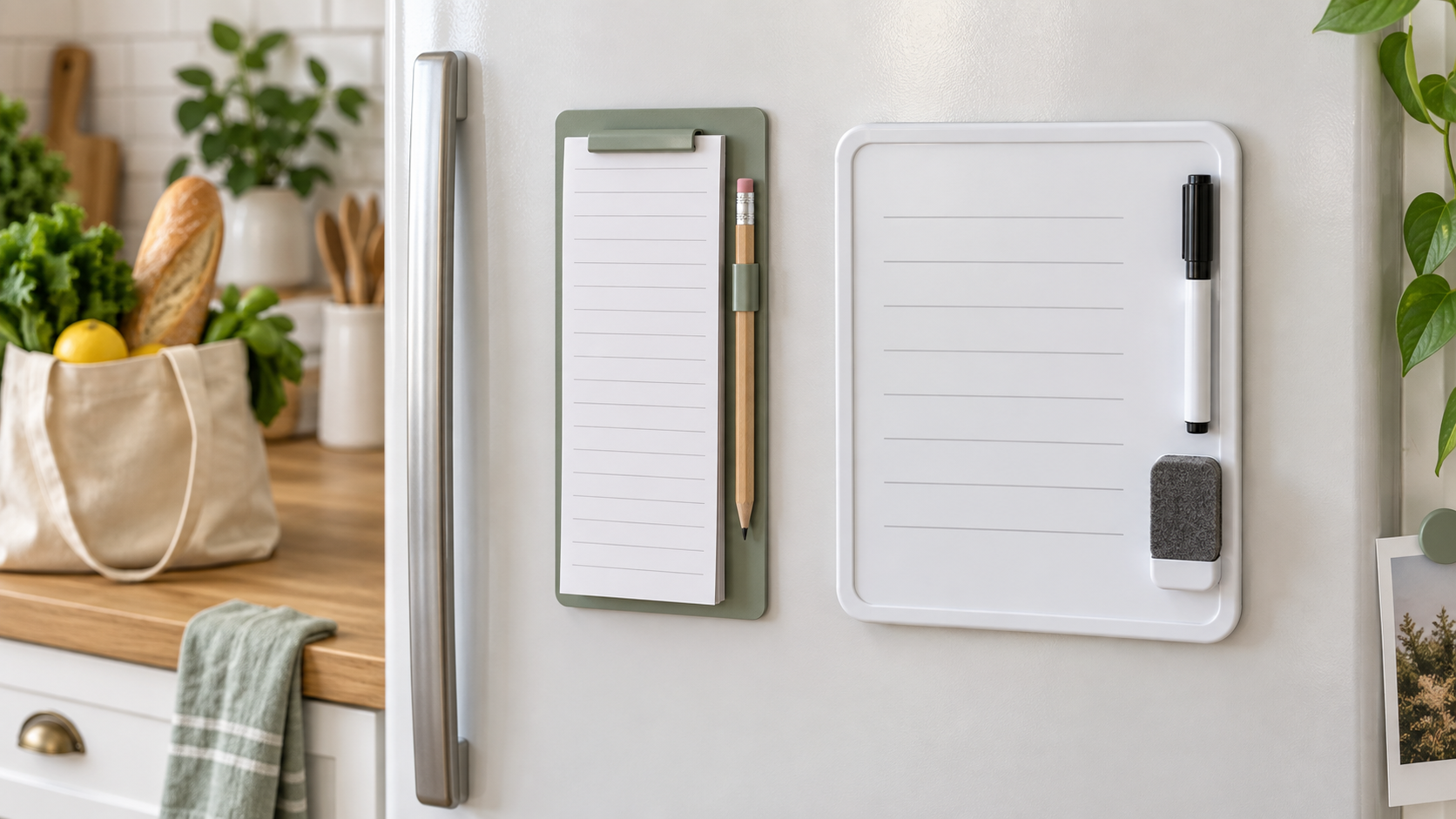
Choose a magnetic paper notepad when the finished list needs to leave the kitchen with no copying. Choose a magnetic dry-erase board when a reusable, highly visible household list matters more and someone already has a reliable way to transfer it before shopping.
As an Amazon Associate, GoodWeighFinds earns from qualifying purchases.
The quick comparison
| Decision | Magnetic paper notepad | Magnetic dry-erase board |
|---|---|---|
| Finished list | Tears off and goes to the store | Must be copied, photographed, or remembered |
| Ongoing supplies | Replacement pads plus a pen or pencil | Compatible markers and a usable eraser |
| Shared visibility | Good while the current sheet remains attached | Good when the board stays readable and current |
| Writing reset | Remove the sheet | Erase the board and clean residue as directed |
| Main limitation | Paper is consumed and can run out | The list itself does not travel |
| Best fit | One-step capture-to-store workflow | Reusable household capture with a transfer habit |
Start with the handoff to the store
Both formats can hold the same words. The meaningful difference is what happens when shopping begins. A paper sheet can move directly from refrigerator to pocket, tote, or cart. A board stays behind, so someone must take a clear photo, copy the list into a phone or onto paper, or shop from memory.
Use the transfer step you will actually remember on a rushed day. Reusability does not help if the board is regularly left at home, and portable paper does not help if the pad is usually empty or the sheet disappears.
When a magnetic notepad fits better
- You want one artifact: household members add items to the sheet, then the same sheet travels to the store.
- You annotate while shopping: paper supports crossing out, circling, or adding an aisle note without unlocking a phone.
- You can store a writing tool: check whether a pencil loop or pen holder is actually included and usable.
- You accept refills: compare usable sheet count, page size, backing, tear-off edge, and replacement availability without assuming a claimed lifespan.
- You need flexible placement: measure the full pad and confirm the magnet does not obstruct a handle, dispenser, vent, or door seal.
When a dry-erase board fits better
- The list mainly coordinates the household: a larger reusable surface can make additions visible without consuming sheets.
- You already transfer lists reliably: photographing or copying the board is an established step, not a hoped-for habit.
- You can manage the accessories: the marker and eraser need dependable storage beside the board.
- You will maintain the surface: follow the maker's marker and cleaning directions; do not assume every marker or cleaner is compatible.
- You want a flexible layout: an open board can be divided into store, pantry, or household sections, but more structure is not automatically more useful.
Measure the refrigerator before buying
Test the proposed spot with a piece of paper cut to the listed exterior dimensions. Open both nearby doors and drawers, reach for the handle, and check whether notes remain readable at the shortest regular user's eye level. A stainless-looking refrigerator may still have a nonmagnetic face, so test the exact surface with a magnet you already own.
Also measure the usable writing area rather than only the outer frame. For a pad, compare line spacing and sheet size with typical handwriting. For a board, subtract the frame and any accessory holders, then check whether the marker blocks a line.
Compare the full cost and upkeep
A notepad has a simple recurring cost: sheets are used and the pad is replaced. Estimate that cost from your real shopping frequency and the listing's stated usable sheet count. A dry-erase board avoids paper refills but still needs compatible markers, erasing, periodic cleaning, and eventual replacement if the surface becomes difficult to read.
Neither format is automatically less wasteful or cheaper in every household. Avoid broad environmental, durability, and lifetime-savings claims unless a seller provides enough specific, relevant evidence to check them.
Run a no-buy one-week test
Tape a small stack of scrap paper or one reusable sheet to the proposed refrigerator spot for a normal week. Ask everyone to record missing items there. On shopping day, tear off the paper or photograph the reusable sheet and note which handoff you remembered without extra prompting.
If a plain sheet, phone note, shared app, or existing board already works, skip the purchase. If additions are being missed, fix placement and writing-tool access before assuming a more elaborate list product will solve the routine.
Questions to verify on every listing
- Are the exterior dimensions and usable sheet or writing area stated?
- Is the mounting surface a full magnetic backing, separate magnets, or adhesive?
- Does your exact refrigerator surface accept magnets?
- For paper, are usable sheet count, line spacing, tear-off method, and refill path clear?
- For a board, are compatible marker type, included accessories, holder location, and cleaning directions clear?
- Can every regular user reach and read it without blocking appliance controls or movement?
- Are durability, stain, magnetic-strength, and erasability statements described and testable, or merely sales language?
Continue to the right model guide
If the paper workflow wins, use the grocery list pad guide to compare layout, sheet size, mounting, and refill tradeoffs. If reusable visibility wins, use the dry-erase board guide to compare writing area, mounting, marker storage, cleaning, and household fit. For a broader visibility-versus-portability decision beyond grocery capture, see the board-versus-planner comparison.
Bottom line
A magnetic paper notepad creates the shortest path from fridge-side capture to a portable grocery list. A dry-erase board creates a reusable shared capture point but requires a dependable transfer step. Test the workflow first, measure the exact refrigerator surface, and buy only the format that removes a real point of friction. This is a routine-support choice within the non-shaming habit-tracking guide, not a weight-loss method.