Buy, delay, or skip
Is a Vacuum Sealer Worth It for Batch Cooking?
A vacuum sealer can be worth buying when sealing freezer-bound food is a repeated task, the machine fits your workspace, and the ongoing bag cost makes sense. Delay or skip it when ordinary freezer bags and containers already handle the routine.
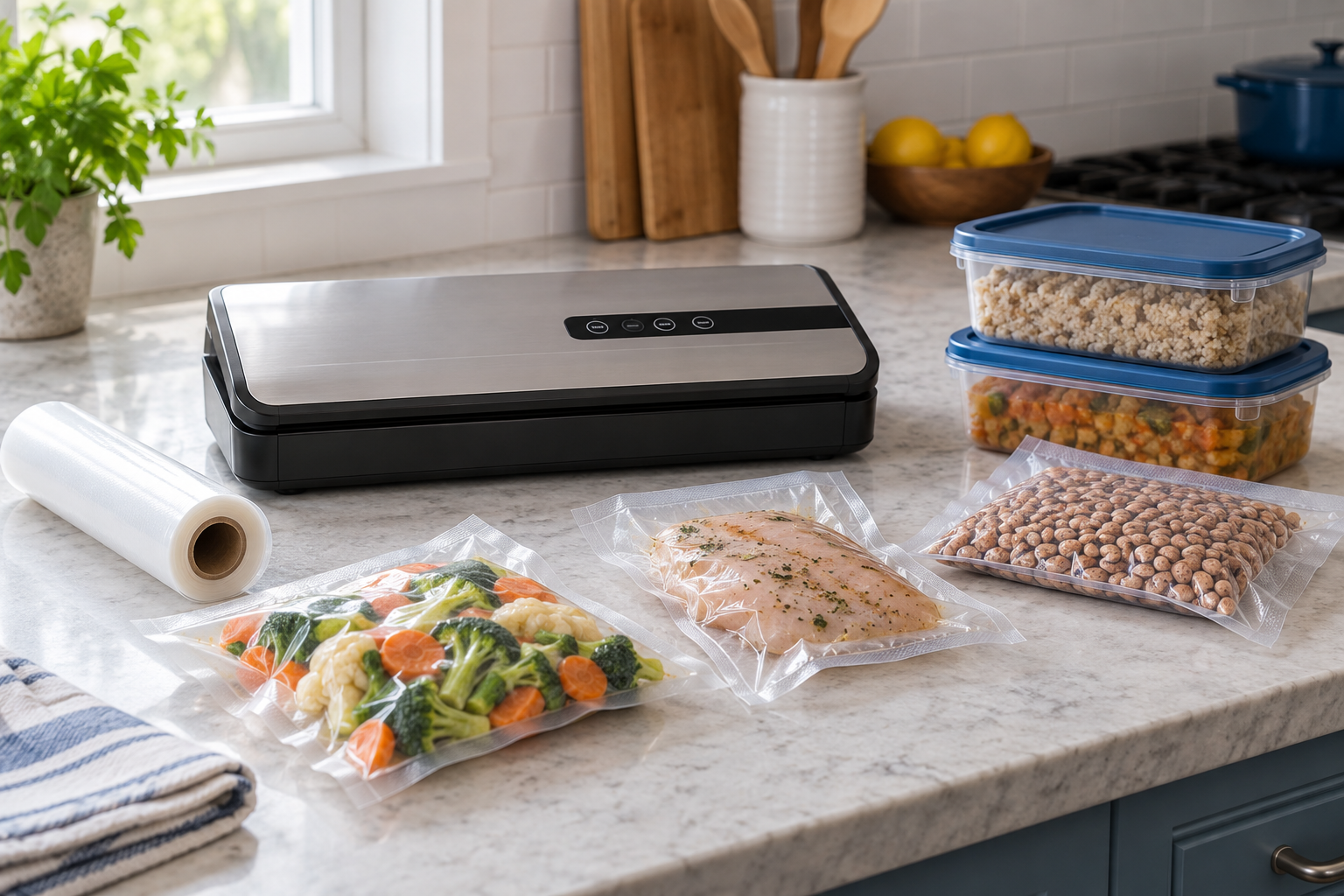
The quick decision
- Buy: you regularly freeze several sealable items at once, have a permanent or convenient setup spot, and accept the supply and cleanup costs.
- Delay and test: track every job for two to four weeks, including what you sealed, how you stored it, and whether an ordinary bag or container failed the task.
- Choose an alternative: use freezer-rated bags or rigid containers when they fit the food, stack well, and are easier to refill and clean.
- Skip: sealing would be occasional, counter and cabinet space are tight, or proprietary supplies would add an unwanted recurring expense.
Run a no-buy workflow test first
For two to four weeks, note each item you place in the freezer and the container you use now. Record awkward filling, trapped air, bulky storage, or a poor fit—but do not count a problem a vacuum sealer cannot solve. A machine does not create freezer space, label packages, organize inventory, or decide sensible quantities.
At the end of the test, count only recurring jobs that suit the machine and the supported bags. If there are just one or two, a handheld air-removal system or ordinary freezer storage may be enough. If there are repeated sealing sessions and the setup can remain convenient, compare current models.
Measure the full setup
- Appliance footprint: verify width, depth, height, cord path, lid-opening clearance, and the working space needed in front of the sealing bar.
- Bag path: measure the widest item and confirm the maker's supported bag or roll width. “Universal bags” is not a measurement.
- Food and liquid limits: follow the maker's instructions for moist foods and liquids. Do not assume every machine or mode handles them.
- Controls: compare documented seal-only, pulse, or moisture settings only when those controls match your recurring jobs.
- Storage: include the appliance, roll or bag boxes, cutter if separate, and any accessory hose—not just the machine body.
Calculate the recurring cost
Add the machine price, compatible rolls or precut bags, replacement parts named by the maker, and any accessory containers you actually expect to use. Divide that total by a conservative number of likely sealing sessions, not an idealized daily routine. A low machine price can be misleading if the supply format is expensive or hard to replace.
Check whether the warranty comes from the manufacturer or only the marketplace seller, what proof of purchase is required, and who pays return shipping for a bulky appliance. Do not rely on an old price, star rating, review count, or availability claim; those can change.
Maintenance and setup tradeoffs
A vacuum sealer adds loading, positioning, sealing, checking, labeling, and cleanup steps. Read the current manual before purchase to see whether the drip channel or gasket can be removed, how the sealing area is cleaned, how long the machine must pause between seals, and how it should be stored. Those details matter more than a long accessory list.
Reusable bags may reduce reliance on cut-to-length rolls for some tasks, but only when the selected machine explicitly supports them and the cleaning routine is acceptable. Do not assume reusable bags, accessory containers, or third-party rolls are compatible.
Red flags on a listing
- No complete appliance dimensions, supported bag widths, compatible supply types, manual, warranty, or seller identity.
- “Keeps food fresh for X times longer,” “prevents freezer burn,” or fixed storage-duration claims without clear conditions and a competent source.
- “Works with every bag,” “commercial grade,” or “airtight every time” without a defined test or compatibility list.
- Claims that the appliance guarantees savings, prevents waste, improves nutrition, controls portions, or supports weight loss.
- A bundle that looks inexpensive but does not identify the quantity and dimensions of included supplies or the cost of replacements.
Who should skip it
Skip a vacuum sealer if lifting or operating the lid and cutter is difficult, the controls are hard to read, the setup cannot be used safely in the available space, or the extra sealing routine would make meal prep more stressful. Also skip it when the likely foods, bag sizes, or liquid-heavy jobs fall outside the maker's instructions.
Delay if you cannot verify the manual, compatible supplies, warranty, or return path. Escalate questions about safe storage, thawing, or preparation to current authoritative food-safety guidance; a vacuum seal is not proof that food is safe, and this page does not set storage durations.
Alternatives that may fit better
Rigid freezer containers are easier to refill and may stack predictably, but they take up a fixed amount of space. Freezer-rated bags are inexpensive and flexible but need a stable filling method and careful closure. If that filling step is the actual problem, compare a freezer bag holder with a wide-mouth funnel. For reusable rigid storage, use the freezer-container guide.
Bottom line
A vacuum sealer is worth considering after a real workflow test shows frequent, compatible sealing jobs and the total cost, cleanup, and storage fit the household. Otherwise, delay the appliance and keep using the simplest storage format that does the job. For a broader product-selection framework without body-result promises, visit the routine-support tools guide.