Nested set or one adjustable tool
Magnetic Measuring Spoons vs Adjustable Measuring Spoon for Small Drawers
A magnetic set keeps several fixed spoon sizes together. One adjustable spoon replaces that set with a sliding or movable measure. Both can reduce loose-tool clutter, but they differ in simultaneous use, jar access, markings, cleanup, and reliance on moving parts.
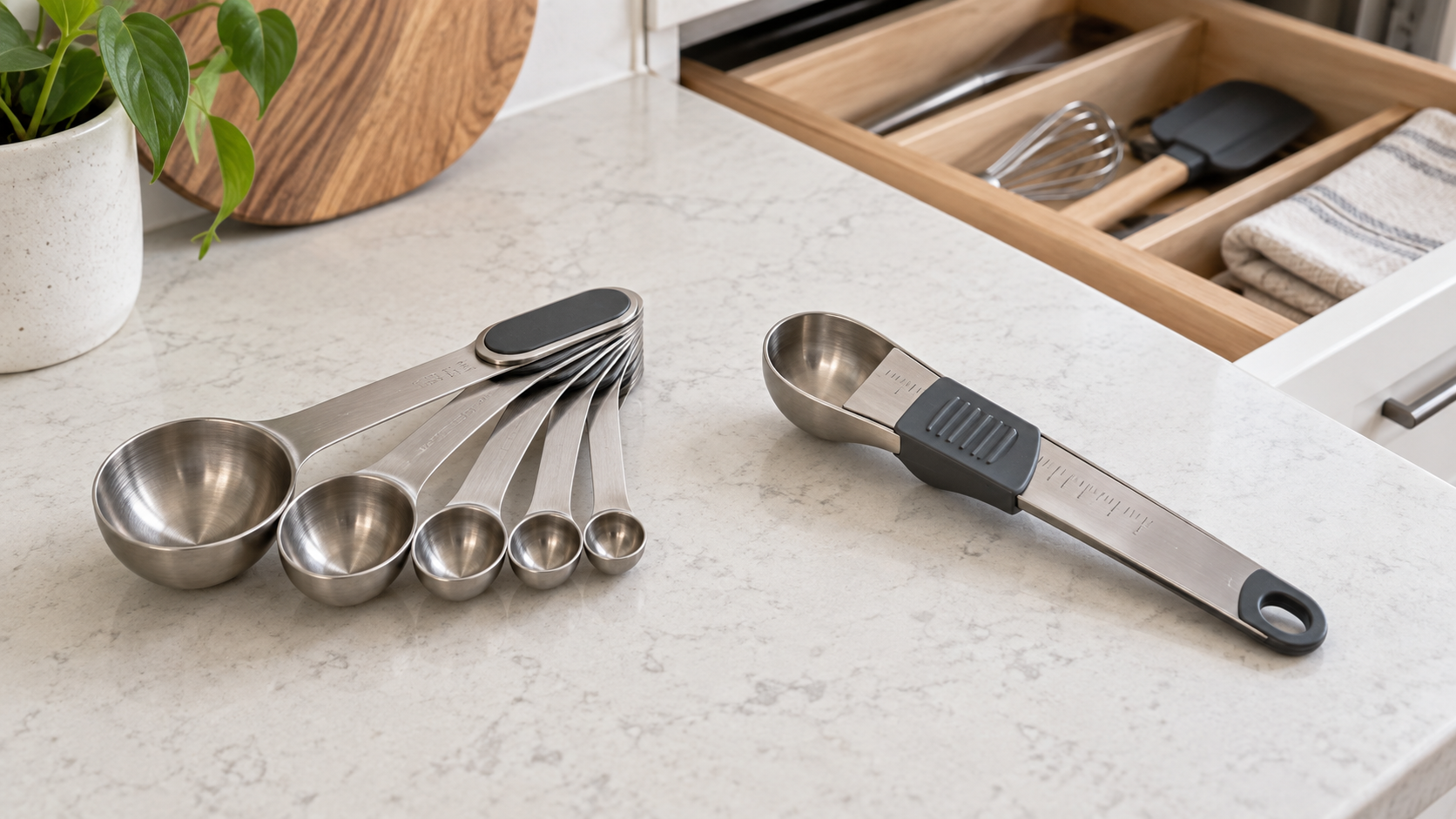
As an Amazon Associate, GoodWeighFinds earns from qualifying purchases.
The quick comparison
| Decision | Magnetic spoon set | Adjustable spoon |
|---|---|---|
| Prep workflow | Several fixed sizes can stay in use at once | One tool usually needs clearing between ingredients |
| Storage | Nests into one stack, but still has several pieces | One piece, with a mechanism that may add height or width |
| Measurement changes | Select another marked spoon | Move and confirm the setting |
| Cleaning | Separate bowls, handles, and magnetic contact points | Bowl plus slider, track, seam, or moving insert |
| Best fit | Recipes using several measures in quick succession | Occasional measuring when one-piece storage matters most |
Measure the drawer before counting pieces
Measure usable drawer width, depth, and height after accounting for the organizer, drawer lip, handles, and utensils that remain. For a magnetic set, compare the complete nested length, widest spoon bowl, and total stack height. For an adjustable spoon, include the slider, handle, and any raised mechanism—not only the bowl.
A single tool is not automatically the smaller one. Some adjustable designs are wide or tall enough to snag a shallow drawer. A nested set is not automatically tidy if its magnetic layout separates in the exact compartment. Use listed dimensions, or test the proposed outline with folded paper or cardboard.
Who each format fits
A magnetic set can fit a cook who measures several dry ingredients during the same recipe, wants familiar fixed volumes, and has room for the complete nested stack. Separate spoons let one hold a dry ingredient while another handles a liquid, though every piece still needs washing and drying.
An adjustable spoon can fit someone who measures one ingredient at a time, values one-piece storage, and can clearly read and operate the settings. It may also reduce the problem of one size going missing. That convenience depends on the mechanism staying easy to position and clean.
Check the actual range and increments
List the measures your recurring recipes use, then compare them with the product's visible markings. Do not assume that either format includes every common fraction. A fixed set may skip a size; an adjustable tool may move in increments that do not match a recipe.
Treat precision claims cautiously. Product labels and listing language do not independently establish laboratory accuracy. For everyday cooking, prioritize legible permanent markings, a stable filled position, and a shape that can be leveled when the recipe calls for it. Neither format determines a personally appropriate food amount or produces weight-loss results.
Jar access and simultaneous use change the decision
Measure the openings of spice jars and other containers you use often. Check the spoon bowl's outside width and the handle angle at the depth needed to reach the ingredient. A narrow oval spoon may reach farther than a round bowl, but that is a model-level geometry check rather than a benefit of magnets alone.
For recipes with several ingredients, a set can keep different measures available. With one adjustable tool, consider whether you will need to rinse, dry, or wipe it before changing ingredients. That extra step may be trivial for occasional use and frustrating during frequent batch cooking.
Setup, cleaning, and maintenance
- Magnetic set: inspect where magnets sit, whether bowls and handles align when nested, and whether maker directions address dishwasher use. Food residue and moisture still need to be removed from contact areas.
- Adjustable spoon: inspect the slider or insert, track, seams, and underside. Confirm whether the maker permits disassembly and how the mechanism should be cleaned and dried.
- Both formats: check whether markings are molded, etched, printed, or otherwise described, and follow the stated care limits instead of assuming they will remain readable.
- Replacement: consider whether one lost fixed spoon can be replaced and whether failure of the adjustable mechanism makes the entire tool unusable.
Tradeoffs that marketing photos can hide
A perfectly nested product photo does not show how quickly spoons realign during everyday use. “Space saving” does not establish fit in your drawer. Likewise, an adjustable spoon shown at one setting does not show how positively it holds other settings, how the filled tool can be leveled, or how residue reaches its track.
Check current buyer-visible details, maker instructions, seller identity, and return terms. Customer anecdotes can reveal questions worth checking, but they do not prove universal accuracy, durability, magnet strength, or ease of cleaning.
Who should skip both?
- Keep an existing fixed spoon set when its markings are readable, the needed sizes are present, and a small cup or ring already keeps it organized.
- Use a frequently washed favorite spoon when exact recipe measurement is not required for the task.
- Skip an adjustable design when small markings, grip effort, or moving the mechanism is difficult to use reliably.
- Skip a magnetic set when nearby magnet-sensitive items, loose pieces, or the nested height create more drawer friction than they solve.
- Delay buying when the real problem is an overfilled drawer; remove duplicates and test a simple divider first.
Bottom line
Choose a magnetic set when several fixed sizes and simultaneous use matter more than keeping one piece. Choose an adjustable spoon when one-at-a-time measuring and one-piece storage fit the routine, and its range, mechanism, markings, and cleaning instructions pass inspection. Skip both when a working set plus a simpler drawer organizer solves the problem. For fixed-set criteria, use the magnetic measuring-spoon guide; for the broader shopping framework, see routine-support tools that do not promise body results.