Compact-drawer buying guide
Best Magnetic Measuring Spoons for Compact Meal-Prep Drawers
Magnetic measuring spoons can keep a set nested without a ring, but magnets do not fix unreadable markings, awkward bowls, poor drawer fit, or difficult cleanup. The useful set is the one whose sizes match your recipes, reaches the containers you use, separates easily, and fits the intended drawer as a complete stack.
As an Amazon Associate, GoodWeighFinds earns from qualifying purchases.
Start with the drawer, not the magnet
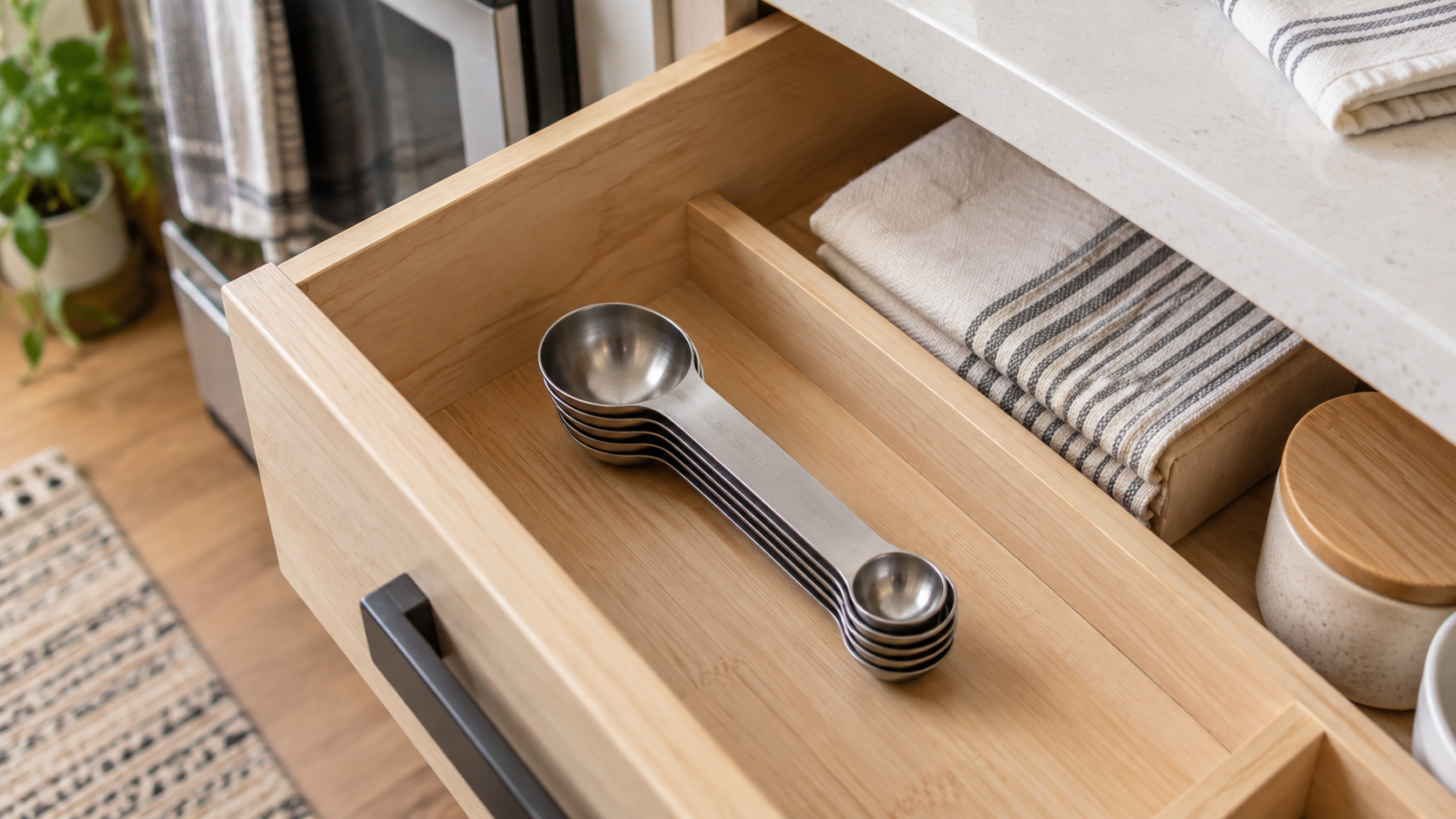
Measure the drawer's usable width, depth, and height after allowing for dividers, handles, and anything stored above the spoon stack. Compare those numbers with the listed dimensions of the complete nested set. A slim side view can be misleading when a double-ended bowl, thick handle, or protruding leveler makes the stack wider than expected.
First test whether an existing ring, small tray, or different drawer section keeps your current spoons together. Magnetic nesting is worth paying for only when loose spoons are a repeated problem and the replacement solves it without creating a new fit or cleaning problem.
Choose the size sequence you will use
Write down the spoon measures that appear in your recurring recipes, then match that list to the individually marked pieces. Do not treat a larger piece count as automatically better: bonus tools and uncommon sizes can increase the count while omitting a measure you need.
Look for markings that can be read when the spoons are separated and nested. If the listing shows only one side, treat claims about etched, stamped, or fade-resistant markings as unverified until the exact product details explain them.
Compare bowl and handle formats
| Format | Potential fit | Check closely |
|---|---|---|
| Narrow oval bowl | May enter smaller spice jars | Exact bowl width, depth, leveling edge, and whether the stated volume remains readable |
| Round bowl | Familiar shape for filling and leveling | Jar-opening clearance and total nested width |
| Double-ended spoon | Two bowl shapes without separate pieces | Which end represents the marked measure, drawer length, balance, and cleaning at both ends |
| Single-ended nested set | Simpler handling and fewer surfaces | How the magnets align, handle thickness, and access to each size |
Inspect where the magnets sit
Product photos should show how the spoons align as a full stack and how one piece separates from the others. Magnets near the handles may keep bowls from rubbing together, while other layouts may build a shorter or wider stack. Neither format is universally better; the dimensions and the motion needed to remove one spoon matter more than the feature label.
Avoid assuming magnetic strength from marketing words. Check current seller details and owner directions, and keep the set away from items whose manufacturer warns against nearby magnets. If someone in the household uses an implanted medical device, follow the device manufacturer's magnet-distance instructions or ask an appropriately qualified clinician about the specific situation before choosing magnetic kitchen tools.
Check narrow-container access with real measurements
Measure the inside diameter of the smallest jar or canister you regularly scoop from. Compare it with the spoon bowl's listed outside width, not with a styled photo. Also check handle length and the angle needed to reach the bottom without forcing the spoon against the container rim.
A narrow bowl can help with access, but it does not establish measurement accuracy or make a set appropriate for every ingredient. Follow the recipe's method when precision matters, and use a clean, dry spoon when the ingredient or product directions require it.
Audit the wash-and-dry path
Separate the spoons for washing and inspect seams, recessed markings, magnet housings, handle joints, and any removable leveler. “Stainless steel” does not by itself verify grade, corrosion performance, dishwasher placement, or care requirements. Use only the exact maker's current directions.
Plan a place where every piece can dry before nesting. Skip a design when magnets or joined components create inaccessible gaps, the care directions are missing, or damage would be hard to notice.
When a magnetic set is not the best answer
- Keep your current spoons when they include the right sizes and a ring, cup, or tray already prevents drawer scatter.
- Choose a nonmagnetic nested set when you want compact storage but do not need magnetic retention.
- Skip a set when complete nested dimensions, individual sizes, materials, or care directions are absent.
- Avoid double-ended designs when the extra bowl makes storage or cleaning harder than the second shape helps.
- Skip measuring tools when they do not match how you cook or when measuring food feels rigid, stressful, or shaming.
Run a paper drawer-and-jar check
Draw the listed nested length and width on paper, fold a strip to the stated stack height, and place both in the intended drawer. Then cut a paper oval to the listed bowl width and test it against the opening of your narrowest recurring container. This cannot verify product quality, but it can expose obvious fit conflicts before ordering.
Keep the job separate from portion promises
These spoons are kitchen organization and recipe tools; magnetic nesting does not cause weight loss or determine a suitable amount of food for an individual. For broader size, marking, material, and emotional-fit criteria, use the measuring cups and spoons guide. If you are deciding between volume and weight, read the food scale versus measuring cups comparison. The routine-support tools guide keeps all of these categories in perspective.
Bottom line
A magnetic measuring-spoon set is most useful when a verified full stack fits a tight drawer, includes the measures you repeatedly use, reaches your containers, comes apart without fuss, and has clear care directions. Buy for that specific workflow—not for a larger piece count, vague accuracy language, or the magnet feature by itself.