Non-shaming tracking comparison
Paper Food Journal vs Food Tracking App
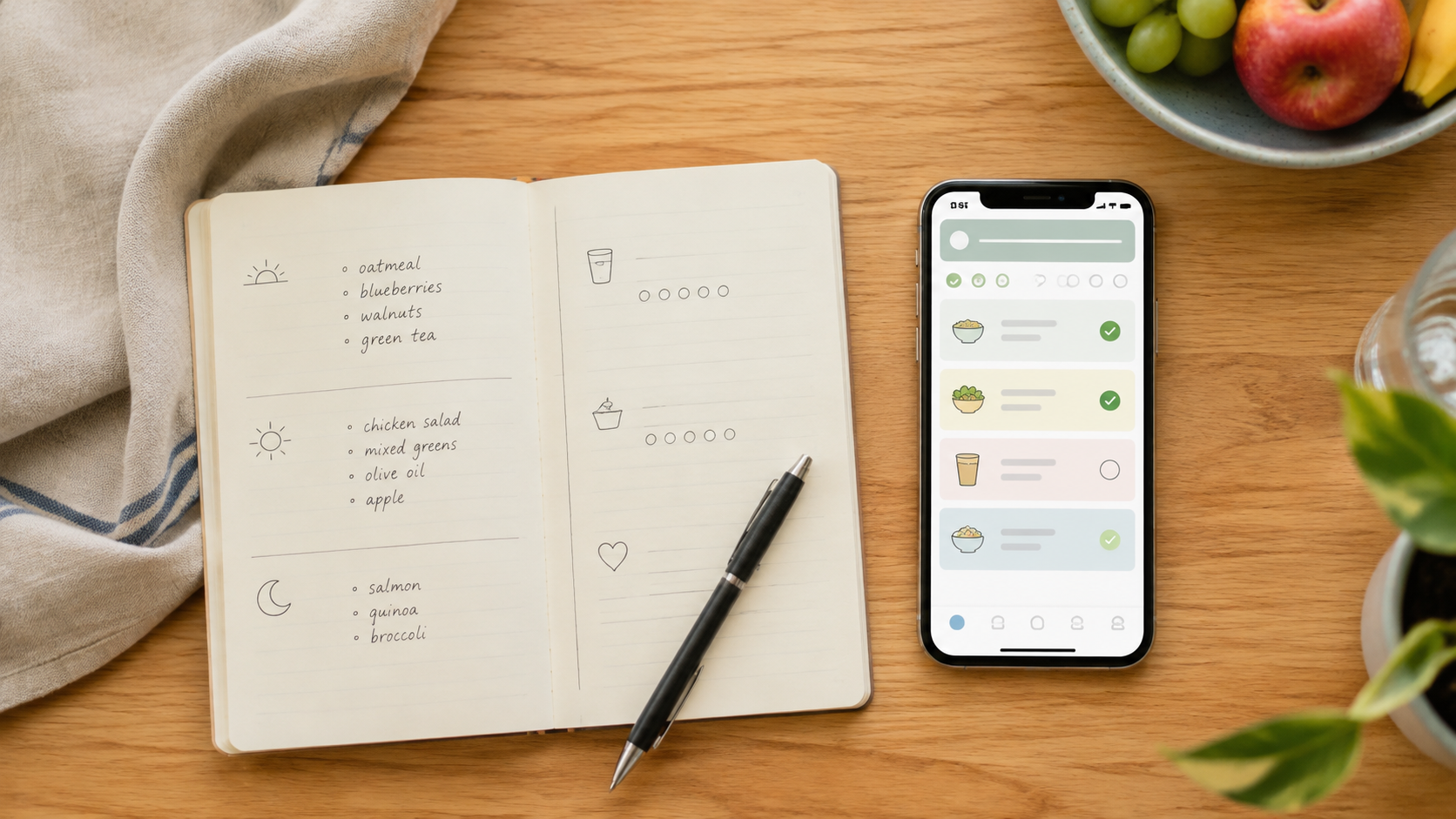
A paper journal and a food tracking app can both record meals, but they create very different kinds of friction. The better format is the one that captures only the information you actually need, protects your privacy, and stays easy to pause—not the one that produces the most numbers.
As an Amazon Associate, GoodWeighFinds earns from qualifying purchases.
Quick answer
Choose paper if you want an offline record, flexible wording, and no automated targets. Choose an app if searchable history, quick entry, accessibility features, or optional reminders solve a real problem for you. Choose neither if recording food increases guilt, rigid rules, compulsive checking, or distress.
Paper journal and app tradeoffs
| Decision point | Paper journal | Tracking app |
|---|---|---|
| Privacy | Stays offline but can be seen or misplaced. | May use an account, cloud storage, analytics, or third-party services; settings and policies require review. |
| Entry effort | Free-form writing is flexible but slower to search. | Saved items and search may speed entry, while database choices can add friction. |
| Prompts | You control the headings, unless a printed journal imposes them. | The app controls available fields and may foreground calories, streaks, weight, or paid features. |
| Reminders | No notifications; the journal must be kept visible or carried. | Reminders may help, distract, or create pressure; check whether they can be disabled. |
| Cost | A plain notebook can be inexpensive; guided journals vary. | Free access may be limited, ad-supported, or paired with a subscription. |
| Restarting | A blank page makes a quiet restart possible. | Streaks and missed-day messages can make restarting feel graded unless they are optional. |
What to check before choosing an app
- Purpose: Write down the one question the app should help answer. More fields are not automatically more useful.
- Data collection: Review permissions, account requirements, advertising or analytics disclosures, retention, export, and deletion controls in the current policy and settings.
- Pressure controls: Check whether calorie budgets, weight prompts, streaks, badges, social sharing, and notifications can be hidden or turned off.
- Subscription terms: Confirm which features require payment, the renewal interval, cancellation route, and whether records remain accessible after cancellation.
- Claim limits: Treat promises about rapid weight change, appetite control, metabolism, hormones, or medical outcomes as red flags rather than app features.
What to check before choosing paper
- Prompt tone: Prefer neutral words such as notes, patterns, planning, and reflection. Skip moral labels for food or missed entries.
- Visible samples: Do not buy from the cover alone. Confirm that the pages provide enough space and do not hide rigid targets inside.
- Portability and privacy: Decide where the journal will live, whether the cover attracts unwanted attention, and whether a smaller notebook would be easier to secure.
- Restart flexibility: Undated pages avoid wasting a dated section and can reduce pressure after a break.
- Simplicity: Test the idea in a notebook you already own before paying for a specialized journal.
A low-pressure test before buying
For one week, use a folded sheet of paper or a basic note stored locally on your phone. Record only a meal name and one piece of context you have already decided matters, such as where you ate or whether advance planning helped. At the end, ask whether the record changed a practical decision. Do not use the trial to set a calorie target or grade the day.
If handwriting feels useful but the paper gets lost, a bound journal may solve the storage problem. If repeated entries are the main friction, an app with saved items may help. If the record produces no useful next step, neither purchase is necessary.
When to skip food tracking
Stop or skip food logging if it leads to guilt, hiding food, rigid restriction, binge-restrict cycles, compulsive checking, or anxiety about incomplete entries. A blank day is not a failure, and a consumer tracker cannot judge the quality of a person or a life.
For individualized nutrition needs, sudden or unexplained weight change, medication questions, diabetes, pregnancy, or eating-disorder concerns, a qualified healthcare professional or registered dietitian is a more appropriate source than a generic journal or app.
Useful next steps
This comparison maps to the non-shaming habit-tracking guide. For paper-product criteria, use the journal buying guide. If quick check marks fit better than meal notes, compare a journal with a habit tracker. For broader claims and subscription pressure, use the habit tracker claim check.
Bottom line
Paper is better for flexible offline reflection; an app is better when search, repeated entries, or optional reminders remove real friction. Start with the least detailed format that answers your question, review privacy and payment terms before using an app, and keep skipping tracking as a valid choice.