Countertop recipe-tool comparison
Recipe Binder vs Cookbook Stand for Countertop Cooking
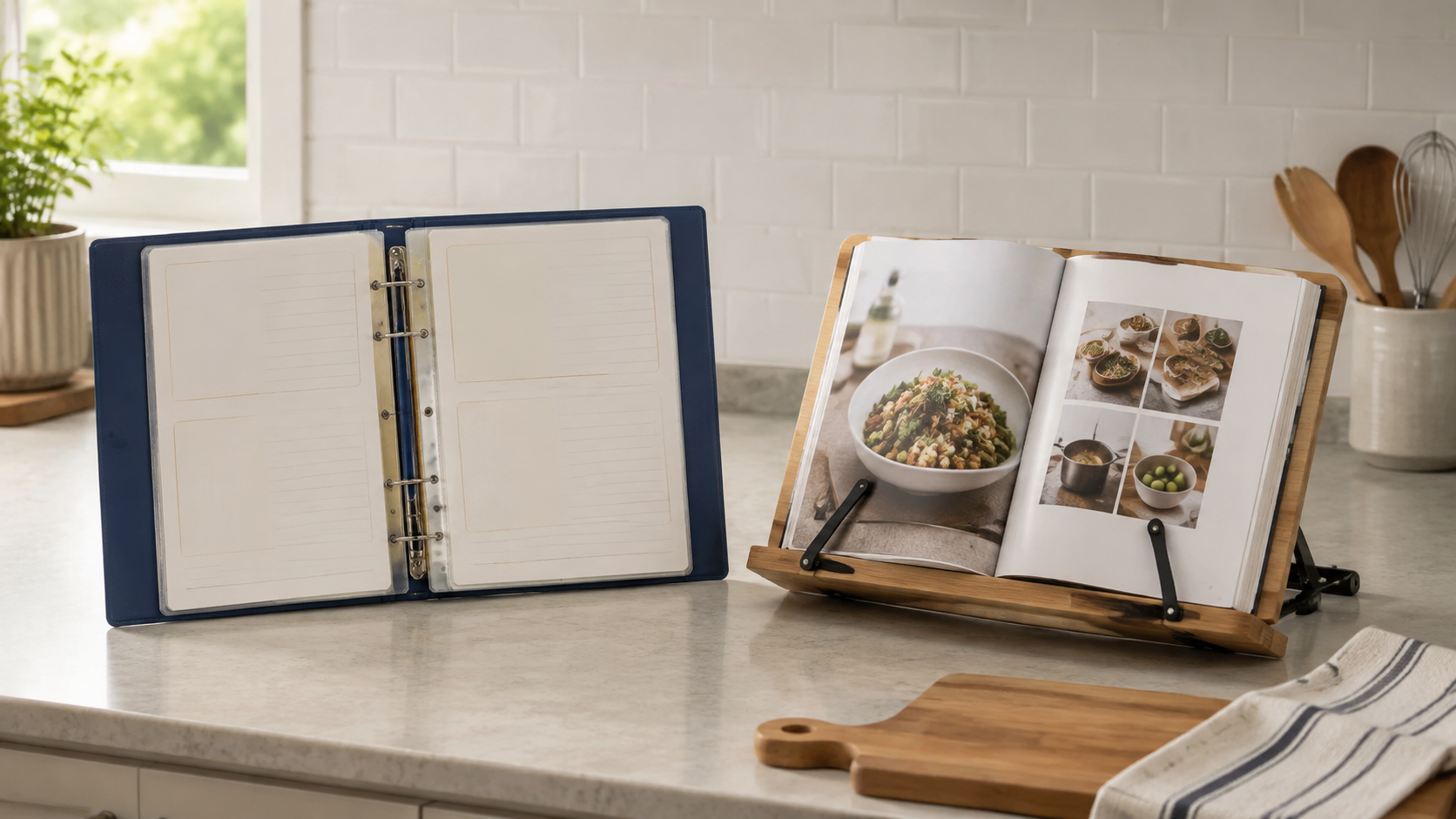
A recipe binder organizes loose pages and keeps a personal collection together. A cookbook stand holds a book, tablet, or sheet at a readable angle while you cook. The better choice depends on whether your recurring problem is storing recipes or seeing them—not on which accessory looks better on a counter.
As an Amazon Associate, GoodWeighFinds earns from qualifying purchases.
Quick answer
Choose a recipe binder when loose pages get lost, damaged, or scattered across several places. Choose a cookbook stand when your recipes are already organized but books or screens lie flat, close unexpectedly, or occupy useful prep space. You may need neither: a recipe in an existing binder can lie open, and a tablet case or cabinet clip may already provide a readable angle.
How the formats differ
| Decision point | Recipe binder | Cookbook stand |
|---|---|---|
| Main job | Collects and orders loose or personal recipes. | Supports material at a readable angle during cooking. |
| Works with | Punched sheets, sleeves, dividers, and cards sized for the binder. | Books, tablets, or sheets within the stand's stated ledge and support dimensions. |
| Counter footprint | Needs room to lie open; thick rings can add height and page curvature. | Needs both a base footprint and rear clearance; an open book can be wider than the stand. |
| Page protection | Sleeves may shield paper from light splashes but are not a reason to place it near heat or water. | Usually leaves the book or device exposed unless a separate shield is specified. |
| Portability | Keeps a personal collection together but grows heavier as pages accumulate. | Moves easily if it folds, but does not carry the recipe collection itself. |
| Storage | Stores like a book and needs shelf height for its spine and rings. | May fold flat; verify folded thickness and hinge shape rather than assuming. |
Choose a binder when organization is the bottleneck
A binder fits a cook who regularly prints recipes, saves handwritten family notes, or wants dividers for meal types and repeat favorites. Its value comes from retrieval: a page should be easy to add, find, remove, and return without rebuilding the whole system.
Before buying, count and measure the formats you actually keep. Check ring size, sheet and sleeve dimensions, divider width, whether sleeves remain inside the cover when closed, and whether the binder can rest open on the available surface. “Spill resistant” or “easy clean” needs specific material and care information; a sleeve does not make paper safe beside a burner, sink, or hot pan.
Choose a stand when viewing is the bottleneck
A stand fits a cook whose books, printed pages, or tablet are already organized but awkward to read while hands are busy. The useful measurements are the open base depth, ledge depth, maximum supported width and thickness, available angles, page-holder reach, and folded size.
Match the stand to the heaviest and widest format you expect to use, including a tablet case. Do not assume “universal,” “non-slip,” or “heavy duty” describes your setup unless the listing provides dimensions and support guidance. A stand is not a heat shield or splash barrier, and it should not crowd the cutting area or sit where a cord, elbow, or cabinet door can knock it.
Measure the whole setup
- Recipe format: List whether you use cards, letter-size sheets, thick cookbooks, a cased tablet, or several formats.
- Open footprint: Measure the width and depth of the binder or book when open, not only the product's closed size.
- Safe placement: Reserve stable counter space away from burners, hot cookware, sink spray, and the active cutting edge.
- Reading position: Test the distance and angle with an existing book or device before paying for adjustable hardware.
- Cleaning: Check maker directions for covers, sleeves, ledges, hinges, feet, and any parts that trap residue.
- Storage: Identify the exact shelf, drawer, or cabinet space the product will use after cooking.
Cost and upkeep tradeoffs
A binder can require sleeves, dividers, labels, and occasional page sorting in addition to the cover itself. A stand may need hinge checks, wiping, and a dedicated storage space, but it does not organize recipes. Compare the total setup with the simplest existing alternative: a plain binder and sleeves you already have, a tablet's folding cover, a clothespin-style page clip, or a printed sheet placed in a safe visible location.
Return terms matter when dimensions are unclear. Keep packaging intact until you have checked the open footprint, page or ledge fit, viewing angle, cabinet clearance, and storage location.
Who should skip either product
Skip a recipe binder if most recipes already live in one searchable digital place, you rarely save loose pages, or a small folder handles the collection. Skip a cookbook stand if an existing tablet case, book weight, or safe wall-mounted clip already provides comfortable viewing.
Skip both when the only available counter position is beside heat, water, an appliance vent, or an active prep edge. The useful fix may be moving the recipe station rather than adding another object. Also skip listings that omit the dimensions or material details needed to check fit.
Next steps
This comparison maps to the routine-support tools pillar. If organizing loose pages is the problem, use the recipe binder guide for capacity, sleeves, dividers, and restart-friendly setup criteria. If hands-free viewing is the problem, use the cookbook stand guide for footprint, ledge, angle, stability, and storage checks.
Bottom line
A recipe binder solves collection and retrieval. A cookbook stand solves viewing position. Define the failure in your current routine, measure the open setup, test a no-cost substitute, and buy only when the chosen format removes that specific friction.