Routine-support buying guide
Best Cookbook Stands for Small-Space Meal Prep
A cookbook stand can keep a recipe visible and free a little working space, but only if its base, support ledge, and folded size fit your kitchen. Compare the format against the recipes you actually use instead of assuming the largest or most adjustable stand is automatically better.
As an Amazon Associate, GoodWeighFinds earns from qualifying purchases.
Who this guide is for
This guide is for adults who use cookbooks, printed sheets, recipe cards, or a tablet during meal prep and want a hands-free viewing position without permanently occupying the counter. A stand organizes a recipe; it does not improve a recipe's accuracy or produce a body result.
For the broader product framework, start with the routine-support tools guide. If loose recipes are the main problem, compare recipe binders for app-free planning. For additional temporary work surface, see the over-the-sink cutting-board criteria.
Useful formats—not universal winners
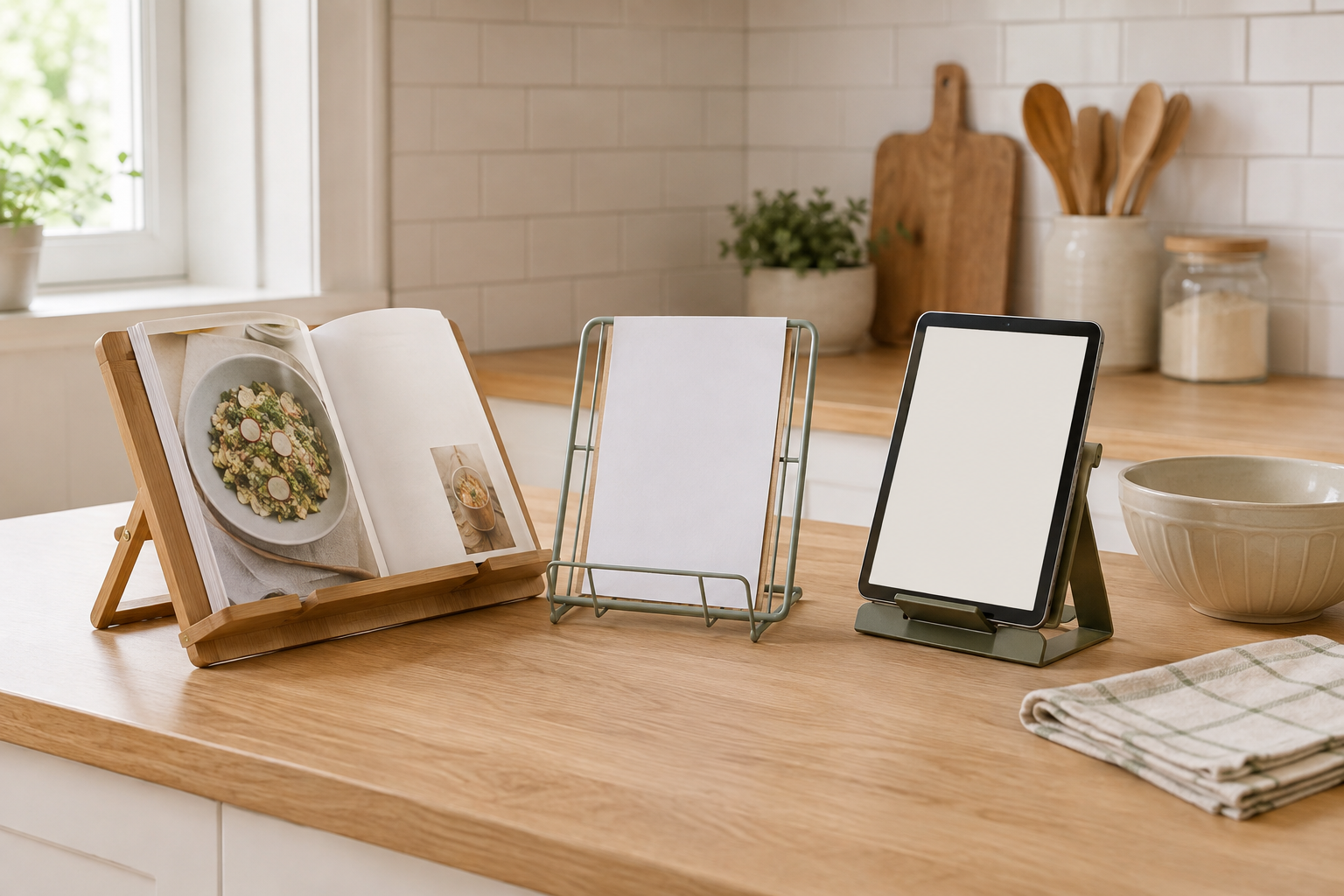
- Folding wood or board stands: Often support books across a broad back panel, but ledge depth, page arms, hinge positions, finish care, and folded thickness vary.
- Wire stands: Usually visually light and easy to move. Check whether thin sheets sag through the frame and whether the front rail blocks text or tablet controls.
- Adjustable tablet and recipe stands: Multiple angles can help with glare and viewing height, but device thickness, case fit, charging-port clearance, and hinge stability matter.
- Page-protector or shield formats: A clear panel may help separate a page from splashes, but reflections, cleaning directions, sheet capacity, and stored size can outweigh that benefit.
Selection criteria that matter
- Working footprint: Measure the stand at its intended viewing angle, including rear supports—not only the width shown from the front.
- Folded profile: Check folded length, width, thickness, protruding arms, and whether it fits the planned drawer, shelf, or vertical slot.
- Supported format: Match ledge depth and back support to your thickest cookbook, largest page, recipe card, or tablet with its usual case attached.
- Page and control clearance: Page arms should hold paper without hiding the lines you need. Tablet ledges should not cover controls, speakers, or a charging port you expect to use.
- Viewing angle: Prefer stated angle positions or clear mechanism photos over vague “fully adjustable” language. Consider overhead light and window glare.
- Stability: Look for the base dimensions, hinge or kickstand design, nonslip contact points, and maker guidance about supported weight. A tall open book changes the balance.
- Cleaning: Verify whether surfaces wipe clean, parts detach, and hinges or wire joints can trap residue. Treat “splashproof” as unverified unless the listing defines it.
- Heat and water distance: A recipe stand is not a heat shield. Plan a stable location away from burners, hot cookware, sink spray, and counter edges.
- Returns: Verify seller identity and return terms before opening packaging in a way that prevents a fit check from being returned.
A small-counter fit check
Before buying, set a book or tablet where the stand would go and mark the maximum usable width and depth. Leave room for the stand's rear support, the open book, your prep board, and safe distance from heat and water. Then ask:
- Does the open footprint fit without pushing the stand against a sink or cooktop?
- Is the ledge deep enough for the actual book or cased device?
- Can pages stay open without obscuring instructions?
- Is at least one angle readable under the kitchen's normal lighting?
- Can the stand fold into a storage spot you already have?
- Are material and cleaning directions specific enough for the planned location?
Claims and practical limits
“Universal,” “non-slip,” “waterproof,” and “heavy duty” are marketing descriptions unless the listing supplies dimensions, supported formats, material details, and use limits. Counter material, book weight, device case, stand angle, worn feet, and contact with moisture can all change stability.
Keep electronics and paper away from splashes, steam, open flame, and hot cookware. Do not place a tablet in a stand if its case or charging setup conflicts with the maker's instructions. Move the whole stand only after removing the book or device.
Who should skip this purchase
Skip a stand if a wall-mounted recipe, existing tablet cover, binder laid flat, or printed sheet clipped to a cabinet already works without crowding the counter. Skip listings that omit open dimensions, ledge depth, folded size, or a clear side view of the support mechanism.
A stand also may be a poor fit when your only available position is close to heat, water, or an active prep edge. In that case, reorganizing the recipe location is more useful than adding another countertop object.
Binder or stand?
If the bigger problem is scattered printouts rather than viewing angle, use the recipe binder versus cookbook stand comparison before shopping for a stand.
Bottom line
The best-fit cookbook stand is the one that holds your real recipe format at a readable angle, remains stable within the available counter depth, cleans as directed, and folds into an existing storage space. Measure those constraints first and skip broad compatibility claims that are not backed by dimensions.