Leftover-storage comparison
Reusable Bowl Cover vs Container Lid for Leftover Storage
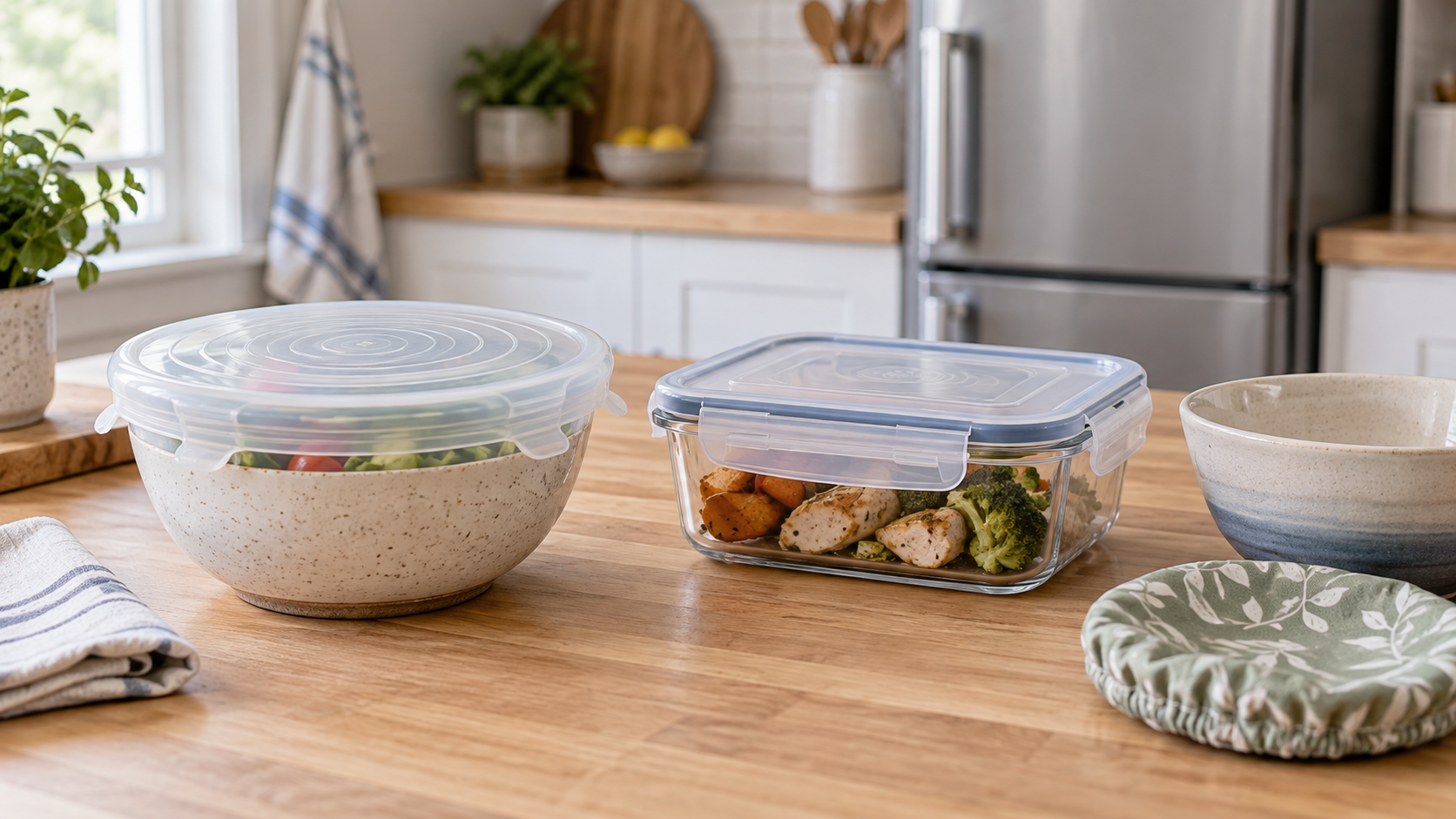
A reusable bowl cover avoids transferring leftovers, while a fitted-lid container is usually easier to stack and carry. The better choice depends on the bowl rim, storage space, closure design, cleaning routine, and exact use directions—not on a blanket promise that either format seals every vessel.
As an Amazon Associate, GoodWeighFinds earns from qualifying purchases.
Quick decision
| Choose a reusable bowl cover when… | Choose a fitted-lid container when… |
|---|---|
| You repeatedly store food in an existing bowl and want to avoid a transfer step. | You need a predictable lid-and-base match and can transfer the food without creating extra friction. |
| The cover's stated fit range matches the measured outer rim and the cover can grip that rim shape. | The complete closed container fits the refrigerator, lunch bag, or freezer location allowed by its directions. |
| The covered bowl can sit on a shelf without stacking another item on top. | Stable stacking, portability, or clear identification matters more than covering the serving bowl in place. |
| You have a practical place to wash, fully dry, and store the cover open or flat. | The lid, seal channels, hinges, and removable parts are easy to inspect, clean, dry, and replace. |
Start with cover-in-place versus transfer-and-stack
A bowl cover can remove the transfer step between serving and storage. That is useful only when the covered bowl fits the refrigerator shelf and is not needed again before the leftovers are used. Its irregular footprint can waste vertical space, and a flexible cover should not be treated as a stacking surface unless the maker explicitly designs it for that load.
A dedicated container adds a transfer and another vessel to wash, but its matching base and lid can create a more predictable closed shape. Measure the complete exterior with the lid installed. A stackable-looking photo does not establish stability, nesting efficiency, or compatibility across different product lines.
Measure the rim, not just the bowl diameter
For a stretch or elastic cover, measure the widest outside diameter and note whether the rim is round, oval, square, flared, textured, chipped, or interrupted by handles or a pouring spout. Compare those details with the maker's stated fit range and compatible shapes. A diameter range alone does not prove that a cover will stay attached.
Fabric covers may sit loosely over a bowl and are not interchangeable with a tensioned silicone cover. Treat every closure description literally. Do not infer an airtight, watertight, or leak-resistant seal unless the exact product makes a defined claim and its instructions support the intended orientation.
Check the lid as a system
- Compatibility: Match the lid to the exact container line, size, and model rather than guessing from capacity or shape.
- Closure: Inspect tabs, latches, rims, valves, and gasket channels for damage and residue.
- Replacement: Check whether the maker sells the lid or gasket separately before replacing an entire usable set.
- Portability: Carry foods upright inside a washable secondary barrier when a spill would damage electronics, papers, or a bag.
- Visibility: Decide whether a clear base, transparent cover, or simple date label will make leftovers easier to identify.
Read use limits component by component
“Reusable,” “silicone,” “fabric,” “plastic,” and “glass” do not establish where an item can be used. Check current directions for the cover, container base, lid, gasket, and valve separately. Refrigerator, freezer, microwave, oven, dishwasher, and temperature statements can differ among components.
Follow applicable food-storage guidance and manufacturer directions. This comparison does not establish storage time or temperature safety, and a tight-looking cover does not correct unsuitable storage or handling.
Compare washing, drying, and storage
Stretch covers can have edges, pull tabs, and textured undersides that need to be opened fully for washing. Fabric covers may need laundering and a complete air-dry cycle. Fitted lids can add gasket grooves, clips, hinges, or valves. Count the actual surfaces and removable pieces rather than assuming the visually simpler option is easier to maintain.
Plan a drying location before buying. Folding or closing a damp cover or lid can undermine the convenience it was meant to add. Also measure the stored footprint: a nested container set can still consume substantial cabinet space, while loose flexible covers can disappear in a crowded drawer unless kept together.
Run a one-week no-cost test
- Use bowls and containers you already own for one week.
- Note each time transferring leftovers feels wasteful, or each time a covered bowl blocks needed shelf space.
- Measure the bowls, refrigerator shelf, current container stack, and drawer or cabinet where a new item would live.
- Count washing and drying steps, and record whether portability or stacking is actually needed.
- Buy only if one format solves the repeated problem with verified dimensions and use directions.
When to skip either purchase
- An existing plate, compatible lid, or container already covers the recurring job.
- The listing omits usable dimensions, compatible rim shapes, material details, or component-specific care directions.
- You need a spill-proof commuting solution but the product offers only vague seal language.
- The new format would create more unmatched lids, hard-to-dry folds, or cabinet clutter.
- A damaged bowl, container, lid, or cover should be retired under the maker's guidance rather than hidden by another accessory.
Related guides and claim boundaries
If cover-in-place already wins, use the reusable bowl cover guide to compare stretch, fabric, and elastic formats without treating them as interchangeable. If the actual problem is a missing part, check the replacement-lid guide before buying another container set. The broader routine-support tools guide keeps storage purchases tied to practical friction rather than body-result promises.
Neither format causes weight loss, sets an appropriate portion, or changes the qualities of the food inside. Treat weight-loss, “portion control,” freshness, and food-safety language as claims requiring specific support rather than reasons to prefer one storage format.
Bottom line
Choose a reusable bowl cover when covering an existing bowl is the recurring job and the verified rim fit, shelf space, care, and drying routine all work. Choose a fitted-lid container when transfer is acceptable and predictable closure, stacking, visibility, or carry fit matters more. Measure first, verify every component's directions, and keep using what you own when it already solves the problem.