Routine-support buying guide
Best Reusable Bowl Covers for Meal-Prep Storage
A reusable bowl cover can save the step of transferring leftovers or prepped ingredients into another container. The useful choice fits bowls you already own, matches the storage job, and can be washed and dried without becoming a second chore.
As an Amazon Associate, GoodWeighFinds earns from qualifying purchases.
Who this guide is for
This guide is for adults who regularly put a mixing, serving, or prep bowl into the refrigerator for short-term storage and want to cover it without moving the contents. A cover is an organization tool, not a way to change the nutrition of a meal or produce a weight-loss result.
If the storage format is still undecided, first compare a reusable bowl cover with a fitted container lid by transfer, stacking, carry, and care needs. For the broader buy-or-skip framework, start with the routine-support tools guide. If stackability, commuting, or portioning matters more than keeping food in its original bowl, use the meal-prep container guide instead.
Useful formats—not named winners
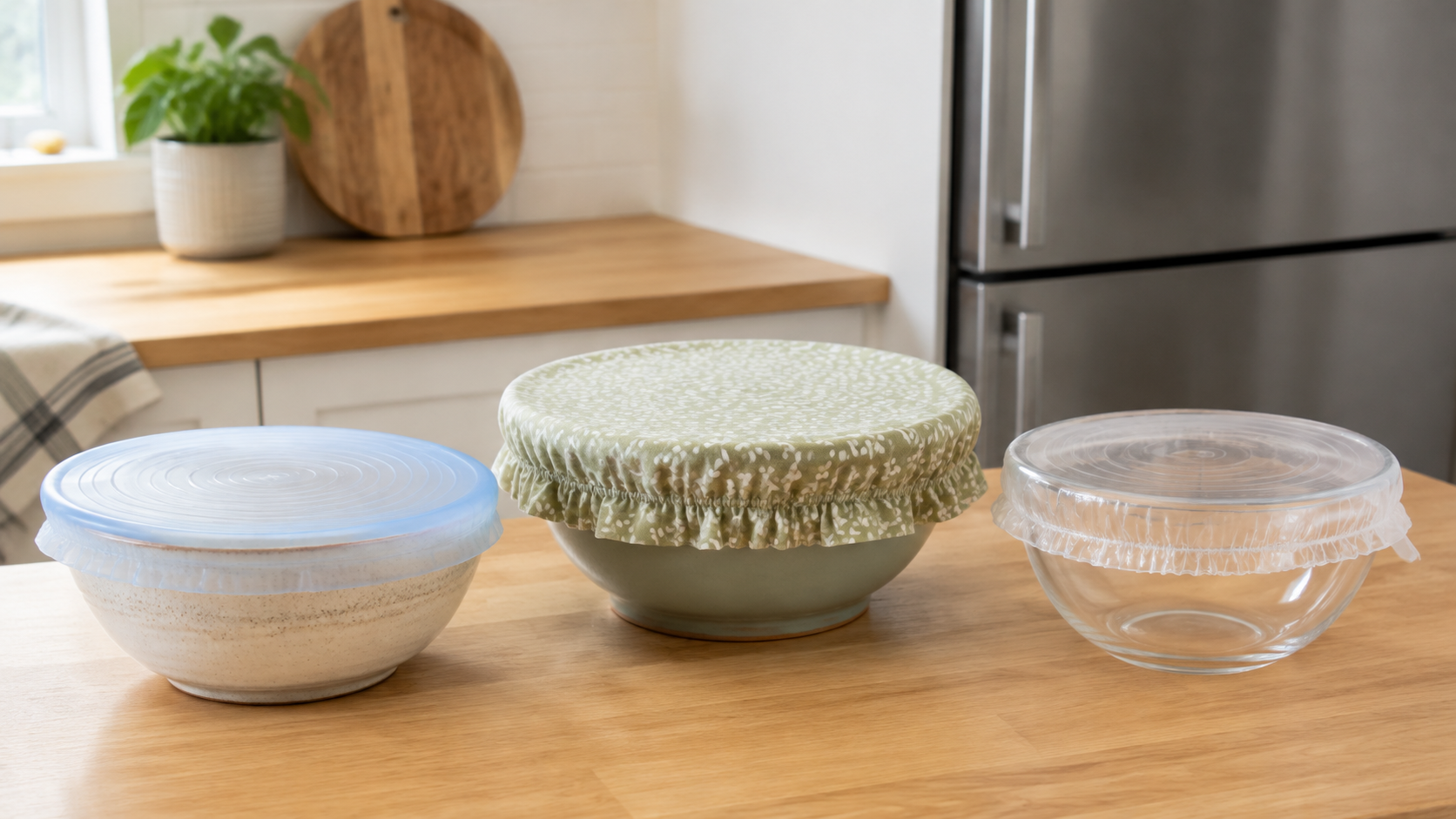
- Silicone stretch lids: These rely on tension around a compatible rim. They can be compact, but fit depends on the lid's stated range, bowl shape, rim condition, and how far the material must stretch.
- Fabric elastic covers: Washable fabric covers can suit dry prep, proofing, or short refrigerator use when the maker labels them for that job. They generally do not let you see the contents and should not be treated as leakproof.
- Clear elastic covers: A transparent cover makes contents easier to identify. Check whether the material is intended to be washed and reused, how the elastic should be dried, and whether the maker states a reuse limit.
- Structured reusable caps: Some covers use a firmer top with an elastic or silicone edge. Compare their collapsed or nested footprint because the structure may trade drawer space for easier handling.
Measure your bowls before shopping
Measure the outside diameter across the widest part of each bowl, including any lip. Note whether the rim is round, oval, flared, thick, irregular, or fitted with handles or a pouring spout. A listing that gives only “small, medium, large” offers less useful fit information than one that provides an actual diameter range.
Also check bowl depth and surface. A stretch cover may need enough straight wall below the rim to stay in place, while an elastic cover may bunch around a handle or spout. Do not infer compatibility from a staged photo alone.
Selection criteria that matter
- Stated size range: Compare measured minimum and maximum diameters with your bowls. Avoid choosing at the extreme edge of a range when the listing does not explain how fit is determined.
- Rim compatibility: Look for explicit guidance on glass, ceramic, metal, or plastic bowls and on smooth, flared, lipped, or irregular rims.
- Intended use: Confirm whether the cover is labeled for refrigerator storage, counter use, transport, freezing, reheating, or none of those. One allowed use does not prove the others.
- Material disclosure: Prefer a clear material description and care guide over vague phrases such as “eco,” “food grade,” or “premium.” Those words alone do not establish a specific performance property.
- Visibility and labeling: Transparent covers make contents visible; opaque covers may benefit from a removable date label. Use a method that does not damage the cover or interfere with washing.
- Cleaning and drying: Check machine-wash, dishwasher, or hand-wash instructions and whether elastic channels, folds, or textured edges can open enough to dry fully.
- Storage footprint: Stretch lids may nest flat, fabric covers can fold, and structured covers may need more drawer space. Count only the sizes that fit bowls you use.
- Returns and replacements: Verify current terms before food use if fit cannot be established from measurements. Check whether individual sizes can be replaced or only complete sets.
Claims to slow down around
“Airtight,” “leakproof,” “spillproof,” “freezer safe,” “microwave safe,” and broad temperature ranges are claims that need current manufacturer instructions. Even a well-fitting cover can shift if a bowl is tipped, overfilled, wet around the rim, or squeezed. Keep covered bowls upright unless the product explicitly documents another use, and do not rely on a bowl cover for loose transport inside a bag.
A cover also does not make food safe indefinitely. Follow ordinary food-storage guidance for the food itself, refrigerate promptly when required, and discard food when storage time or condition is uncertain. The cover's job is covering the bowl, not certifying the contents.
A quick buy-or-skip check
- Do you repeatedly store food in uncovered bowls, or could a plate you already own do the job?
- Are the bowls round and within a clearly stated diameter range?
- Does the maker label the cover for your intended refrigerator, counter, freezer, heat, or transport use?
- Can every seam, fold, and elastic edge be washed and dried according to the directions?
- Will you use enough sizes in the set to justify the storage space?
- Would a rigid container be safer or more practical because you need stacking, commuting, or a secure closure?
Who should skip this purchase
Skip a set when your bowls have irregular rims, handles, spouts, or diameters the listing does not cover. Skip it when you need reliable stacking or bag transport; a purpose-built container with a compatible lid is usually the clearer category to compare. You can also skip buying if a clean plate or an existing correctly sized lid already covers the bowl without creating a storage problem.
For leftovers that need dates or freezer rotation, compare food-storage labels and freezer inventory boards. Those tools address visibility and rotation rather than making preservation promises.
Bottom line
The best-fit reusable bowl cover is the one with a documented size range that matches your actual bowls, clear intended-use limits, and care instructions you will follow. Choose the format around visibility, washing, drying, and storage—not broad environmental or preservation language—and use a rigid lidded container when stacking or transport is the real job.