Packed-snack storage comparison
Reusable Snack Bag vs Small Rigid Container for Packed Snacks
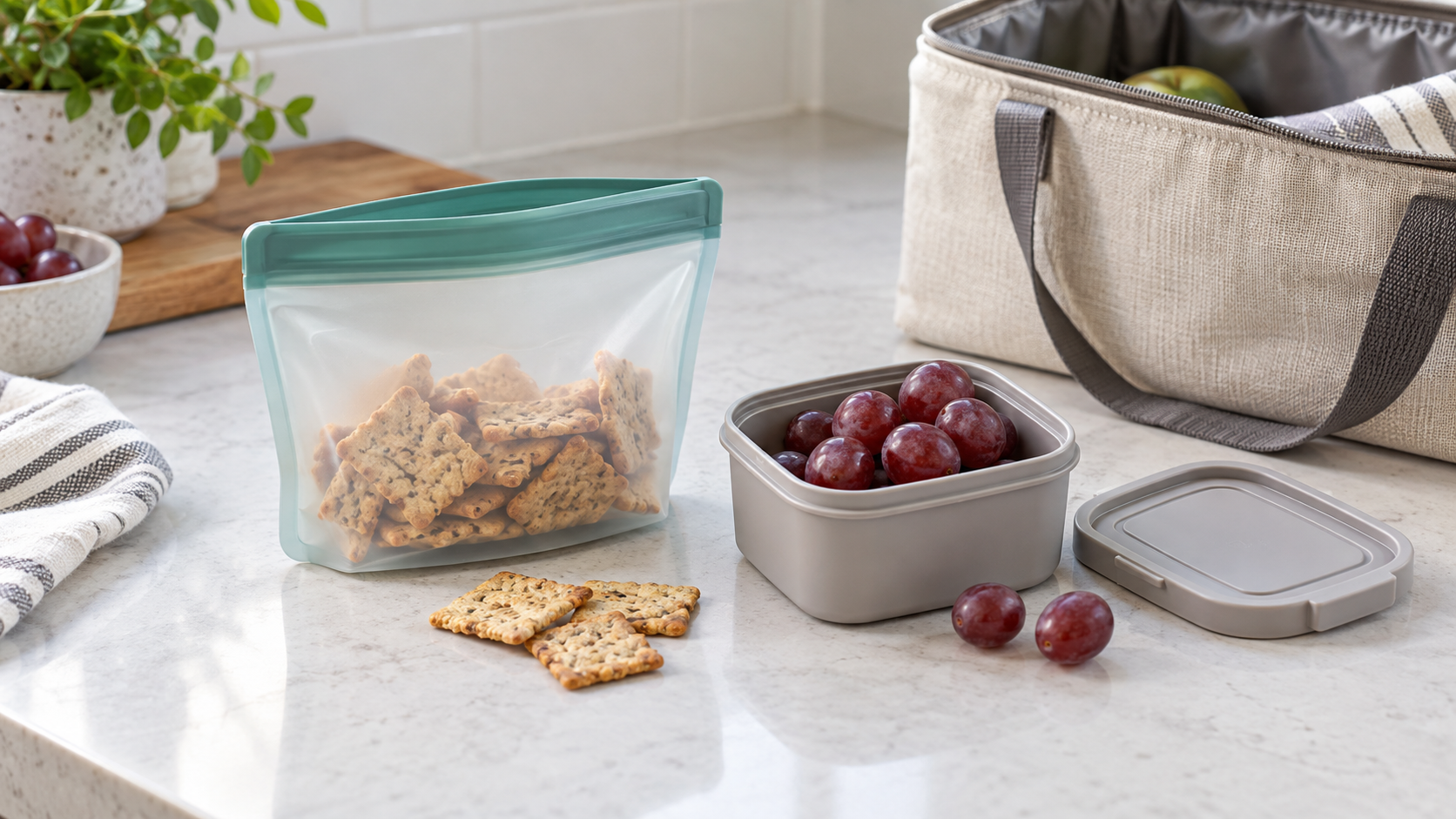
A reusable snack bag bends around other items and stores nearly flat. A small rigid container holds a fixed shape and can shield crush-prone food. Neither is the universal winner: the useful choice depends on the snack, the packed bag, and the cleanup you will actually do.
As an Amazon Associate, GoodWeighFinds earns from qualifying purchases.
Quick decision
| Decision point | Reusable snack bag | Small rigid container |
|---|---|---|
| Best fit | Dry or low-mess snacks that tolerate some movement | Crush-prone, shaped, or easily bruised items |
| Packed space | Can conform around other items | Uses the same footprint whether full or partly full |
| Protection | Provides separation but little structural shielding | Creates a fixed boundary; exact strength is product-specific |
| Empty storage | Often folds or lies flat once fully dry | May stack or nest if the exact set is designed for it |
| Cleanup friction | Seams, corners, and drying the interior can take attention | Corners, lid channels, seals, and separate parts need inspection |
Who a reusable snack bag fits
Choose the flexible format when the usual snack is not easily crushed, lunch-bag space changes from day to day, and flat storage between uses is valuable. A bag can slide beside a container or fill an irregular gap that a fixed box cannot use.
Check the usable interior rather than the seller's broad size label. A thick closure and rounded seams reduce usable space. A wide opening can make filling and hand washing easier, while a narrow opening may be awkward to turn or prop open for drying.
Who a small rigid container fits
Choose the rigid format when shape protection and predictable stacking matter more than minimum bulk. It may better suit crackers that break easily, berries that would be pressed by heavier items, or a snack that needs a distinct boundary inside a crowded lunch bag.
Measure the exterior footprint and lid hardware as well as the stated capacity. A small container can still be inefficient if tabs protrude, the lid adds height, or its base does not sit steadily beside the other packed items.
Setup and maintenance tradeoffs
Neither format is maintenance-free. For a reusable bag, inspect the closure, corners, seams, and any gusset after washing. Follow the maker's directions for hand washing, dishwasher placement, temperature limits, and drying position. Do not fold or store it while moisture remains inside.
For a rigid container, inspect the lid channel, gasket if present, hinge or tabs, and base corners. Confirm whether parts separate for cleaning and whether replacement lids are available. Microwave, freezer, and dishwasher permissions are separate claims; verify each intended use for the exact product.
Before buying either format, pack the normal lunch with a folded paper template matching the listed length, width, and height. This shows whether a rigid footprint blocks the zipper or whether a flexible bag would be pressed against heavy items.
Claims to treat cautiously
- “Leakproof”: A zipper or fitted lid does not establish performance. Verify the maker's exact wording, intended orientation, and exclusions; carry liquid foods only in a product designed for that job.
- “Keeps food fresh”: Do not infer a storage duration from a closure style. Follow food-specific storage and temperature guidance.
- “Unbreakable” or “crushproof”: Material and construction vary. A rigid wall can separate food from nearby items without guaranteeing protection from every load or drop.
- “Eco-friendly”: Reuse depends on how often the item is actually used, washed, dried, and replaced. Avoid broad environmental conclusions from marketing labels alone.
When to skip both
- Your current small container or washable bag already fits the snack and the lunch bag.
- The snack comes in a suitable reusable package or does not need a separate carrier.
- You cannot fully clean, inspect, and dry the seams, seals, or lid parts in your routine.
- The listing omits the dimensions, materials, care directions, or intended-use details needed for your decision.
- Tracking or pre-portioning food feels stressful or rigid. These are storage tools, not requirements or weight-loss devices.
Bottom line and next steps
Use a reusable snack bag for flexible packing and compact empty storage; use a small rigid container when a fixed boundary and shape protection better match the food. Run the paper-template test, check the maker's labels, and skip a purchase if something you own already works.
If the flexible format fits, continue to the reusable snack-bag buying guide for closure, shape, washing, and drying criteria. If you are still deciding whether a dedicated bag earns a place at all, use the reusable snack-bag worth-it test. For the broader no-hype framework, see the routine-support tools pillar.