Reusable work-lunch storage comparison
Utensil Pouch vs Hard Case for a Reusable Work Lunch Kit
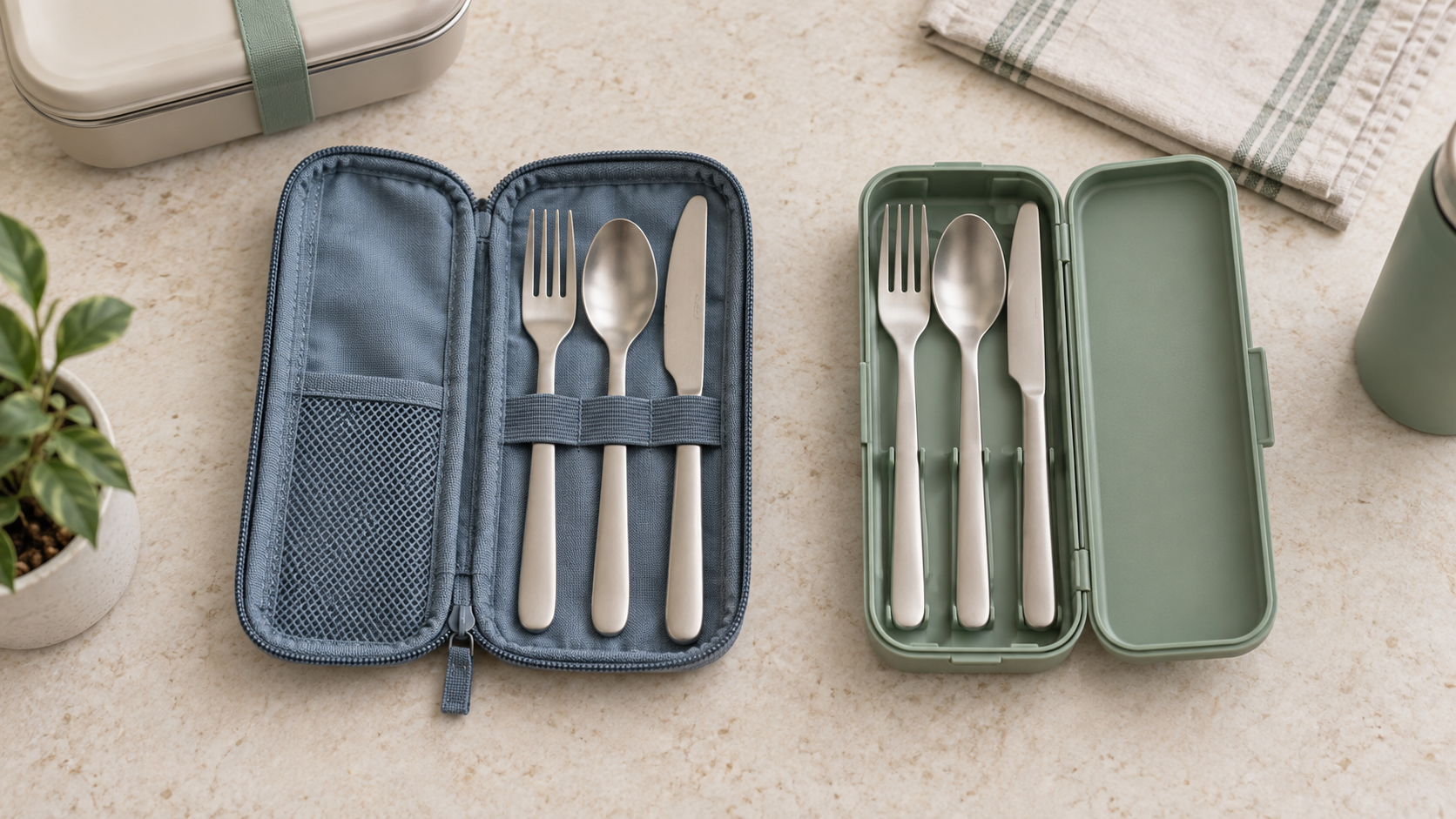
A soft utensil pouch bends around the rest of a packed lunch and stores compactly when empty. A hard case keeps a fixed shape and can shield cutlery from pressure. The better format is the one that fits your actual utensils, bag, washing routine, and reason for using a carrier at all.
As an Amazon Associate, GoodWeighFinds earns from qualifying purchases.
The quick comparison
| Decision | Soft utensil pouch | Hard utensil case |
|---|---|---|
| Best fit | A changing cutlery set and a tightly packed bag | A repeat set that needs a defined shell |
| Empty storage | May fold or lie flat, depending on its seams and closure | Keeps its full footprint |
| Protection | Groups utensils but offers little crush resistance | Separates cutlery from pressure when correctly fitted and closed |
| Noise | Fabric may soften contact, but loose pieces can still move | Fitted slots may limit movement; an oversized interior can rattle |
| Cleaning | Fabric, lining, seams, and zipper need maker-specific care | Hinges, grooves, clips, and corners need inspection |
| Skip when | It stays damp, snags, or adds an unnecessary closure | Its fixed bulk crowds the lunch or the utensils do not fit |
Measure the utensils before either carrier
Measure the longest utensil from end to end, then stack the pieces you actually carry and note the tallest spoon bowl or thickest handle. A listing's exterior length does not establish usable interior space. Check whether zipper ends, stitched seams, molded clips, a hinge, or a latch reduce the room inside.
Then pack the complete lunch: container, cold pack if used, bottle, napkin, and the closed carrier. A pouch that bends is not automatically smaller once filled, and a hard case that fits an empty bag may crowd the food container or prevent the bag from closing normally.
Choose a pouch for flexible, low-bulk packing
A soft pouch is the stronger candidate when the utensil set changes, the available gap changes from day to day, or empty storage matters. It can also hold a napkin or reusable straw when its dimensions and care instructions support those items. That flexibility is useful only if the pouch closes without pressing sharp edges into the fabric.
- Check the closure: a zipper, tie, flap, or snap should stay clear of utensil tips and thick handles.
- Inspect the lining: look for visible seams and corners you can turn out, reach, or dry according to the maker's directions.
- Plan drying space: a washable pouch still needs enough time and airflow to dry fully before it is closed or repacked.
- Keep claims narrow: “antimicrobial,” odor-resistant, or water-resistant wording is not a cleanliness guarantee.
Choose a hard case for a fixed protective shell
A rigid case makes more sense when the same utensils travel most days and a fixed shell solves a repeated pressure, snagging, or separation problem. The case should close without forcing the utensils against the lid, latch, or hinge. Molded slots are useful only when they fit the pieces you intend to carry.
- Compare inside and outside dimensions: the shell, hinge, and latch add bulk beyond the usable cavity.
- Check retention: fitted clips should not require bending the utensil or excessive force to remove it.
- Inspect cleanup points: grooves and hinge areas must be reachable under the stated care method.
- Do not infer sealing: a closed case does not necessarily contain liquid, odor, or residue.
Cleaning is a workflow, not a material promise
Neither format keeps used utensils hygienic by itself. Follow the exact maker directions, remove food residue promptly, expose all washable surfaces, and let the carrier dry as directed before closing it. If you carry used utensils home, keep the carrier separate from ready-to-eat food unless the complete setup is intended and maintained for that use.
Material names alone do not prove dishwasher compatibility, food-contact suitability, stain resistance, or long-term durability. Look for model-specific labels and instructions rather than relying on broad marketplace headings.
Run a no-buy test
Wrap the normal utensil set in a clean washable napkin for one lunch and place it in a small clean rigid container you already own for another. These stand-ins will not reproduce every closure or care step, but they reveal whether flexible packing or a fixed footprint works better. Notice the actual friction: bag closure, access, movement, washing, drying, and where the empty carrier goes after lunch.
If a built-in lunch-bag pocket or a spare utensil set stored at work already solves the problem, skip both purchases. If rigid storage appears useful, use the narrower guide on whether a hard utensil case earns its space before choosing a model.
Skip criteria
- Skip both when loose clean utensils already have a suitable dedicated pocket or container.
- Skip the pouch when it is hard to inspect, cannot dry fully in your routine, or offers no advantage over a washable napkin wrap.
- Skip the hard case when the fixed footprint crowds the lunch, the latch is stressed, or the utensils do not fit its interior.
- Skip any carrier with unclear care instructions or unsupported cleanliness and material claims you would need to trust.
- Choose different utensils instead when unusually long, sharp, or thick pieces cannot be carried securely in either format.
Bottom line
Choose a soft utensil pouch when adaptable fit and compact empty storage matter most. Choose a hard case when a measured fixed shell solves a real protection or separation problem. Neither format is automatically cleaner or more durable, so verify the dimensions and care instructions and skip the purchase when an existing pocket, napkin wrap, or container works. For the complete carry setup, continue with the insulated lunch-bag buying guide.