Everyday walking carry comparison
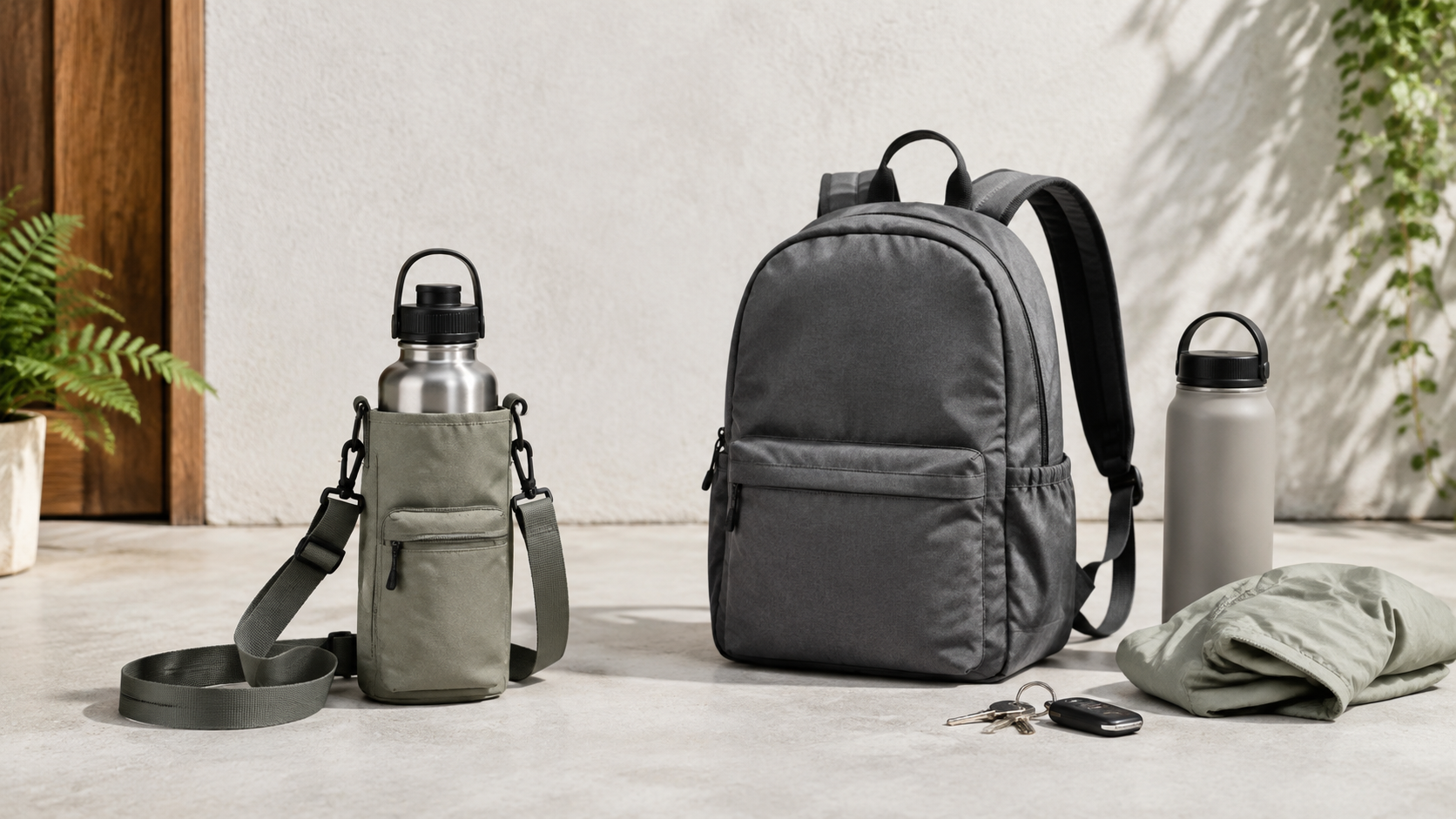
Water Bottle Sling vs Walking Backpack for Hands-Free Carry
A water bottle sling keeps one bottle and perhaps a few small items close at hand. A walking backpack spreads a larger load across two shoulder straps. Neither format improves a walking routine by itself: the useful choice is the smallest carrier that securely fits what you actually take, feels manageable on the route, and does not add needless packing or cleanup.
As an Amazon Associate, GoodWeighFinds earns from qualifying purchases.
Quick decision
| Choose a bottle sling when… | Choose a walking backpack when… |
|---|---|
| Your repeat load is one compatible bottle, keys, and perhaps a small phone or card pocket. | You regularly carry a bottle plus a layer, snack, larger phone, personal items, or weather gear. |
| Fast bottle access and a small stored footprint matter more than load separation. | Two-strap load distribution and separate compartments matter more than minimal bulk. |
| The measured bottle, strap range, opening, retention, and pocket all fit. | The measured torso fit, strap adjustment, capacity, openings, and bottle pockets all fit. |
| The crossbody position does not create distracting swing, rubbing, or one-sided pressure. | The pack stays stable without overfilling and both straps can be used as designed. |
Start with the load, not the carrier
Lay out what you took on your last few ordinary walks. A bottle sling is a focused carrier, so a phone, large key ring, glasses case, snack, or folded layer may exceed its real pocket space even when a listing calls the pocket “large.” A backpack earns its extra bulk when those items recur rather than appearing on one unusual trip.
Measure the bottle at its widest point and include the cap or carry loop in the total height. For a sling, compare those measurements with the holder’s stated interior dimensions and retention method. For a backpack, check the bottle-pocket opening, usable depth, elastic or closure, and whether the bottle competes with the pack’s filled main compartment.
Compare fit and load distribution
A crossbody sling places the filled bottle on one side of the body. Check the full adjustable strap range, strap width, hardware position, and how the carrier sits over the clothing you actually wear. Marketing words such as “one size fits all” or “bounce-free” are not substitutes for measurements or a useful return policy.
A two-strap backpack can distribute a larger load across both shoulders, but the label “walking backpack” does not prove a particular fit or comfort level. Compare back-panel length, strap shape and range, empty weight, filled weight, and any chest strap position. Stop using either carrier if it causes persistent pain, numbness, or skin irritation; a qualified professional can help when discomfort continues.
Bottle access and retention
A sling usually keeps the bottle visible and reachable, but a loose holder can let it tilt or move. Look for exact compatibility wording and inspect how a drawcord, collar, strap, or pocket holds the specific bottle. Test access while stopped in a safe place before relying on it along a route.
A backpack bottle pocket can keep liquid outside the main compartment, though access may require removing the pack and a short pocket may not retain a tall bottle. Do not assume a closure is leakproof or that an external pocket prevents every spill. Close the bottle according to its maker’s directions and keep moisture-sensitive items separately protected.
Weather, visibility, and route limits
“Water-resistant” and “weatherproof” wording varies by product and does not establish protection in a specific duration or intensity of rain. Check which fabric, seams, zippers, and closures the claim covers. A backpack may offer more enclosed storage; a sling leaves more of the bottle and small pocket exposed. Neither format replaces route planning, suitable weather gear, or attention to traffic and surroundings.
Reflective trim is also a product feature, not a visibility guarantee. If low-light walking is part of the routine, assess the whole setup and route rather than treating a small reflective detail as collision prevention.
Setup, cleaning, and storage
- Sling: Check whether the bottle must be removed before cleaning, whether the strap or hardware can be washed, and how the narrow holder dries.
- Backpack: Check lining, pocket, padding, zipper, and spot-cleaning directions; more compartments create more places to inspect and dry.
- Adjustment: Set straps while the carrier holds the normal load. Secure loose strap ends according to the maker’s directions.
- Storage: Compare the sling’s hanging length with the pack’s empty footprint and avoid assuming either folds without affecting padding or structure.
- Returns: Confirm the current seller and return terms before buying, especially when fit can only be judged with the intended bottle and load.
Claims and evidence boundaries
Dimensions, materials, care instructions, and included parts should come from the current manufacturer or seller listing and remain specific to that model. Comfort and durability depend on fit, load, construction, route, use, and care; customer reports are anecdotes, not proof that the same carrier will fit you. Neither carrier causes weight loss, guarantees hydration, or makes a route safe.
If a sling appears to fit the job, the water bottle sling guide gives a more detailed measure-first checklist. If the recurring load is larger, use the compact walking backpack guide. The routine-support tools pillar explains how to choose practical tools without body-result promises.
When to skip both
- Your pockets or a carrier you already own securely handle the repeat load.
- You have not measured the intended bottle, essentials, clothing layers, or strap fit.
- The listing omits usable dimensions, care directions, seller details, or understandable return terms.
- You need specialized medical, mobility, emergency, or technical equipment that an ordinary consumer carrier is not designed to hold.
- The purchase is driven mainly by weight-loss or hydration promises rather than a clear carry problem.
Bottom line
Choose a water bottle sling for a measured bottle-first load when quick access and minimal storage matter. Choose a compact walking backpack when the same walks repeatedly require a layer and several essentials and a two-strap setup fits. Test what you carry, measure the complete load, verify model-specific claims, and skip a new carrier when what you own already works.