X vs Y comparison
Water Bottle with Time Markers vs Plain Water Bottle
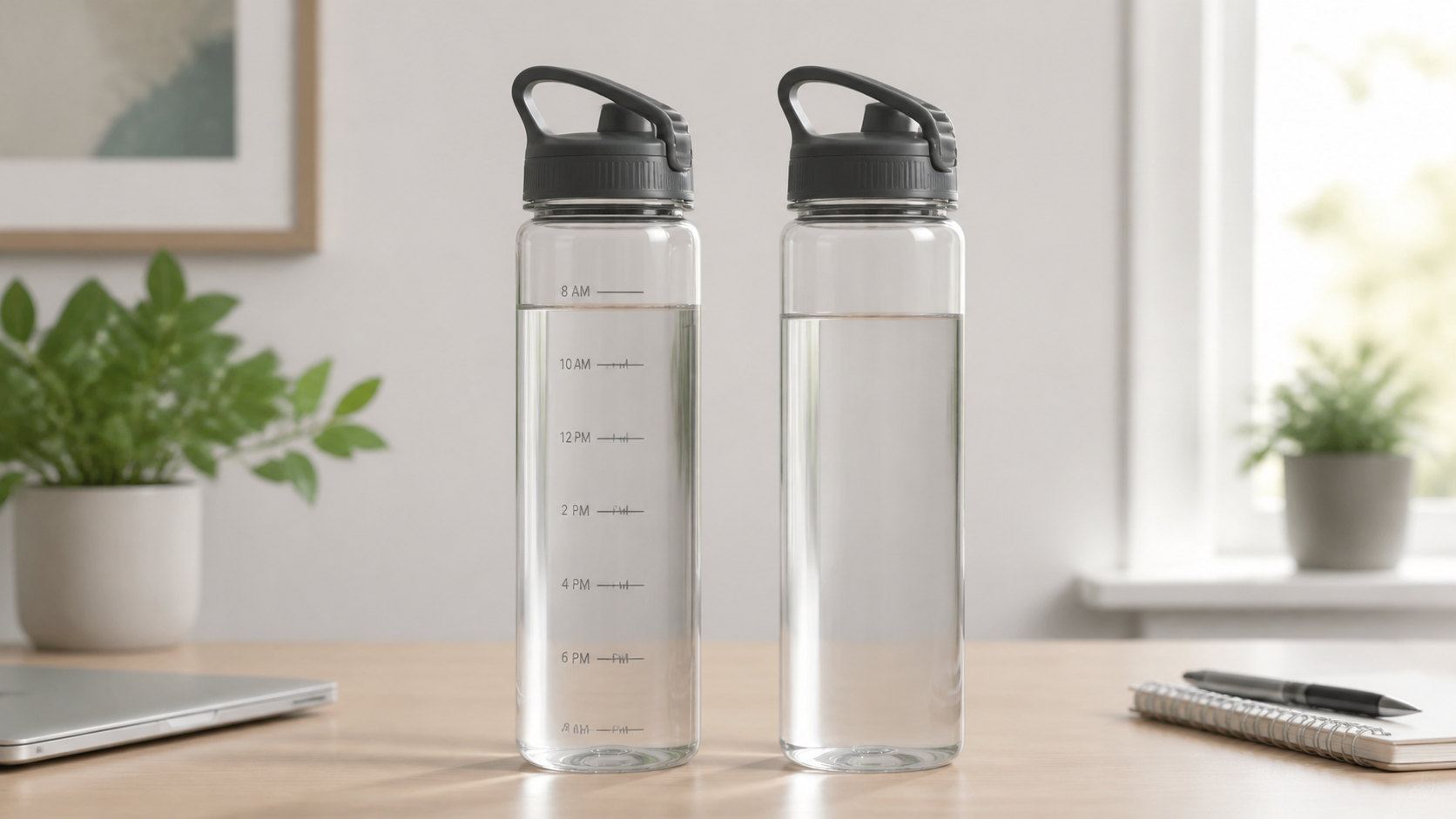
A time-marker bottle puts visible prompts beside the water. A plain bottle leaves timing up to you and may be easier to use flexibly. Neither bottle causes weight loss, and printed times are not personalized hydration advice. The useful choice is the one that fits your day without creating pressure or needless cleaning.
As an Amazon Associate, GoodWeighFinds earns from qualifying purchases.
Quick decision
- Choose time markers if a visible, optional prompt helps you remember a bottle that otherwise sits untouched.
- Choose a plain bottle if you already drink when it suits your routine, want a subtler design, or dislike falling behind a printed schedule.
- Choose neither if you already own a workable bottle, dislike carrying one, or find tracking prompts rigid or stressful.
What a time-marker bottle does well
Time lines make the reminder visible without requiring an app, alarm, or subscription. That can help someone who works at a desk, loses track of breaks, and responds well to gentle environmental cues. The markings also make it easy to notice whether the bottle has been sitting in the same place for hours.
The markings are only prompts. They do not account for bottle refills, drinks from other containers, food, activity, weather, pregnancy, health conditions, or medication. A schedule printed on a generic bottle is not evidence that everyone should drink that amount by that time.
What a plain bottle does well
A plain bottle keeps the job simple: hold a drink and travel through the day. It can feel calmer in meetings, fit more settings, and avoid turning each hour into a target. Plain designs also offer more freedom to choose capacity, insulation, opening style, and lid type without making reminder graphics the main feature.
The tradeoff is that the bottle provides no visible timing cue. If forgetfulness is the actual problem, placing the bottle in view, pairing a drink with an existing break, or using a removable band may work better than buying another plain bottle.
Who each option fits
A time-marker bottle may fit someone who likes low-tech prompts, spends long stretches in one place, and can treat the lines as suggestions rather than rules. It is a weaker fit for irregular shifts, frequent refills, short trips, or anyone who experiences tracking as pressure.
A plain bottle may fit commuters, shared workspaces, people who want fewer visual instructions, and anyone who prioritizes easier cleaning or insulation over printed cues. It can also be the better value when an existing bottle already fits the cup holder, bag, desk, and cleaning routine.
Tradeoffs worth comparing
- Prompt style: Check whether the marker language is neutral. Skip guilt, challenges, body-result slogans, or instructions that present one schedule as mandatory.
- Capacity and full weight: A larger bottle means fewer refills but more weight and a wider footprint. Confirm dimensions rather than relying on listing photos.
- Cleaning: Count lid pieces, inspect gasket access, and check whether a brush can reach the base. Printed graphics do not compensate for an awkward opening.
- Carry fit: Measure cup holders, bag pockets, and shelf clearance. Treat “leakproof” as a claim to verify and carry uncertain lids upright.
- Material: Use the exact maker’s instructions for dishwasher use, hot liquids, and replacement intervals. Do not infer care from the bottle’s appearance.
- Visibility: Transparent time-marker bottles make the level easy to see. Opaque or insulated plain bottles may keep temperature better but hide the level.
- Flexibility: A plain bottle adapts to changing days. A marked bottle works best when the printed sequence feels helpful even when your schedule changes.
Setup and maintenance
Before buying either type, measure the places the bottle must fit and consider its weight when full. Check the opening, straw or spout, vent, hinge, gasket, and handle. Confirm which parts are dishwasher-safe, whether the lid needs hand washing, and whether replacement lids, straws, and seals are sold for the exact model.
For a time-marker bottle, decide in advance that the lines are reminders rather than a catch-up schedule. Refill and wash it according to the maker’s instructions; do not leave water sitting simply to preserve the visual sequence. For a plain bottle, choose one repeatable cue—such as putting it beside your work area—if visibility is the missing part of the routine.
Claims to reject
Skip bottles that promise fat burning, appetite suppression, detoxification, metabolism changes, or guaranteed weight loss. A bottle can make water easier to carry or remember. It cannot establish an individualized intake target or prove a body result.
Be cautious with broad claims such as “BPA-free,” “non-toxic,” “odor-free,” “leakproof,” or “dishwasher-safe” when the listing does not identify the relevant material, component, test, or care instructions. Treat these as seller or manufacturer claims until the exact product documentation supports them.
Skip criteria
Skip a time-marker bottle when the schedule feels demanding, the text is hard to read, the graphics rely on shame or weight-loss promises, or the lid and narrow opening are difficult to clean. Skip a plain bottle when a visible reminder is the only missing feature and your current bottle offers no practical cue.
Skip both if an existing cup or bottle already works, the bottle will be too heavy to carry, replacement parts are unavailable, or the return policy does not allow a realistic fit check. People who have been given fluid restrictions or individualized hydration guidance should follow their qualified healthcare professional’s instructions rather than a bottle’s printed schedule.
Next steps
Use the water-bottle claim check to screen weight-loss language, materials, capacity, lid care, and seller promises. If easy cleaning matters more than prompts, compare wide-mouth water bottles. Desk-focused readers can also use the desk water-bottle guide for footprint and refill criteria.
This comparison maps to the routine-support tools pillar, which covers lower-risk tools that reduce routine friction without promising fat loss.
Bottom line
Choose a time-marker bottle when an optional visual cue solves a real reminder problem. Choose a plain bottle for flexibility, subtlety, and a wider range of practical formats. The better bottle is the one that fits your carry and cleaning routine without turning hydration into a rigid target.