Buy, reuse, or skip
Are Prep Bowls With Lids Worth It for Batch Cooking?
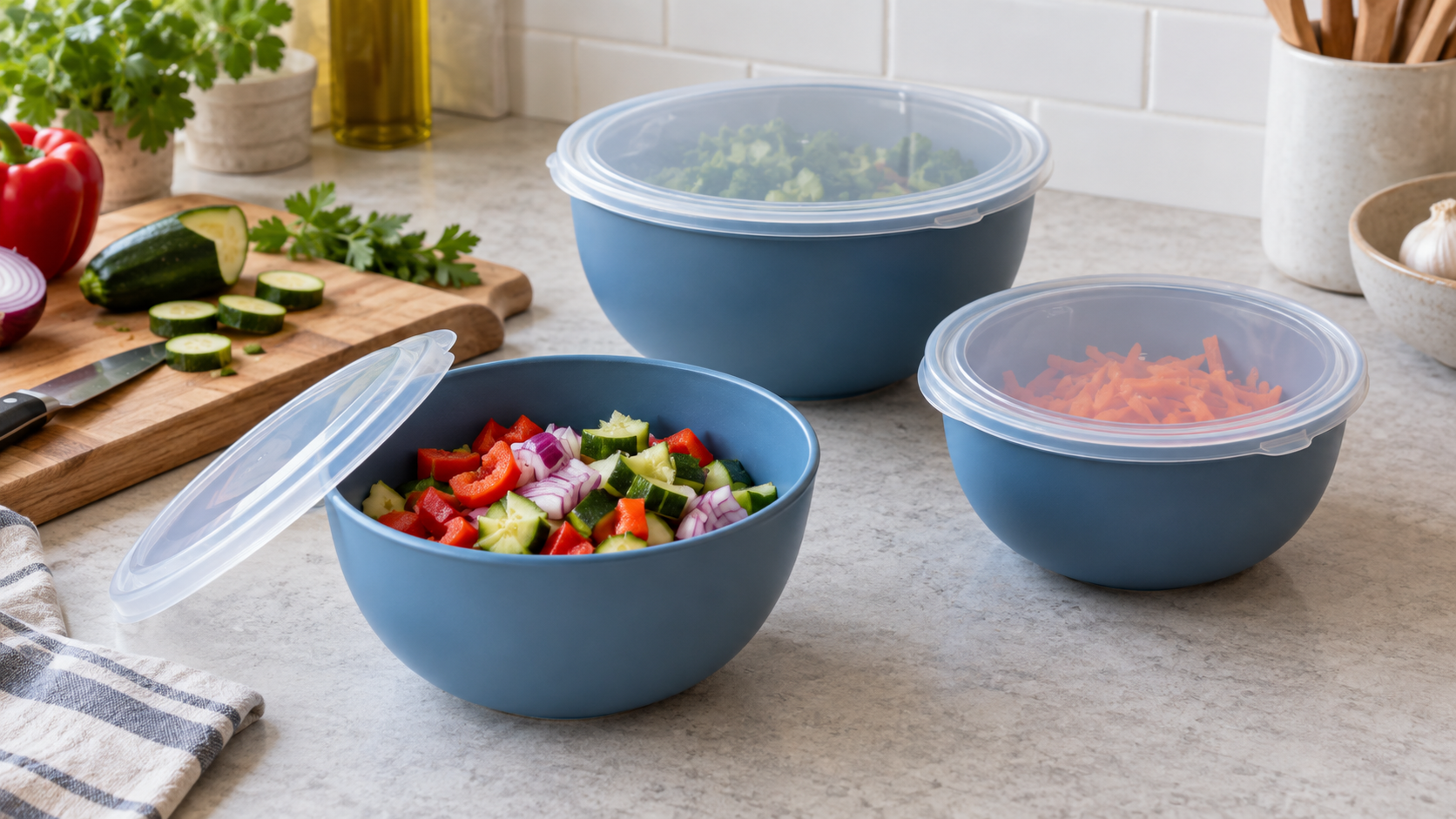
Prep bowls with fitted lids can earn their cabinet space when you regularly stage several ingredients before cooking and sometimes need to pause or rearrange the workflow. They are easy to overbuy, though: ordinary bowls, plates used as covers, or food-storage containers may already handle the same job.
The quick decision
- Buy: you repeatedly prepare several small ingredients, need to cover some of them briefly, and have measured storage space for the complete nested set and loose lids.
- Reuse: existing mixing bowls or storage containers already match the quantities and can be covered when needed.
- Buy fewer pieces: one or two useful sizes solve the routine better than a set with tiny or oversized bowls you would ignore.
- Skip: you usually chop and add ingredients immediately, dislike matching lids, or need containers mainly for packing finished meals.
Run a two-session workflow test
Before shopping, use the bowls and containers already in the kitchen for two typical batch-cooking sessions. Count the ingredients that genuinely benefit from being staged separately. Note their approximate volume and whether any need a cover while you pause, clear the counter, or wait for another step.
This test separates a recurring setup problem from attractive set photography. If you only use one medium bowl, a set of six creates extra washing and storage. If you keep reaching for four small containers and their shapes make the counter awkward, a compact nesting set may be easier to manage.
Measure usable sizes, not the piece count
A listing may count every bowl and lid as a separate piece. Record the number of actual bowls, then look for each bowl's stated capacity and outside dimensions. Compare those measurements with the ingredients from your test rather than assuming labels such as small, medium, or large are consistent.
Check the shape too. A wide, shallow bowl may make chopped ingredients easier to reach but occupy more counter space. A narrow bowl may take less room while making mixing or scooping awkward. This is a workflow choice, not evidence that one shape performs better for every cook.
Inspect the lids as separate components
| Check | Why it matters | What to verify |
|---|---|---|
| Attachment | Press-on, snap, and stretch lids require different handling | Maker instructions, tabs, alignment, and supported bowl |
| Identification | Similar lids can slow setup and cleanup | Size marks, color cues, or a clear matching system |
| Storage | Lids may not nest with the bowls | Complete stacked dimensions and a place for loose lids |
| Replacement | A lost or damaged lid can reduce the set's usefulness | Whether individual lids are currently offered by the maker or seller |
| Claims | “Airtight” and “leakproof” depend on defined conditions | Exact maker wording, test conditions if stated, and intended use |
Do not infer a food-storage duration or transport performance from the presence of a lid. Follow the product instructions and ordinary food-handling guidance for the ingredients involved. For taking finished meals to work, use a container designed and labeled for that job instead of assuming a prep bowl will travel securely.
Check materials and appliance labels
Read the maker's material disclosure and directions for dishwashers, microwaves, freezers, and heat exposure. A bowl and its lid may have different limits. “Food grade,” “BPA-free,” and similar phrases do not replace specific use and care instructions, and they do not establish that every component is suitable for every appliance.
For glass, include empty weight and breakage handling in the decision. For metal, confirm that appliance restrictions fit your routine. For plastic or silicone, verify the stated temperature and care limits without assuming stain, odor, scratch, or durability performance that the listing does not support.
Count the full storage footprint
Measure the cabinet or drawer before buying. Use the set's nested outside diameter and height, then add space for lids if they store separately. Check shelf clearance and whether the largest bowl blocks access to items behind it. A compact photo taken without lids is not a complete storage measurement.
If several existing containers already nest in the same area, replacing them with a second dedicated set may duplicate storage rather than simplify it. A set is more defensible when it replaces a scattered workflow and every size has a known job.
Red flags on a listing
- A large “piece” count that obscures the actual number of bowls.
- No individual capacities, outside dimensions, or nested dimensions.
- No clear match between each lid and bowl, or product photos that omit lid storage.
- Broad airtight, leakproof, stain-proof, unbreakable, or lifetime-use claims without defined conditions.
- Appliance icons or heat claims that conflict across the listing, packaging photos, or instructions.
- Meal-storage or food-safety promises with no useful limits or source.
When another tool fits better
For the direct format decision, compare prep bowls with lids and meal prep containers by workflow stage, shape, filled stacking, empty nesting, and the storage job that actually repeats.
If the main goal is storing or transporting finished food, start with the meal-prep container guide. It covers container shape, lid handling, stacking, cleaning, and packed-meal fit. Prep bowls are better treated as tools for staging ingredients during cooking, even when a lid adds short-term flexibility.
If you need one larger bowl for mixing rather than several small bowls for staging, compare stackable mixing bowls for a small kitchen. A cutting board with separate piles, cups you already own, or a plate placed over a compatible bowl can also test whether covering ingredients is valuable before you buy.
Bottom line
Prep bowls with lids are worth considering when repeated batch-cooking sessions show a real need for several measured staging bowls, occasional covers, and a compact nesting system. Buy for the bowl sizes and workflow you documented—not the set count—and skip the purchase when existing bowls or storage containers already do the work. For the broader decision framework, visit the routine-support tools guide.