Batch-cooking container comparison
Prep Bowls With Lids vs Meal Prep Containers for Batch Cooking
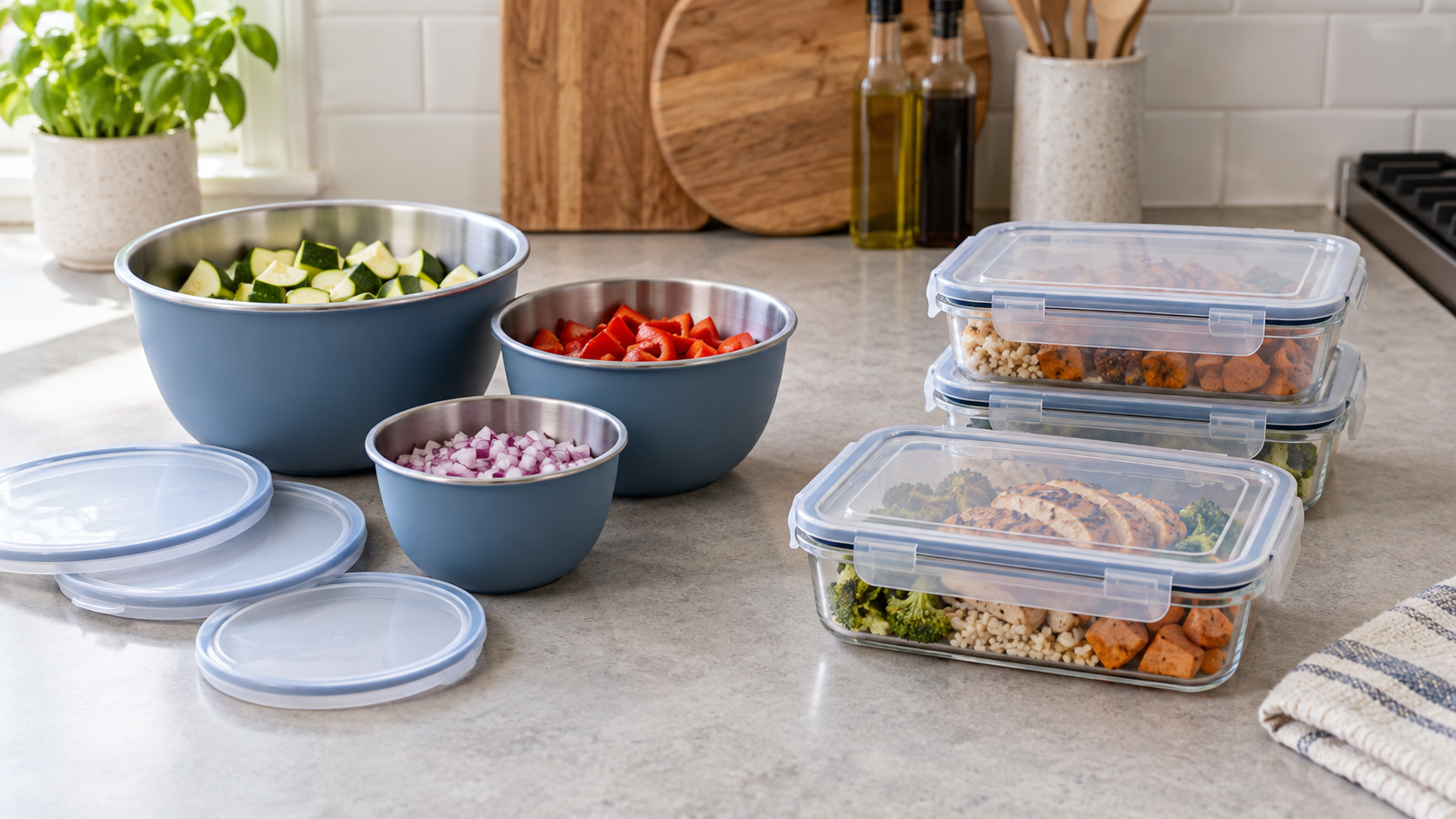
Choose prep bowls when the recurring job is staging ingredients before or during cooking. Choose meal prep containers when the job is packing finished food for refrigeration, transport, or reheating. They can overlap, but their shapes and storage habits favor different parts of the workflow.
As an Amazon Associate, GoodWeighFinds earns from qualifying purchases.
The quick comparison
| Decision | Prep bowls with lids | Meal prep containers |
|---|---|---|
| Primary job | Stage, mix, and temporarily hold ingredients | Store and carry finished food |
| Typical shape | Round, open, and deeper | Rectangular or divided, with a flatter profile |
| Space pattern | Often nests empty; uses more width when filled | Often stacks filled; empty nesting varies |
| Serving use | Convenient for tossing, mixing, and table serving | Convenient for individual packed meals and leftovers |
| Setup check | Bowl sizes, lid matching, counter space, and nesting | Meal fit, shelf and bag dimensions, lid clearance, and stacking |
| Main friction | May duplicate mixing bowls already owned | Flat sides and lid grooves can add washing work |
Who each option fits
Lidded prep bowls fit a cook who chops several ingredients ahead, pauses between recipe stages, or wants one vessel for mixing and short-term covered storage. A useful set has sizes that match real ingredient batches rather than many tiny bowls that add washing.
Meal prep containers fit someone who regularly packs finished food into the refrigerator, freezer when maker-approved, or a lunch bag. Straighter sides can make filled stacking and shelf planning easier. Dividers may keep components separate, but fixed compartments are a poor match for soups, large leftovers, or meals that change shape.
Map the complete workflow first
Write down what happens from ingredient preparation through cleanup. Count how many ingredients need separate holding spaces, then how many finished portions need storage. If existing mixing bowls already handle staging and existing containers already handle leftovers, a new set may only duplicate both cabinets.
Measure the widest bowl in use, the nested stack, the filled container stack, refrigerator shelf height, and any lunch-bag opening. Product photos rarely show the complete working footprint. Compare listed dimensions for every size in a set, not only total capacity or piece count.
Shape, lids, and appliance labels
A rounded bowl gives a utensil room to move and can be easier for tossing or whisking. A rectangular container fits shelves and bags predictably but its corners may take more attention to clean. Neither geometry is automatically better; choose around the repeated task.
Confirm that every lid matches a clearly identified base and that replacements are available if that matters. Microwave, freezer, dishwasher, oven, and temperature-limit statements must come from the maker for the exact component. A label for the base does not automatically apply to the lid. Follow current food-storage and reheating guidance rather than treating any container as a food-safety shortcut.
Setup and maintenance tradeoffs
Prep-bowl sets can nest compactly, but fitted lids may need a separate slot and can be hard to identify. Check rim grooves, rolled edges, non-slip parts, and whether the bowl and lid can dry fully before stacking. Test the largest bowl's working clearance under cabinets and beside the cutting board.
Meal prep containers may stack neatly when all bases share a footprint, though mixed shapes and locking tabs can consume more room than listing photos suggest. Inspect gasket and hinge care, whether removable parts can be reinstalled correctly, and whether the set must be stored with lids on or apart.
Cost and buy-one-or-reuse-what-you-have choices
Piece counts can be misleading because sellers may count every lid separately. Compare the number of usable pairs, their individual sizes, and the stored footprint. Add likely replacement-lid cost only when compatible parts are actually listed.
Run one batch-cooking session with current mixing bowls, plates used as temporary covers, and food-storage containers. Note the exact point of friction. Buy prep bowls only if ingredient staging is the repeated problem; buy meal prep containers only if finished-food storage or carry is the repeated problem.
When to skip each option
- Skip prep bowls when current mixing bowls already cover staging, the lidded stack will not fit, or the set includes sizes you will not use.
- Skip meal prep containers when finished food varies too much for fixed shapes, the filled stack will not fit the refrigerator or bag, or existing containers already close and store well.
- Skip both when the real friction is planning, counter space, washing capacity, or missing lids that can be replaced.
- Skip vague listings that omit individual dimensions, component-specific appliance instructions, materials, care directions, seller identity, or workable return terms.
Next steps
If ingredient staging is the recurring job, use the prep-bowls worth-it guide to decide whether a dedicated lidded set earns its space. If finished-food storage is the bottleneck, start with the meal prep container guide; if food will spend longer in frozen storage, compare meal prep and freezer containers instead.
Bottom line
Prep bowls support the cooking stage; meal prep containers support the storage and carry stage. Choose from the stage that repeatedly creates friction, then verify measurements, lid fit, component-specific use labels, cleaning, and storage. This is a workflow choice within the routine-support tools guide, not a weight-loss method.