Push a wide pass or sweep into a pan
Bench Scraper vs Countertop Crumb Tray for Dry Prep Cleanup
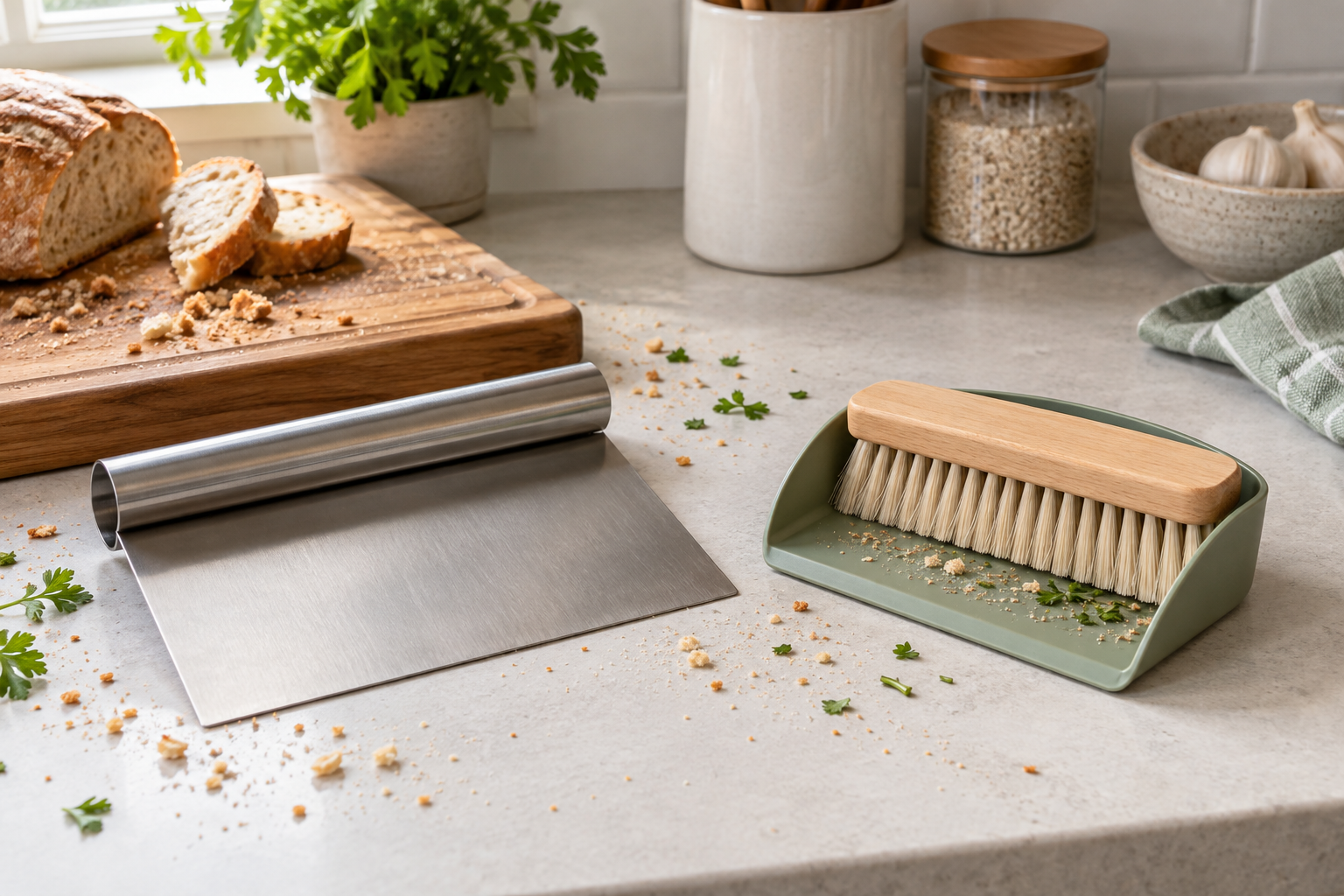
A bench scraper uses one broad rigid edge to gather or lift dry prep fragments. A countertop crumb tray pairs a small brush with a shallow pan for scattered crumbs. The better fit depends on the debris, work surface, transfer target, hand use, storage, and whether a tool you already own handles the job.
As an Amazon Associate, GoodWeighFinds earns from qualifying purchases.
The quick comparison
| Decision | Bench scraper | Crumb tray and brush |
|---|---|---|
| Best task shape | One broad pile or a straight pass across a board | Scattered crumbs around edges, corners, or small objects |
| Collection motion | Push or lift with one rigid edge | Sweep with a brush, then lift the pan |
| Transfer target | Bowl, pan, compost caddy, or waste bin with an accessible opening | The matching tray, then the final bin |
| Surface contact | A rigid edge directly contacts the work surface | Bristles contact the surface; the tray lip must sit close enough to receive debris |
| Storage | One broad flat tool | Two parts that should nest or hang together |
Who a bench scraper fits
A bench scraper fits a cook who already works on a clear board or smooth counter and regularly needs to move one broad pile of dry chopped ingredients, flour, crumbs, or peel fragments into another container. Its wide edge can reduce repeated small passes, and the blade can double as a transfer surface when that use is supported by the maker.
Check the complete blade width and height, handle clearance, edge profile, and stated surface guidance. A rigid metal edge should not be assumed suitable for every countertop, coated pan, or delicate board. It is not a knife unless the maker explicitly describes a cutting use.
Who a crumb tray fits
A countertop crumb tray and brush fits scattered dry debris that sits around a board, toaster area, or counter objects. The brush can reach around edges and into shallow corners where a broad rigid scraper cannot stay flat. The tray provides a small target when the final waste or compost container is inconvenient to hold beside the work area.
Check the brush width, bristle stiffness, handle grip, pan-lip geometry, and whether the pair nests securely. A tall or curled lip can leave a line of fine debris behind. Two parts also create more storage and drying steps than one flat scraper.
Tradeoffs that change the decision
- Debris: a scraper suits a consolidated pile; a brush suits scattered crumbs. Neither is meant for broken glass, hot residue, sticky spills, or unknown sharp fragments.
- Work surface: follow the exact tool and surface maker's guidance. Do not infer scratch safety from a rounded-looking edge or soft-looking bristles.
- Hand use: a scraper can collect and transfer with one tool, while the brush-and-pan sequence normally uses both hands or requires setting the pan down.
- Destination: a scraper needs a reachable bowl or bin; the tray briefly holds debris but adds another transfer step.
- Storage: measure the scraper's blade and handle or the nested tray set, including any hanging loop or protruding brush handle.
Setup and maintenance
For either format, define one dry-cleanup job before buying. Test the motion with a spatula or small brush and a plate you already own. Notice whether the tool can approach the counter edge, whether a backsplash blocks the handle, and where debris will go after collection.
Follow the exact washing and drying directions. Inspect the scraper where blade meets handle and the crumb set where bristles meet the block and debris collects at the pan lip. Store a brush only after it is clean and dry. Neither format sanitizes a work surface; complete normal surface cleaning separately when the task calls for it.
Claims and details to verify
“Scratch-free,” “food safe,” “dishwasher safe,” “rustproof,” “ergonomic,” and “heavy duty” are seller or manufacturer claims unless documented for the exact item and use. Confirm materials, dimensions, care directions, and surface compatibility instead of treating broad listing language as universal. Customer anecdotes may reveal questions, but they do not prove durability, sanitation, or compatibility with your counter.
These are ordinary cleanup tools. Neither improves the nutritional value of a meal, guarantees meal-prep consistency, or produces weight-loss results.
Who should skip each format?
- Skip a bench scraper when the work surface guidance is unclear, the counter is crowded with objects, or the usual debris is dispersed into tight corners.
- Skip a crumb tray when two-part storage is annoying, the pan lip leaves debris behind, or the usual task is moving a single broad pile directly into a bowl.
- Skip both when a washable cloth, existing brush, spatula, or sheet of paper already completes the dry task without damaging the surface.
- Use another cleanup method for wet spills, raw-food residue, hot material, sharp fragments, or anything that needs handling beyond ordinary dry crumbs.
Bottom line
Choose a bench scraper when a clear surface, broad dry pile, and direct transfer path make one rigid tool useful. Choose a crumb tray and brush when debris is scattered and the brush can reach around the real countertop setup. Skip both if an existing tool passes the same cleanup test. For post-decision details, compare bench scraper formats or countertop crumb tray sets. This comparison supports the routine-support tools pillar.