Routine-support buying guide
Best Bench Scrapers for Countertop Meal Prep
A bench scraper can move chopped ingredients, divide dough, and gather loose scraps without using a knife blade as a scoop. The useful choice depends on the jobs you repeat, the surface you use, and whether the edge, handle, and blade dimensions fit those jobs.
As an Amazon Associate, GoodWeighFinds earns from qualifying purchases.
Who this guide is for
This guide is for adults who repeatedly transfer chopped vegetables, portion dough, or clear flour and food scraps from a prep surface. A bench scraper is a small workflow tool; it does not change the nutritional value of a meal or produce a weight-loss result.
For the broader framework, start with the routine-support tools guide. If the main decision is the work surface rather than the transfer tool, compare cutting boards for small-kitchen batch cooking. A mini chopper addresses chopping effort instead of countertop transfer.
Useful formats—not universal winners
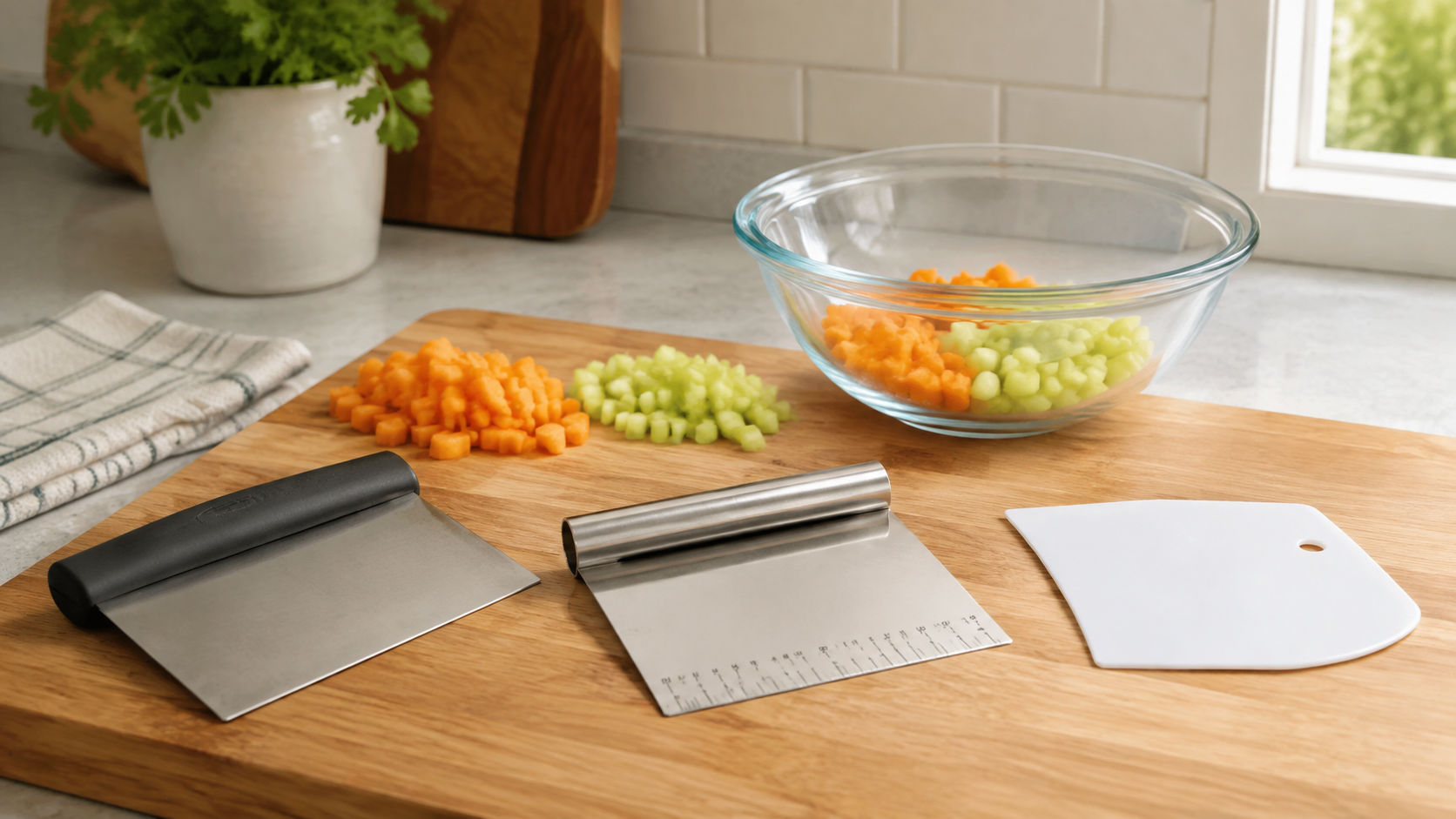
- Handled stainless-steel scrapers: A broad rigid blade can carry chopped ingredients and divide dough. Compare handle clearance, seams, blade dimensions, edge shape, and the maker's cleaning directions.
- Marked stainless-steel scrapers: Printed or etched scales may help with rough dough portions or spacing, but confirm the units, measurement range, starting point, legibility, and whether markings are intended as precise measurements.
- Flexible plastic bowl scrapers: A curved flexible edge may follow a mixing bowl better and can suit surfaces where a metal edge is undesirable. Check stiffness, dimensions, heat limits, and food-contact and care labeling.
- Straight plastic scrapers: These can gather ingredients from a board with less metal-on-surface contact. Thin edges may flex under a larger load, so match the tool to the intended job.
Selection criteria that matter
- Working dimensions: A wider blade carries more but needs more clear board and drawer space. Use stated measurements, not product-photo proportions.
- Edge profile: Distinguish a flat scraping edge from a sharpened or beveled edge. A bench scraper is not automatically safe for every surface.
- Handle clearance: Check the room for your fingers. A thick handle can be comfortable yet reduce how flat the blade sits.
- Blade rigidity: Rigid metal carries firmer ingredients; flexible material can conform to bowls. Neither is automatically better.
- Measurement markings: Verify whether markings are etched, printed, or molded, where zero begins, and which units appear. Treat them as a convenience unless an accuracy tolerance is stated.
- Seams and cleaning: Check where residue could collect and follow the stated hand-wash or dishwasher directions.
- Surface fit: Check the board or counter maker's care guidance. Dragging a metal edge across a delicate surface may leave marks.
- Storage: Compare overall dimensions, hanging holes, any blade guard, and whether the edge could contact hands in a crowded drawer.
- Returns: Confirm seller and return terms before use if handle clearance or stiffness cannot be judged from the listing.
A quick fit check before buying
Name the recurring job first: moving chopped food, dividing dough, cleaning dry flour from a board, or scraping a bowl. Then measure the board and storage space. Ask:
- Is the blade wide enough without crowding the board?
- Does the handle leave finger clearance when the edge lies flat?
- Is the edge compatible with the surface maker's guidance?
- Are dimensions and materials stated instead of inferred from photos?
- Can seams and contours be cleaned using the listed method?
- Will it store without leaving an exposed edge in a busy drawer?
Claims and practical limits
“Professional,” “razor sharp,” “rustproof,” “dishwasher safe,” and “non-slip” are claims to verify in current manufacturer information. Steel grade, construction, moisture, detergents, handle design, and care affect real use. A category search cannot establish those details for every listing.
Use the tool only as its maker directs. Keep fingers away from the working edge, avoid sweeping scraps toward a hand, and do not use a scraper to pry frozen food or strike hard objects. If a listing does not clearly distinguish its edge and intended uses, choose one with better documentation.
Who should skip this purchase
Skip a bench scraper if an existing spatula or another tool already transfers food without damaging the surface. Skip it if the job occurs too rarely to justify drawer space, or if the listing omits dimensions, material, edge description, and cleaning directions.
A scraper is also a poor workaround for an unstable board or overcrowded counter. Fix the work-surface problem first; the drawer-divider guide can help if storage is the limiting factor. If the recurring task is collecting dry crumbs around the board rather than transferring chopped ingredients, use the countertop crumb tray guide to compare a small pan-and-brush set instead.
Bottom line
The best-fit bench scraper matches one recurring prep job, has a clearly described edge and usable dimensions, provides enough handle clearance, follows your surface's care guidance, and has cleaning and storage instructions you can live with. Buy for those details—not a promise that one tool will make every prep task faster.