Small-kitchen cleanup guide
Best Countertop Crumb Trays for Quick Meal-Prep Cleanup
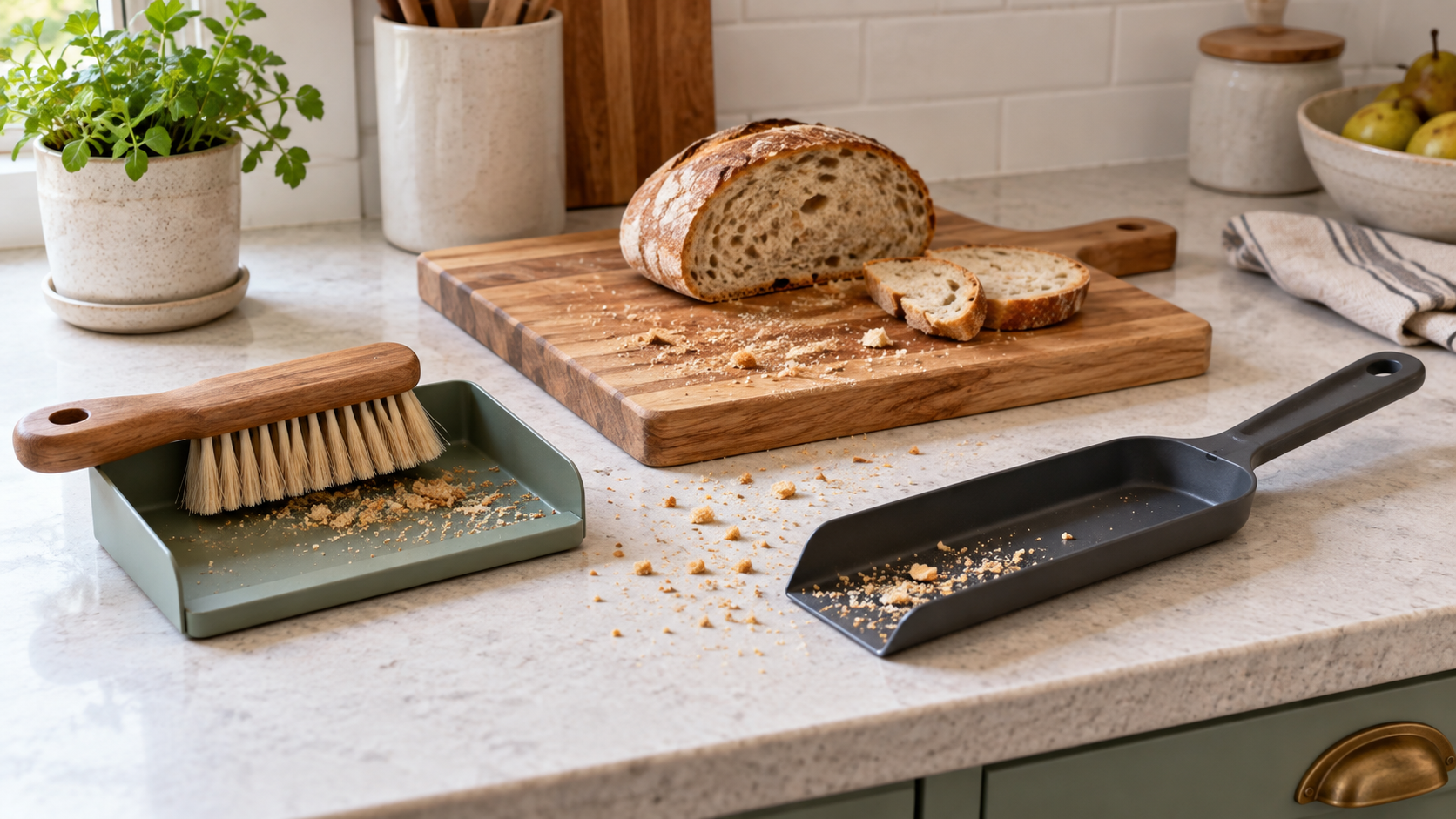
A compact crumb tray and brush can make sense when dry crumbs repeatedly spread beyond a cutting board and a full-size dustpan is awkward to use on the counter. The useful choice is not the fanciest set: it is one whose pan edge, brush, storage, and cleaning routine fit the small job.
As an Amazon Associate, GoodWeighFinds earns from qualifying purchases.
Who this guide is for
This guide is for adults clearing ordinary dry crumbs, flour, seeds, or similar loose debris from a counter or table after food prep. It does not cover floor dustpans, powered vacuums, grill brushes, wet spills, broken glass, hot debris, or products sold with sanitizing claims.
For the broader buy-or-skip framework, use the routine-support tools guide. If the repeated job is moving chopped ingredients or clearing a cutting board, a bench scraper may be the better tool. If the cleanup tool is fine but the paper roll occupies scarce workspace, compare under-cabinet paper towel holders by measured fit and mounting limits.
Best-fit formats, not universal winners
- Best fit for a drawer: A low-profile pan with a brush that locks or nests without bending the bristles.
- Best fit for a narrow sweep path: A palm brush and short pan that can turn around appliances and backsplash corners.
- Best fit for keeping hands farther from debris: A slim handled tray and brush, provided the handles still fit the storage space.
- Best fit when the task is occasional: No new set. Use a clean existing brush, scraper, cloth, or full-size dustpan when it already handles the job appropriately.
Start with the pan edge
The front edge determines whether crumbs cross into the pan or gather against a lip. Look for a clear side view, stated material, and a straight, undamaged edge. Words such as “flush,” “flexible,” or “zero gap” are claims, not proof that the pan will meet every counter surface.
Check the surface maker's care directions too. A stiff or rough edge may be a poor choice for a counter or table that scratches easily. Do not use product photos to infer compatibility.
Selection criteria that matter
- Working width: Compare the brush head and pan opening with the clear sweep path beside the cutting board, appliances, and backsplash.
- Pan depth and sides: A deeper pan contains more, but tall sides can obstruct a shallow-angle sweep and increase the stored size.
- Bristles: Check material, stiffness description, density, attachment, and maker care. Softer is not automatically more effective or safer for a surface.
- Brush grip: Compare palm grip, handle length, wet-hand texture, and clearance between fingers and the work surface.
- Nesting: Confirm how the brush attaches and whether storage pressure bends the bristles. A product photo does not establish secure retention.
- Hanging or mounting: Verify hole dimensions, hook or adhesive requirements, supported surface, and whether mounting hardware is included.
- Cleaning and drying: Inspect bristle roots, pan corners, seams, clips, and handles. Follow the stated hand-wash or dishwasher directions for each part.
- Stored footprint: Measure the full nested set, including protruding handles and bristles, against the intended drawer, hook, or cabinet.
- Seller terms: Confirm the current seller and return conditions before use when edge contact or grip cannot be judged from the listing.
Run a no-buy test first
For one week, note what you are clearing, where it lands, and what you already reach for. Try the tool you already own only when it is clean and appropriate for the surface and debris. If a bench scraper moves board scraps directly to a bowl, or a damp cloth handles the final wipe, another set may only add storage and washing.
If crumbs regularly fall to the floor, a countertop pan may not solve the whole cleanup path. Test whether repositioning the board, using a larger board, or bringing a waste bowl closer removes the friction first.
Use and care limits
Keep a countertop brush separate from tools used on floors or other dirty surfaces. Follow the maker's cleaning directions and let both pieces dry before nesting. Replace a set when bristles loosen into the work area, the pan edge warps or cracks, or seams can no longer be cleaned as directed.
Do not sweep broken glass, sharp fragments, hot material, grease, raw-meat liquid, or another wet contamination with a small dry crumb set. Use a cleanup method appropriate to the specific hazard and the surface.
Claims this tool cannot establish
A crumb tray collects loose debris. It does not sanitize a counter, make food safe, prevent cross-contamination, remove allergens completely, improve nutrition, control portions, or cause weight loss. Treat “antibacterial,” “food safe,” “scratch-free,” “dishwasher safe,” and “non-shedding” as exact-product claims that need current manufacturer support and use limits.
Who should skip this purchase
Skip it when dry crumbs are rare, an existing appropriate tool already works, or the set would live in an overcrowded drawer. Also skip listings that omit full dimensions, bristle material, care directions, or a useful view of the collection edge.
If the real problem is scraps accumulating during chopping, compare a bench scraper instead. If it is wet residue, use the surface maker's recommended cleaning method rather than expecting a dry brush-and-pan set to handle it.
Bottom line
The best countertop crumb tray is a modest tool matched to a repeated dry-cleanup job. Measure the sweep path and storage space, inspect the pan edge and bristles, plan how the set will be cleaned and dried, and skip the purchase when a tool already on hand does the same work.