Small-kitchen setup guide
Best Under-Cabinet Paper Towel Holders for Small-Kitchen Prep
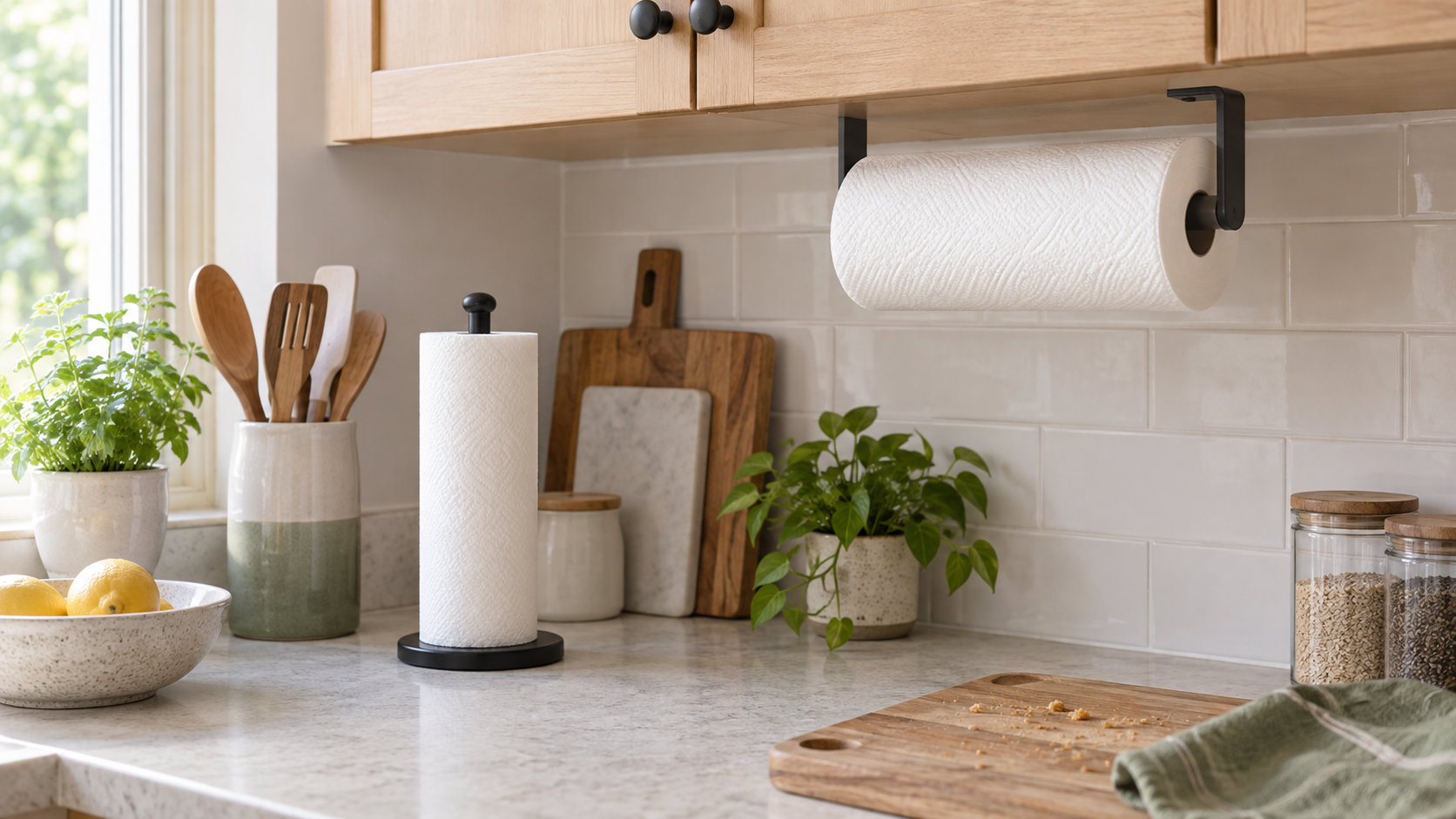
An under-cabinet holder can free a useful patch of counter while keeping a roll near the prep area. The best fit is not a universal model: it is a mounting style that suits the cabinet, clears doors and appliances, accepts the rolls you buy, and can be used without loosening or damaging the surface.
As an Amazon Associate, GoodWeighFinds earns from qualifying purchases.
Who this guide is for
This guide is for adults trying to reclaim counter space while keeping ordinary cleanup supplies reachable. It focuses on manual holders below an upper cabinet or shelf—not powered dispensers, commercial systems, paper-towel quality, or sanitizing claims.
If you have not established that mounted storage fits the kitchen, start with the under-cabinet holder buy-or-skip decision. For the broader framework, use the routine-support tools guide. If the recurring problem is collecting dry crumbs rather than storing the roll, compare compact countertop crumb trays.
Best-fit formats, not universal winners
- Best fit for an owned cabinet and long-term placement: A drilled holder installed according to both the holder and cabinet instructions, when the panel and screw location are suitable.
- Best fit when drilling is not allowed: An adhesive or clamp-style holder only when the maker supports the surface and the removal method fits lease and finish-care rules.
- Best fit for one-hand use: A design with stated resistance or retention, provided the mounting and cabinet can handle the forces described.
- Best fit for uncertain placement: Keep the freestanding holder and test the workflow before mounting anything.
Measure the complete installation
Measure the cabinet underside from the wall or backsplash to the front edge, then note nearby hinges, doors, trim, lighting, outlets, and appliance vents. Add the diameter and width of a full roll to the holder dimensions. The roll must clear the wall, cabinet face, and anything that opens or heats beneath it.
Mock up the full footprint with the roll you normally buy. Check reach from the prep position and open every adjacent door. A holder that technically fits can still obstruct a cabinet, hang over a sink, or put paper too close to heat or splashes.
Selection criteria that matter
- Roll fit: Verify usable spindle length, maximum roll diameter, core requirements, end stops, and loading direction.
- Installed depth: Compare the full holder-and-roll projection with clear space over the counter, sink, and appliances.
- Mounting method: Identify whether screws, adhesive, clamps, or slide-on brackets are required and whether every part is included.
- Cabinet construction: Confirm underside material and thickness; thin panels, veneers, laminates, painted finishes, and stone do not share the same mounting limits.
- One-hand control: Look for a described resistance mechanism, but treat smooth-tearing claims as unverified until used.
- Reloading: Check whether doors, knobs, walls, or side panels block the roll-loading path.
- Cleaning: Inspect seams, brackets, spindle ends, and wall clearance; follow material-specific care directions.
- Removal: Read adhesive removal instructions and surface exclusions before installation. “No damage” is not a guarantee for every finish.
- Seller terms: Confirm the seller and return conditions before drilling, applying adhesive, or discarding packaging.
Drilled versus adhesive mounting
A drilled mount can be mechanically secured only when cabinet material, thickness, fasteners, and location are suitable. Follow supplied instructions and avoid guessing about concealed wiring, lighting, plumbing, or structural capacity. If those conditions are unclear, do not drill.
An adhesive mount avoids holes, but its surface preparation, curing time, temperature, moisture, finish, and removal limits matter. Do not add stronger glue or substitute tape unless both the holder and surface makers support it.
Run a no-buy placement test
Move the current roll into the proposed reach zone for several prep sessions without attaching anything. Note whether you reach there, whether the roll would be exposed to water or cooking residue, and whether opening a door interrupts access. Mark the full-roll outline with removable painter's tape only if the finish maker permits it.
If the freestanding holder is not causing meaningful friction, the saved counter area may not justify installation. A repositioned holder you already own may solve the access problem without new hardware.
Installation and use limits
Keep paper and the holder away from burners, toaster slots, steam outlets, and other heat sources, following appliance clearance instructions. Do not mount where a loose sheet can contact a flame or hot surface.
Stop using the holder if fasteners loosen, adhesive lifts, the cabinet finish changes, or the frame bends. Do not exceed a stated load limit or hang other items from a paper-roll holder unless it is designed for that use.
Claims this holder cannot establish
A paper towel holder organizes a roll. It does not sanitize a surface, prevent cross-contamination, make a kitchen safer, improve nutrition, control portions, or cause weight loss. Treat “damage-free,” “rustproof,” “heavy duty,” “universal fit,” and “one-hand tear” as exact-product claims requiring current manufacturer support and limits.
Who should skip this purchase
Skip it when cabinet material or concealed services are uncertain, mounting is not permitted, the full roll would interfere with a door or appliance, or the current holder works. Also skip listings that omit installed dimensions, supported surfaces, included hardware, installation directions, or removal instructions.
Bottom line
The best under-cabinet paper towel holder is the least complicated format that fits the full roll, cabinet, and reach path. Measure first, test the placement, follow the stated mounting limits, and keep the freestanding setup when installation adds more risk or work than the saved counter space is worth.