Small-kitchen buying guide
Best Clip-On Pot Colanders for Small Kitchens
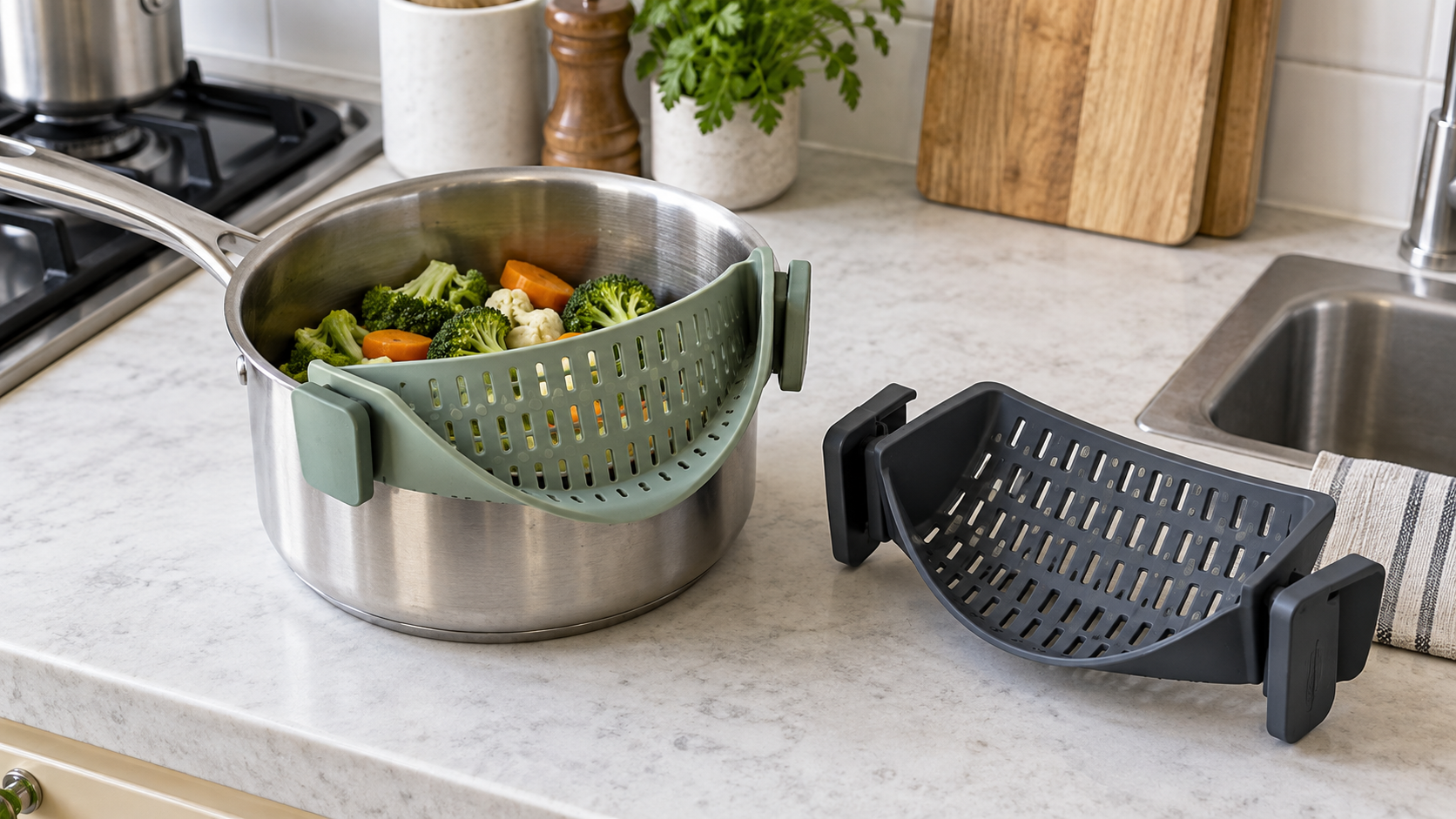
A clip-on pot colander can replace a bulky freestanding bowl for one narrow job: draining a compatible pot. The useful comparison begins with the cookware you already own—its rim shape and diameter, the food you drain, and whether the attachment leaves you a stable way to hold the pot.
As an Amazon Associate, GoodWeighFinds earns from qualifying purchases.
Who this guide is for
This guide is for adults with limited cabinet and sink space who usually drain food from a small or medium pot and want to avoid storing a full-size colander. It compares product formats and listing details; it does not teach hot-liquid handling or claim that an attachment prevents spills.
For the broader buying framework, use the routine-support tools guide. If you need an independent bowl for rinsing produce or draining food hands-free, compare collapsible colanders instead.
Best-fit types, not unsupported winners
- Best fit for one measured saucepan: A compact curved strainer whose stated rim range and clip geometry match that exact pot.
- Best fit for several pots: A flexible format with a clearly stated compatibility range—not a vague “universal” label.
- Best fit for limited storage: A one-piece strainer that fits the planned drawer without the clips snagging nearby tools.
- Best fit for frequent cleaning: A design with accessible drainage slots and clips, plus care instructions you will realistically follow.
Measure your cookware before shopping
Record the outside diameter where the clips will sit, rim thickness, rim profile, and distance from the rim to each handle connection. A rolled, flared, lipped, or unusually thick edge may change how a clip seats even when the pot diameter sounds compatible.
Also note how much open rim remains after attachment. The strainer should not cover a handle, helper handle, lid fitting, or the grip area you rely on. Treat “fits most pots” and “universal fit” as claims to verify against stated measurements and the return policy.
Selection criteria that matter
- Stated compatible range: Look for dimensions or named rim limits rather than assuming a product photo proves fit.
- Attachment method: Compare the number, spacing, and shape of clips and whether the listing explains compatible rim profiles.
- Drainage area: Check slot size and distribution against the foods you actually drain. Very large openings may not suit small pieces.
- Basket depth: A deeper curve may contain food near the rim but can take more storage space and require more clearance.
- Handle clearance: Confirm the strainer does not obstruct either pot handle or the places your hands need to grip.
- Materials and limits: Verify food-contact, material, temperature, and dishwasher statements for the exact model. Do not infer them from appearance.
- Cleaning access: Inspect seams, clip channels, and drainage slots for places that may trap food or water.
- Stored footprint: Measure the complete width, including clips. A compact basket can still be awkward in a shallow drawer.
- Seller and returns: Check who sells the item, the return window, and return-shipping terms in case the rim fit is wrong.
A short comparison checklist
Mark each candidate yes, no, or unclear. An unclear fit claim is a reason to verify or skip, not a reason to guess.
- Does the stated rim range include every pot you expect to use?
- Does the clip design match the measured rim thickness and profile?
- Will both pot handles and grip areas remain clear?
- Are the drain openings suitable for the usual food size?
- Are material, use-limit, and care statements specific to this model?
- Can every food-contact surface, slot, and clip area be cleaned?
- Does the complete item fit its planned storage spot?
- Are the seller and return terms acceptable if compatibility fails?
Clip-on strainer or full colander?
A clip-on format makes the most sense when compact storage is the main constraint and one compatible pot handles the recurring task. A freestanding colander is usually more flexible when you rinse food separately, need hands-free draining, switch among many cookware shapes, or prepare batches larger than one pot-attached basket can contain.
If a full bowl still seems useful but cabinet height is tight, use the collapsible colander versus produce wash basket comparison to match the format to sink support, drainage, cleaning, and storage.
Who should skip this category
Skip a clip-on strainer if the listing omits compatibility dimensions, your cookware has an unusual rim, the attachment blocks a secure grip, or you regularly drain large or heavy pots. A simple freestanding colander may also be the better value if it already fits your sink and storage space.
Do not rely on broad “spill-proof,” “safe,” “heatproof,” or “universal” wording. Follow the instructions and use limits supplied for the exact cookware and strainer; if those details are missing, choose a clearer product or a different draining format.
What this tool cannot do
A clip-on colander can reduce storage footprint and drain food from compatible cookware. It cannot make a meal nutritionally appropriate, guarantee safe handling, prevent every spill, control portions, or cause weight loss. Those claims do not belong in the product decision.
Bottom line
The best clip-on pot colander is not the one with the broadest “universal” promise. It is the one whose stated rim fit matches your measured cookware, leaves a clear grip, drains the foods you prepare, cleans without hidden trouble spots, and fits the drawer you actually have. If any of those basics are uncertain, a freestanding colander is the simpler choice.