X vs Y comparison
Collapsible Colander vs Produce Wash Basket for Small Sinks
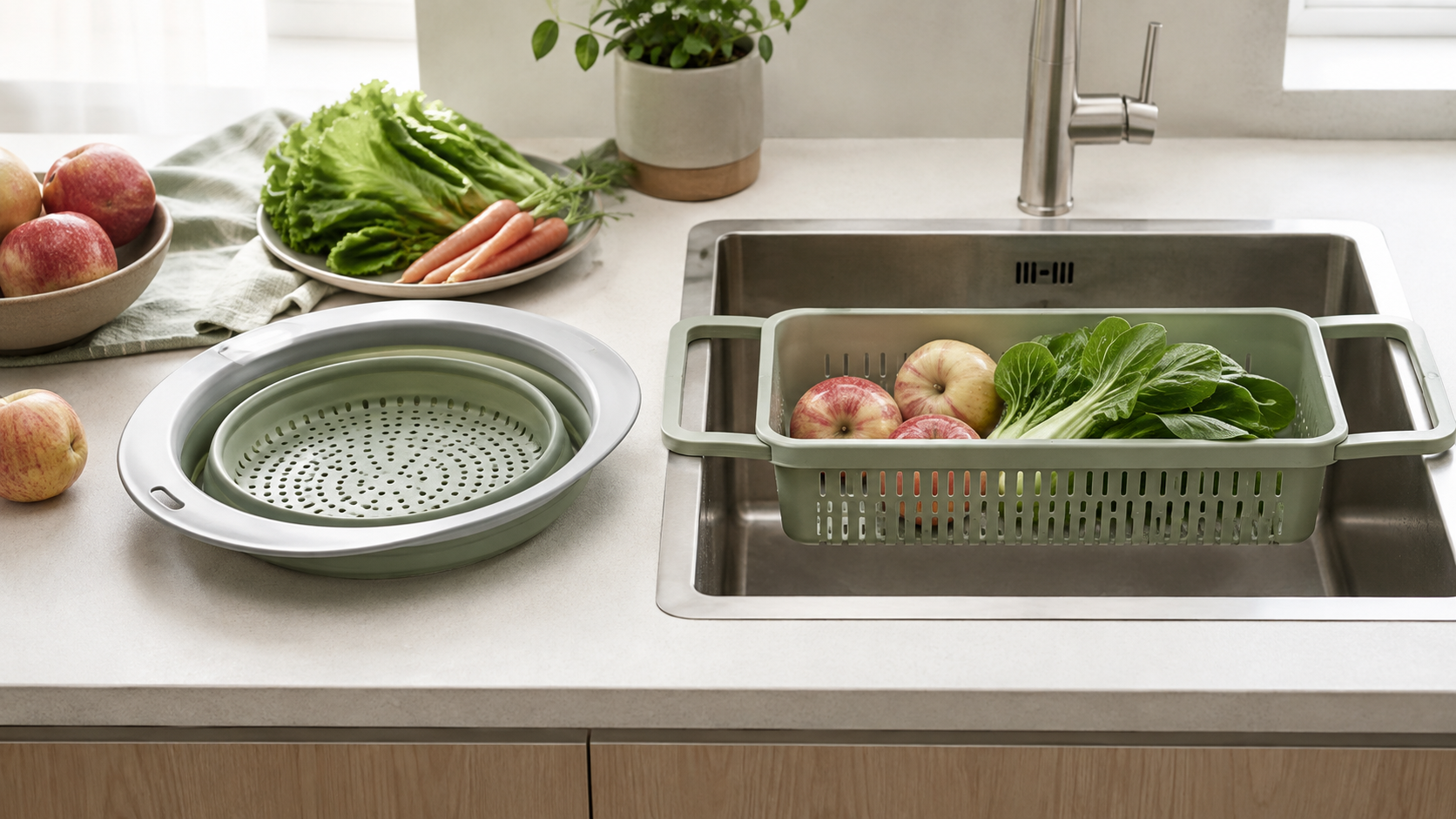
A collapsible colander saves cabinet height and can move from sink to counter. A produce wash basket uses the sink rim or basin for support and can keep food above the drain. In a small kitchen, the better choice depends on exact sink geometry, the amount you rinse, how you drain it, and where the tool will dry and live afterward.
As an Amazon Associate, GoodWeighFinds earns from qualifying purchases.
The quick decision
- Choose a collapsible colander when you need a freestanding tool, often drain pasta or other foods away from this sink, and have shallow storage but enough room for folds to dry fully.
- Choose a produce wash basket when the sink has reliable support edges, counter space is scarce during rinsing, and an over-sink position keeps the basin and drain usable.
- Keep what you own when a standard colander or bowl-and-strainer routine already fits without crowding the sink.
- Skip both when neither can sit securely in your measured sink or the extra seams and holes would make cleanup harder than the current method.
What is actually different?
A collapsible colander is defined by flexible walls that compress for storage. Most stand in the sink or on a stable counter when open, so their fit depends on base diameter, open rim diameter, and full depth. The folds create the storage advantage, but they also add surfaces that need cleaning and drying.
A produce wash basket is usually rigid or semi-rigid and may extend across the sink or nest inside it. Its useful fit depends on the complete outside span, the length of each support area, basket depth, faucet clearance, and whether the drain remains accessible. “Over sink” is not a universal size.
Measure the sink before comparing listings
Measure the basin opening left to right and front to back, the rim width available for support, the depth to the drain, and the faucet's position and sweep. Note a divider, rounded corner, raised lip, sprayer hose, or countertop edge that could interrupt support. Compare those measurements with the product's complete dimensions—not only its stated capacity.
For an extending basket, check both its shortest and longest stated span and how much handle remains supported at your sink width. For a freestanding colander, check the base against the flat area of the basin and confirm that the open rim will not interfere with the faucet.
Compare the working tradeoffs
- Support: A freestanding base depends on a flat surface; an over-sink basket depends on adequate rim contact. Neither format should wobble in the intended position.
- Drainage: Compare hole size and placement, base clearance, and whether water can leave without collecting around food. Do not treat a dense hole pattern as proof of better rinsing.
- Capacity: Use the foods and batch sizes you actually handle. Large dimensions can crowd a small faucet or leave too little sink access.
- Handling: Check where hands go when the tool is wet and loaded. Flexible walls, telescoping handles, and narrow grips create different lifting jobs.
- Counter use: A colander may stand on a counter if its base is designed for it. A sink basket may need a tray or bowl underneath once removed.
- Storage: Measure collapsed height for the colander and full rigid footprint for the basket, including handles that do not retract.
- Cleaning: Inspect folds, sliding handle channels, feet, rims, and perforations for areas that are difficult to reach and dry.
Run a no-cost fit test
Mark the listing's full outline on cardboard or folded paper. Place it where the tool would sit, then turn and move the faucet, reach the drain, and set a bowl or dish in the remaining sink space. For an extending basket, mark the claimed support points rather than assuming the entire handle rests on the rim.
Next, collect the amount of produce you normally rinse at once in a bowl you own. Compare that volume with the mock-up and consider how the loaded tool would move to the counter. This simple test can reveal that a smaller standard strainer already solves the job.
Setup and maintenance
When a tool arrives, compare it with the listing and your measurements before use. Open or extend it fully, place it empty in the intended position, and check that every support point makes stable contact. Follow the maker's care and temperature directions; flexible construction does not establish heat tolerance, and a produce basket is not automatically suitable for hot foods.
Wash and dry every fold, channel, foot, rim, and handle area according to the instructions. Store it only after those areas are dry. Replace or stop using a tool when flexible walls split, supports deform, handles no longer lock as intended, or rough damage makes cleaning impractical.
Claims and assumptions to reject
Neither format removes pathogens, pesticides, waxes, or contaminants merely because a listing calls it a produce washer. The tool holds and drains food; it does not establish a food-safety outcome. Follow current food-handling guidance relevant to the food instead of relying on marketing language.
Also treat “space-saving,” “universal sink fit,” “non-slip,” “dishwasher safe,” and capacity claims as model-specific statements to verify. Product photos can hide support overhang, faucet interference, and the true stored footprint.
Who should skip which format?
Skip a collapsible colander when the folds are difficult for you to expand, scrub, or inspect; the open base is unstable in the sink; or it would be stored damp in a tightly closed cabinet. Skip an over-sink basket when the sink rim is narrow or uneven, the faucet blocks the basket, extending parts have too little support, or you need a vessel that stands independently after draining.
Skip a new purchase entirely when the task is occasional, a standard strainer already fits, or a bowl and existing colander handle the routine without extra clutter.
Related decisions
If a folding format already fits, use the collapsible colander guide to compare open and stored dimensions, stability, handles, holes, cleaning, and stated limits. If the sink-supported format fits instead, compare produce wash baskets by supported span, basket depth, faucet clearance, drainage, cleaning, and storage. If drying leafy greens rather than rinsing over the sink is the bottleneck, compare salad spinners for small kitchens. For a work surface that spans the sink, use the separate over-sink cutting board guide.
This comparison supports the routine-support tools pillar: choose ordinary kitchen tools by the task and measured fit, not by body-result promises.
Bottom line
Choose the collapsible colander when freestanding versatility and shallow storage matter most. Choose the produce wash basket when your measured sink can support it securely and preserving counter space during rinsing is the real need. The cardboard fit test is more useful than a “universal” label, and keeping a workable tool is better than adding another one.