Buying guide
Best Salad Spinners for Small-Kitchen Meal Prep
A salad spinner can dry washed leafy produce faster than repeated towel handling, but its bowl, basket, and lid all demand space and cleaning. The useful choice is not the spinner with the biggest claim; it is the format whose measured capacity, mechanism, and stored footprint fit a recurring prep job.
Who this guide is for
This guide is for adults who regularly wash leafy greens or herbs and want a dedicated drying tool without giving up more cabinet and counter space than the task justifies. It covers manual bowl-and-basket spinners, not electric appliances, produce-storage systems, or claims that a tool changes the health value of food.
If the unresolved choice is active drying versus simple draining, start with the salad spinner versus colander comparison. For the broader decision, use the routine-support tools pillar. If you mainly need a general strainer, compare collapsible colanders for small kitchens. If storing washed produce is the actual problem, use the produce-container guide.
Best-fit formats, not unsupported winners
No spinner was purchased, timed, durability-tested, or ranked for this guide. These are formats to compare against your sink, hands, storage, and typical batch size.
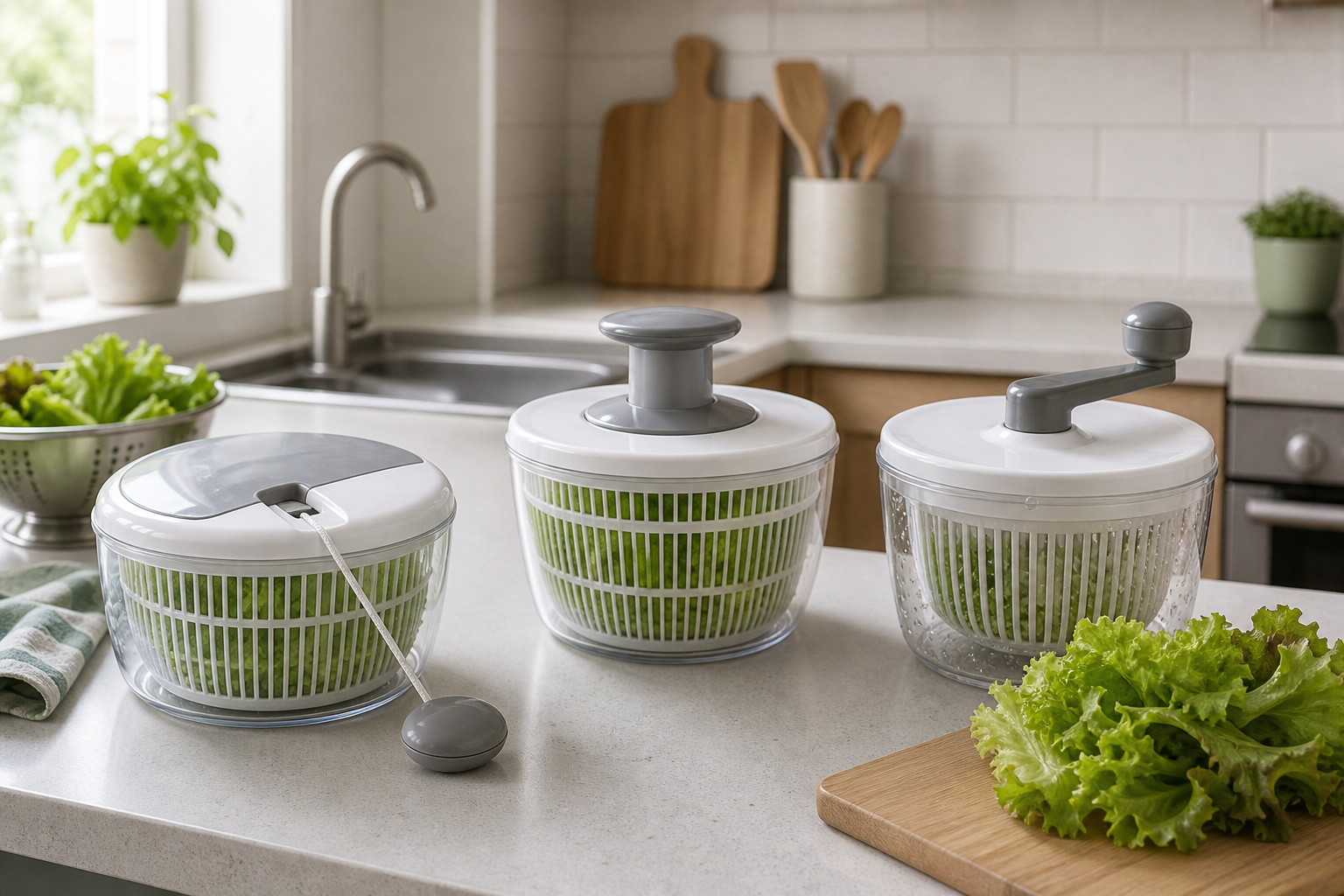
- Best format for low operating effort: A pump-top model with a broad button and a separate brake, provided the raised lid fits the intended shelf.
- Best format for a lower lid profile: A pull-cord model whose handle retracts fully and whose cord housing can be cleaned as directed.
- Best format for direct speed control: A hand-crank model with a grip and turning clearance that feel manageable.
- Best format for very limited storage: A genuinely compact spinner whose complete exterior dimensions fit a measured shelf—not merely a listing labeled “small.”
- Best format for multipurpose use: A removable basket and plain outer bowl that the maker identifies as suitable for separate draining or serving.
Selection criteria that matter
- Exterior dimensions: Check diameter and total lid height, including any knob, handle, or pump in its stored position.
- Usable capacity: Compare the basket's stated volume with the amount you normally wash. Overfilling can limit movement and drying.
- Mechanism: Pull cords, pumps, and cranks differ in hand motion, operating clearance, and the number of enclosed parts.
- Brake: A separate stop control can be convenient, but confirm how it works rather than assuming every top button is a brake.
- Base grip: Look for a broad, level base and documented nonslip features. Keep one hand available to steady the bowl if the directions call for it.
- Drainage: Inspect basket openings and whether water must be poured from the outer bowl between cycles.
- Cleaning access: Check whether the lid comes apart, whether water can collect in its mechanism, and which parts are labeled dishwasher-safe.
- Storage configuration: Verify whether the pump locks down, the crank folds, or the cord handle retracts, then measure the resulting height.
- Return terms: Mechanism comfort and cabinet fit are difficult to judge from photos, so verify the current seller and return path.
A simple comparison framework
Measure the available shelf, sink, and counter area, then note the typical amount of produce you wash. Mark each listing yes, no, or unclear:
- Do the full exterior diameter and stored height fit the measured cabinet?
- Does the basket capacity suit a normal batch without packing it tightly?
- Can the mechanism operate without hitting a wall, faucet, or upper cabinet?
- Is there a clearly described way to stop the basket?
- Are the basket, bowl, lid, and mechanism cleaning instructions specific?
- Can the lid and basket dry fully before storage?
- Would this replace repeated towel handling often enough to justify its space?
Use limits and practical handling
A spinner removes surface water through motion; it does not wash produce by itself, guarantee complete drying, preserve freshness for a stated number of days, or make damaged produce usable. Follow current food-handling guidance and the spinner maker's washing, load, operation, and care directions.
Use the spinner on a stable, level surface. Avoid forcing a jammed mechanism, spinning an overfilled basket, or lifting the bowl by its lid or operating handle unless the maker explicitly permits it. Let enclosed lid parts drain and dry as directed before storage.
Who should skip this purchase
Skip a salad spinner if you wash leafy produce only occasionally, already have a draining-and-towel routine that works, or cannot spare space for all three main pieces. A standard or collapsible colander may be more versatile when spinning is not a recurring need.
Also skip listings that omit full dimensions, care instructions, or mechanism details. If gripping, pulling, pressing, or cranking is uncomfortable, choose a format you can try and return—or use a simpler draining method rather than assuming a different mechanism will be accessible.
Bottom line
The best small-kitchen salad spinner is the one that handles your normal batch, operates within your available clearance, comes apart enough to clean and dry, and fits its measured storage spot. Compare those facts first; treat “compact,” “effortless,” and durability language as claims until the listing provides useful specifics.