X vs Y comparison
Salad Spinner vs Colander for Washing Leafy Greens
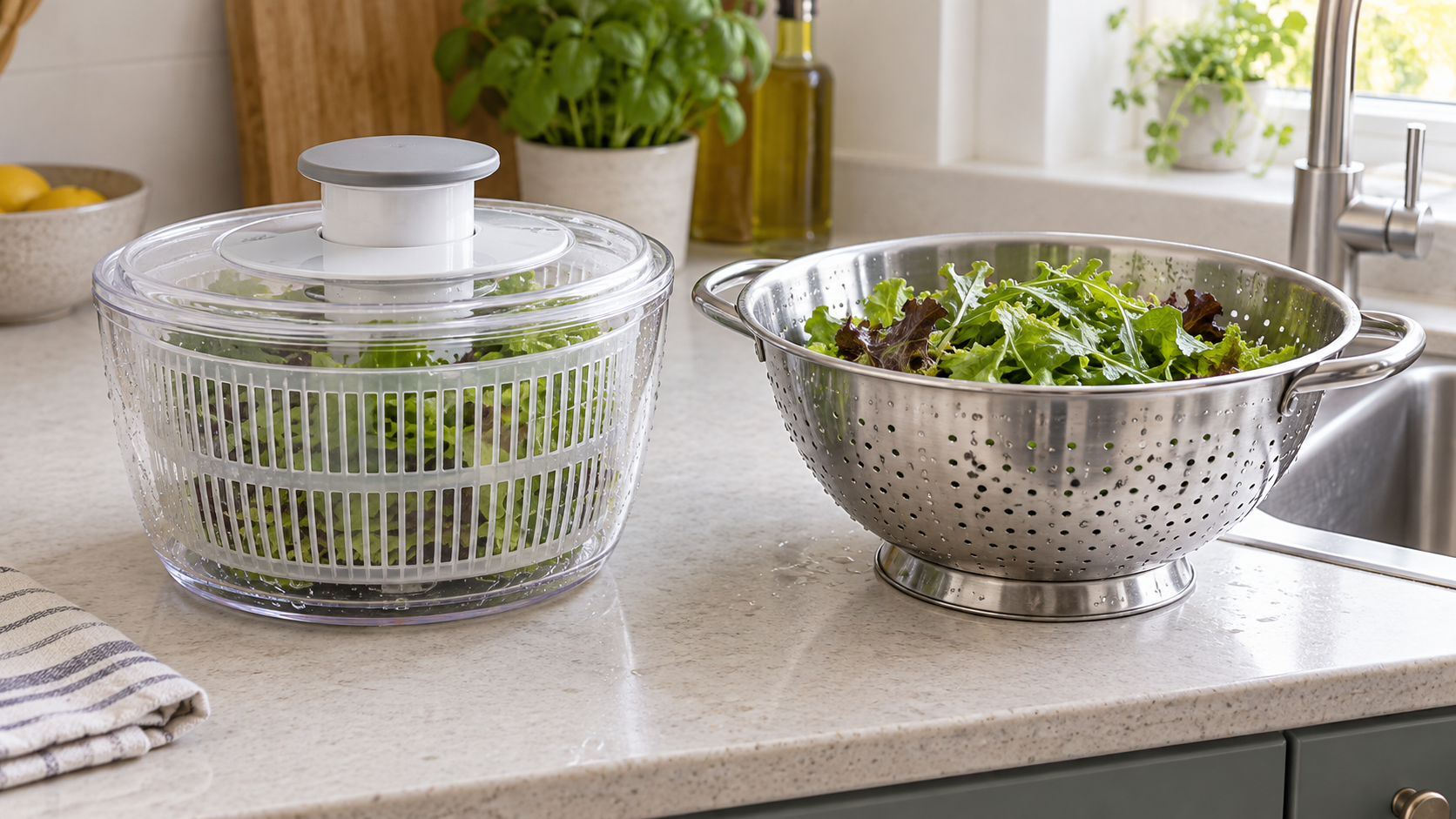
Both tools hold greens while water drains. A colander handles that basic job with fewer parts; a salad spinner adds a rotating basket to remove more surface water. The useful choice depends on whether drying is a repeated bottleneck and whether the spinner's full footprint and cleanup earn their space.
As an Amazon Associate, GoodWeighFinds earns from qualifying purchases.
The quick decision
- Choose a salad spinner when washed greens are a recurring job, surface water is the bottleneck, and there is room to operate, clean, dry, and store every part.
- Choose a colander when rinsing and basic draining are enough, you want one multipurpose tool, or space and cleanup time are limited.
- Keep what you own when a colander plus a clean towel already handles the usual batch.
- Skip both when neither fits securely or another tool already solves the task.
What each tool does
A colander supports food while water drains through perforations. It serves many kitchen jobs, but gravity does not actively spin water away. A salad spinner places a perforated basket inside a bowl and turns it with a crank, pump, cord, or similar mechanism. Rotation can remove more surface water, but it adds a lid, moving parts, operating clearance, and a larger item to maintain.
Neither tool sanitizes produce, guarantees freshness, changes nutrition, or causes weight loss. Follow current food-handling guidance for the food itself.
Who each option fits
A spinner fits someone who prepares leafy greens or herbs often enough to notice repeated towel handling or slow draining. It also requires a stable surface and a mechanism that is comfortable to operate. A colander fits a broader routine and has fewer parts to wash, dry, inspect, and store.
For occasional greens or a small household, compare the usual batch rather than advertised capacity. A large spinner can be underused while consuming substantial space; a modest colander may complete the actual job.
Tradeoffs to compare
- Water removal: A spinner actively moves water into the outer bowl. A colander drains freely but may leave more surface moisture; neither creates a freshness or safety guarantee.
- Footprint: Measure maximum diameter, lid height, handles, and operating clearance—not only stated capacity.
- Batch size: Compare usable basket dimensions with the greens normally prepared.
- Effort: Check whether the crank, pump, or cord motion is comfortable. A colander avoids the mechanism but may require another drying step.
- Versatility: A colander commonly serves more draining jobs. Assume secondary uses only when the maker describes them.
- Parts and cost: A spinner has more components that can jam, retain residue, or need replacement.
Setup and maintenance
Measure the sink, counter, cabinet shelf, and dishwasher rack if machine washing matters. Inspect the bowl, basket, lid, base, handles, and mechanism. Operate an empty spinner on a flat, dry surface. A colander should sit securely without blocking the drain unexpectedly.
After use, separate only maker-approved removable parts. Check perforations, basket rims, lid seams, cords, gears, feet, and handles for trapped residue and water. Let everything dry before nesting. Stop using cracked, rough, loose, or malfunctioning parts.
Run a no-buy test
Use the colander or strainer already in the kitchen for two normal sessions. Note the batch size, draining time, towel step, and whether wet greens actually disrupt the next task. Measure where a spinner would operate and dry, not just where it would be stored. If the existing workflow works, a spinner adds parts without solving a meaningful problem.
Skip criteria
Skip a spinner if its motion is uncomfortable, the lid is difficult to clean, parts cannot dry fully, or it displaces a more useful tool. Skip a colander if its base is unstable, the usual leaves escape through its holes, or handles interfere with the sink. Skip a purchase driven mainly by diet or weight-loss marketing; neither format determines what or how much a person should eat.
Next steps
If active drying solves the measured problem, use the salad spinner buying guide and check whether a spinner earns its space in a real week. If a multipurpose tool fits better, compare collapsible colanders. For the wider decision framework, see the routine-support tools pillar.
Bottom line
A salad spinner is the specialized water-removal tool; a colander is the simpler multipurpose drainer. Choose the spinner only when drying greens is a frequent, measured bottleneck and every part fits the workflow. Otherwise, a stable colander—or the tool already owned—is the calmer choice.