Buy, reuse, or skip
Is a Salad Spinner Worth It for Weekly Meal Prep?
A salad spinner can be worth buying when washing leafy greens is a repeat task, a normal batch fits the basket, and all three pieces have a realistic place to be cleaned, dried, and stored. It is usually not worth the cabinet space when a colander and clean towel already handle occasional prep without much friction.
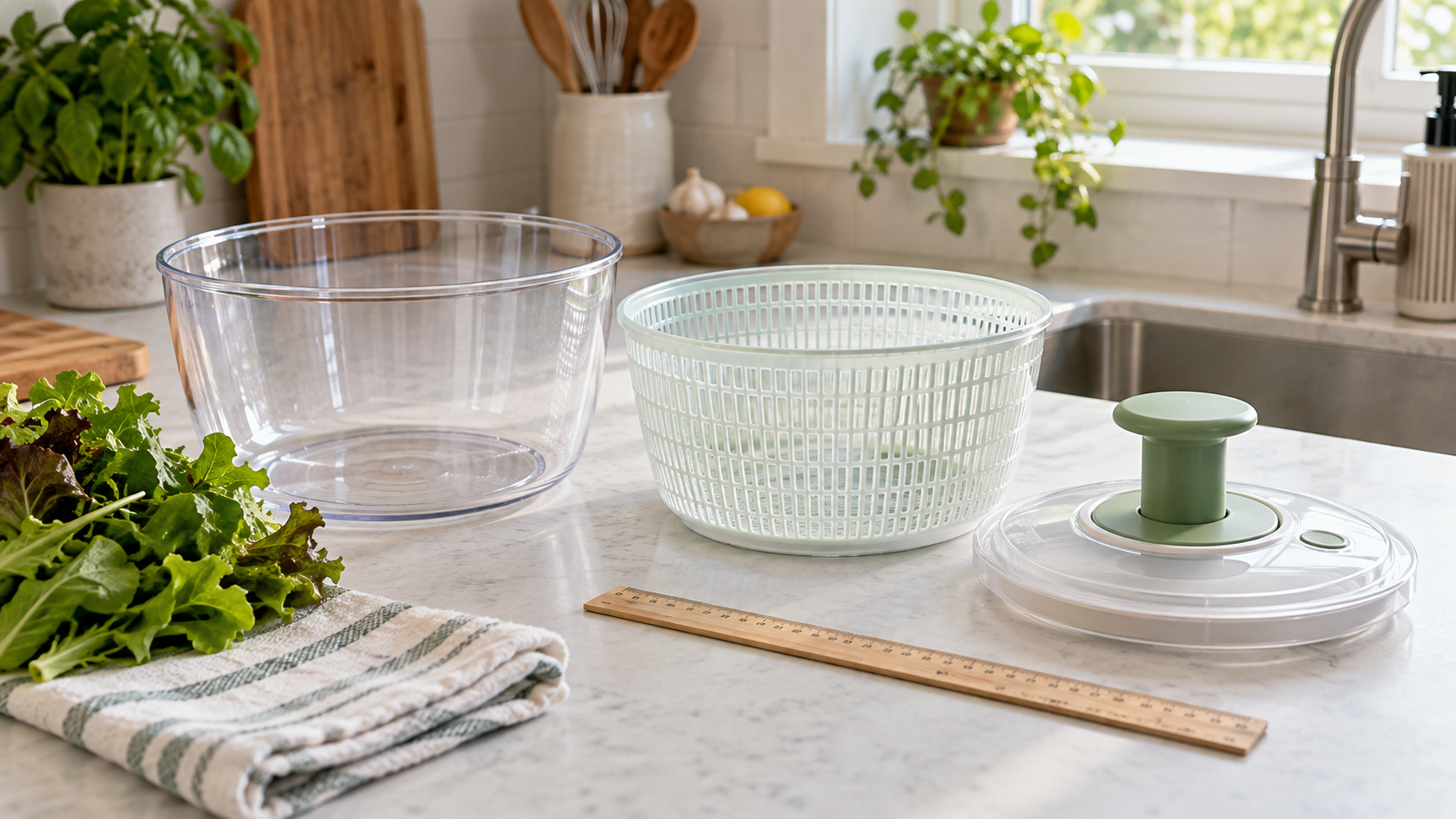
The quick answer
- Likely worth it: you prepare leafy greens most weeks, towel handling is a recurring nuisance, and a spinner that fits your usual batch also fits the sink, counter, and cabinet.
- Test first: track two or three prep sessions with your current colander and clean-towel method. Note the batch size, hands-on effort, towel use, cleanup, and space occupied.
- Probably skip it: leafy-green prep is occasional, storage is already tight, or the spinner would create more washing and drying work than it removes.
Run a one-week prep audit
Count actual prep sessions, not planned ones. For each session, note roughly how much leafy produce you handle at once and which part of the current process is inconvenient. A spinner only addresses surface-water removal; it does not replace washing, trimming, inspecting produce, or cleaning the tools afterward.
If the problem appears once a month, a dedicated bowl, basket, and lid may be hard to justify. If the same awkward towel-and-colander routine repeats several times a week, the tool has a clearer job.
Measure the spinner in every state
- Stored size: check the complete exterior diameter and height, including a crank, handle, or pump in its locked position.
- Operating clearance: allow room above and beside the lid to press, pull, or turn the mechanism without hitting a faucet, wall, or cabinet.
- Typical batch: compare the basket's stated capacity with what you actually prepare; the outer bowl's volume is not necessarily usable basket capacity.
- Sink and counter fit: confirm each piece can be washed and set down without taking over the workspace needed for the rest of prep.
- Drying footprint: the bowl, basket, and lid may need separate positions before storage, especially when the lid contains an enclosed mechanism.
Choose a mechanism you will maintain
Pump, pull-cord, and hand-crank designs use different motions and require different clearance. A listing may call any of them easy to use, but that is not proof the motion suits your hands or counter. Check how the basket is stopped and whether the control remains reachable while the bowl is steady.
The lid deserves special scrutiny. Look for specific maker instructions covering whether it can be immersed, separated, or placed in a dishwasher. Do not assume a dishwasher-safe bowl means the lid is treated the same way. If the mechanism cannot drain and dry in the space you have, that upkeep belongs in the purchase decision.
Compare the no-buy alternatives
A colander plus a clean towel may be enough for small or infrequent batches. It uses tools many kitchens already own, though it can require more counter area or towel handling. Letting produce drain in a colander takes less equipment but may not remove as much surface water in the same workflow. These are practical tradeoffs, not food-safety or freshness guarantees.
If a colander is the better fit, compare collapsible colanders for small kitchens by expanded stability, sink fit, drainage, cleaning, and storage. Follow current produce-handling guidance and the directions for whichever tools you use.
When to move from deciding to shopping
If the audit identifies a repeat task and the full tool fits, use the salad-spinner comparison guide to compare pump, pull-cord, hand-crank, and compact formats. Keep your measurements beside the listing and treat words such as “compact,” “effortless,” and “easy-clean” as seller or manufacturer claims until the specifications explain them.
Reasons to skip or delay
- Your current colander-and-towel routine works for the few batches you prepare.
- No cabinet can hold the assembled spinner without displacing more frequently used tools.
- The listing omits exterior dimensions, basket capacity, mechanism details, or separate care directions.
- You cannot give all pieces enough room to drain and dry before reassembly.
- The return path is unclear and you cannot judge the operating motion or fit from the listing.
Bottom line
A salad spinner is worth it when a real weekly pattern—not an aspirational routine—gives it a repeat surface-water-removal job and your measurements account for operation, washing, drying, and storage. Otherwise, keep the simpler tools you already use. For the wider buy-or-skip framework, see the routine-support tools guide.