Small-kitchen buying guide
Best Produce Wash Baskets for Small-Sink Meal Prep
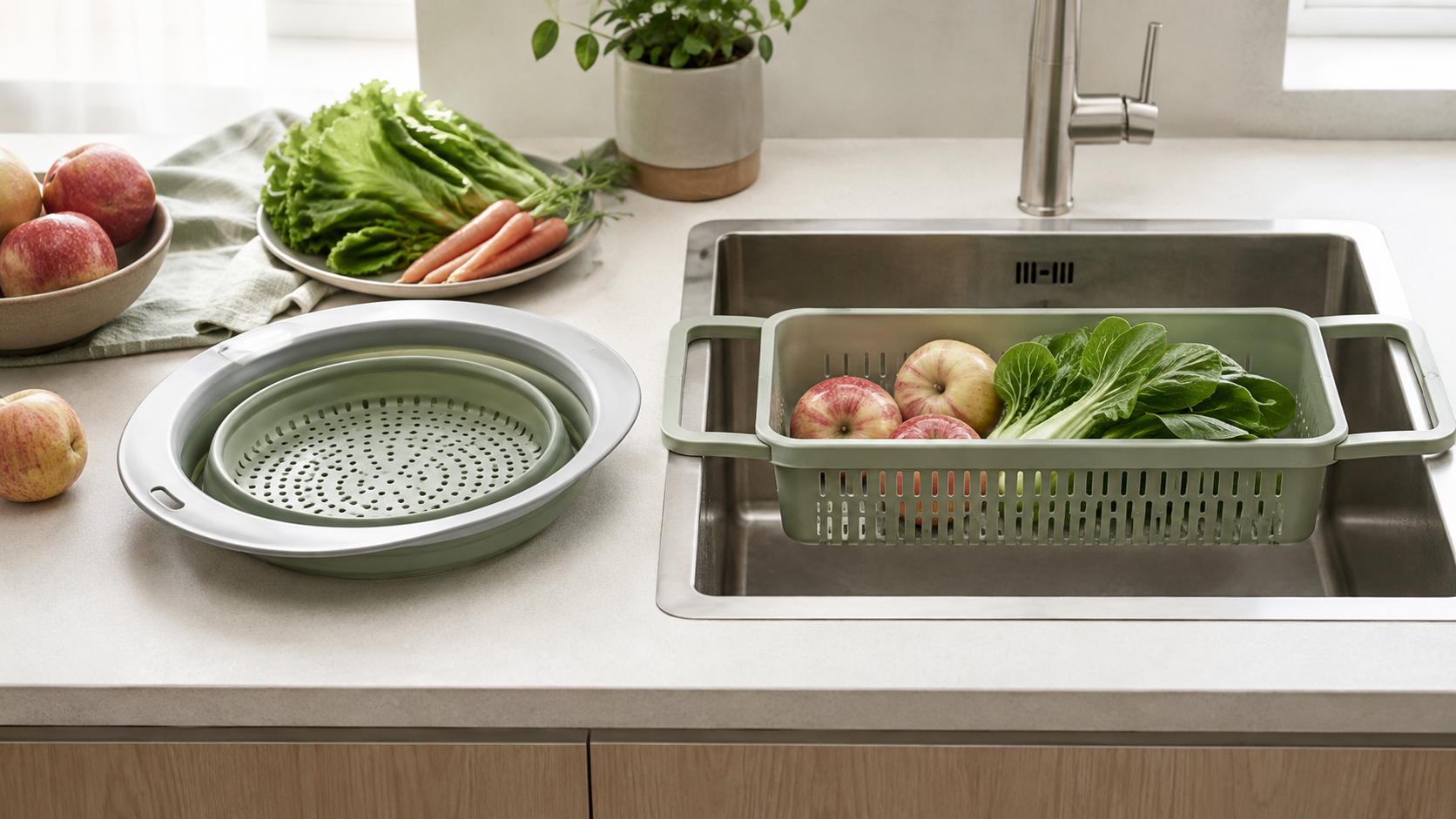
A produce wash basket can hold food above the drain and preserve some counter space, but only when its complete span, support points, depth, and faucet clearance match the sink. This guide compares useful basket formats and listing details without treating “produce washer” as a food-safety claim.
As an Amazon Associate, GoodWeighFinds earns from qualifying purchases.
Who this guide is for
This guide is for adults who regularly rinse fruit, vegetables, or herbs in a compact sink and want a basket supported by the sink rather than a freestanding bowl. It does not cover salad spinners, produce-storage containers, clip-on pot strainers, or devices claiming to remove contaminants.
For the format decision, first compare a collapsible colander with a produce wash basket. For a broader framework for ordinary kitchen helpers, use the routine-support tools guide.
Best-fit formats, not unsupported winners
- Best fit for an unusual sink width: An extending basket whose stated adjustment range includes the measured opening while leaving substantial support at both ends.
- Best fit for a known standard basin: A fixed-span basket that matches the sink measurements and avoids sliding channels that add cleaning work.
- Best fit for moving food to the counter: A basket with two full handles and a stable resting position away from the sink, if the maker shows and permits that use.
- Best fit for limited storage: A shallow or nesting basket whose complete stored footprint—including rigid handles—fits a measured cabinet or shelf.
Measure the whole sink setup
Measure the basin opening from left to right and front to back, plus the usable rim on each side. Note rounded corners, a raised lip, a sink divider, sprayer hose, drain position, and the faucet's reach and sweep. For an extending basket, compare both the shortest and longest stated span and calculate how much handle will rest on each support edge at your setting.
Then check basket depth against the distance to the sink bottom and drain. A deep basket may reduce usable basin room or sit where draining water collects. Product capacity does not establish sink fit.
Selection criteria that matter
- Supported span: Look beyond maximum width. The basket needs adequate contact at both ends at the exact setting you will use.
- Basket dimensions: Compare usable interior length, width, and depth with a normal batch rather than shopping for the largest label.
- Faucet clearance: Check whether the faucet can reach the basket and still move without striking the handles or food.
- Drainage: Review the location and size of openings and the clearance beneath the basket. More holes do not prove better rinsing.
- Handle design: Compare wet-hand grip, rigid versus sliding sections, end stops, and whether the handles create a secure lift point.
- Stability: Treat “non-slip” and “universal fit” as model-specific claims. Inspect the support shape and follow the maker's placement directions.
- Material and use limits: Confirm food-contact, temperature, and dishwasher statements for the exact model. Do not assume a produce basket is suitable for hot cookware or pasta.
- Cleaning and drying: Inspect perforations, sliding rails, feet, seams, and handle channels for places that could be difficult to reach and dry.
- Storage: Measure the complete rigid footprint. Extending handles may retract, but the basket itself usually does not collapse.
- Return terms: Verify the current seller, return window, and return-shipping terms before relying on fit claims.
Use a cardboard fit test before buying
Cut or fold cardboard to the listing's full outside dimensions. Mark the claimed support areas, place the template across the empty sink, and test faucet movement, access to the drain, and the remaining room for dishes or another bowl. This does not prove stability, but it can reject a clearly oversized format before purchase.
Next, place the amount of produce you usually rinse in a bowl of similar interior size. If the normal batch is much smaller, a standard strainer you already own may be easier to store and clean.
Setup and maintenance
On arrival, compare the product with the listing and your measurements before loading it. Place it empty in the intended position and confirm that each support point sits as the instructions describe. Do not load or lift it beyond the maker's stated directions, and do not rely on an extending mechanism that slips, binds, or has too little rim contact.
Wash and dry perforations, rails, feet, rims, and handles according to the care instructions. Stop using the basket if supports crack or deform, extending parts no longer hold their intended position, or damage leaves surfaces that cannot be cleaned as directed.
Claims this tool cannot establish
A perforated basket holds food while water passes through it. It does not by itself remove pathogens, pesticides, wax, or other contaminants, guarantee food safety, extend freshness, improve nutrition, control portions, or cause weight loss. Follow current food-handling guidance for the food rather than relying on “washer,” “cleaner,” or wellness language in a listing.
Who should skip a produce wash basket
Skip it when the sink rim is narrow or uneven, the faucet occupies the support area, the drain cannot remain clear, or the full basket would crowd the only basin. A collapsible colander may fit better when shallow cabinet storage matters and a stable freestanding base is available.
Also skip listings without complete dimensions, care directions, or a clear support design. Keep the strainer you already own when the task is occasional or the new basket would add more cleaning and storage friction than it removes.
Bottom line
The best produce wash basket for a small sink is the one whose full span, support contact, basket depth, faucet clearance, drainage, and stored footprint all fit measured space. Start with the sink, reject “universal” language without dimensions, and choose no new tool when an existing strainer already handles the job.