Routine-support buying guide
Best Cutting Boards for Batch-Cooking Prep in Small Kitchens
In a small kitchen, the useful cutting board is not automatically the smallest one. It needs enough stable work area for repeated prep, a cleaning routine you can actually manage, and a storage position that does not take over the counter. This guide compares formats, not body results or unsupported “healthier eating” promises.
As an Amazon Associate, GoodWeighFinds earns from qualifying purchases.
Who this guide is for
This guide is for adults who prepare several meal components at once but have limited counter, sink, or cabinet space. It focuses on workspace and cleanup friction—not personalized diet advice. For the broader role of kitchen tools that support a routine without promising fat loss, start with the routine-support tools guide.
If storage visibility is the bigger obstacle, compare small-pantry lazy Susans. If cooking tasks overlap and timing is the problem, the meal-prep kitchen timer guide covers that separate decision.
Best-fit formats, not unsupported rankings
- Best fit for one main prep surface: A medium rigid board that fits between the sink and stove while leaving a safe landing area for bowls or ingredients.
- Best fit for simple cleanup: A plastic board explicitly labeled for the dishwasher you intend to use, provided its dimensions fit the rack without blocking the spray arm.
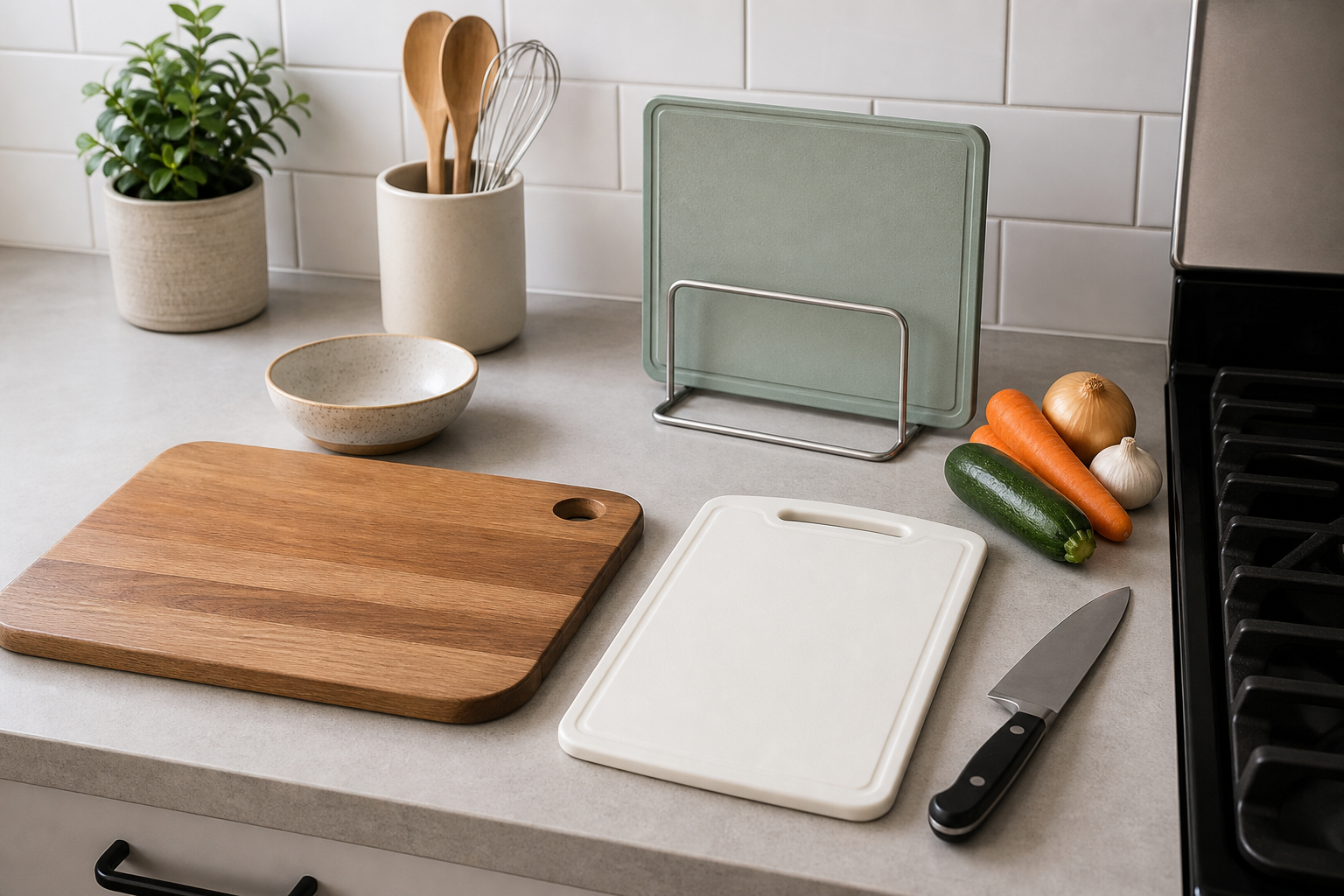
- Best fit for vertical storage: A thin rigid board or small set that stands securely in a ventilated rack without bowing or trapping moisture.
- Best fit for frequent hand washing: A board that fits flat in the sink and can be turned, rinsed, and dried without striking the faucet or surrounding dishes.
- Best fit for wet or juicy prep: A board with a useful perimeter groove only if the groove does not remove too much work area or make cleaning needlessly fiddly.
Selection criteria that matter
- Usable area: Measure the flat working surface inside handles, grooves, or raised edges—not only the exterior dimensions.
- Counter fit: Map the actual uninterrupted counter space and leave clearance from burners, sink edges, appliance doors, and crowded corners.
- Stability: Look for integrated nonslip feet or edges and follow the manufacturer’s use directions. Replace a warped board or one that rocks during cutting.
- Thickness and weight: A thicker board may feel steadier but can be harder to lift, wash, and store. A very thin board saves space but may flex or slide.
- Material care: Verify hand-wash, dishwasher, drying, oiling, and heat instructions for the exact product. Do not assume all wood or all plastic boards share the same care rules.
- Grooves and handles: Grooves can contain some liquid but reduce usable area; handles make lifting easier but may catch scraps and complicate wiping.
- Storage profile: Compare thickness, hanging-hole placement, rack clearance, and airflow. A damp stack is not useful compact storage.
- Replacement signals: Deep cuts, cracks, warping, loose layers, rough fibers, or surfaces that can no longer be cleaned are reasons to follow maker guidance and replace the board.
A practical comparison framework
Record the answers for each candidate before treating it as a good small-kitchen fit:
- What are the exterior dimensions, usable flat area, thickness, and empty weight?
- Does it fit the clear counter space without sitting over a burner, sink gap, or unstable edge?
- Will the board fit inside the sink or dishwasher position used for cleaning?
- Are the material and every care instruction stated for the exact model?
- Does the grip come from integrated feet or edges, and can those parts be cleaned and dried?
- Does a groove help the foods normally prepared, or merely shrink the work surface?
- Can the board dry fully and store without blocking the counter or bowing in a tight rack?
- Would it still be useful if it caused no change in weight or body measurements?
One large board or a small set?
One medium board usually gives more continuous work area and fewer pieces to wash. A compact set can help separate tasks or keep prep moving while one board is being cleaned, but only if every board has a real job and the set fits the drying and storage space. Color coding is an organizational cue, not evidence that a board cleans itself or prevents cross-contact.
Do not rely on listing phrases such as “antibacterial,” “knife safe,” or “dishwasher safe” without checking what the maker actually states for that model. Clean, handle, dry, and replace boards according to current food-safety guidance and the product instructions.
Who should skip this purchase
Skip a new board if the one you own is stable, cleanable, large enough, and easy to store. Skip a heavy wood board if lifting, hand washing, drying, or routine oiling would add more work than it removes. Skip a multi-board set if the extras will crowd the sink or remain stacked while damp.
A board that overhangs the counter, bridges an uneven surface, rocks, slides, or sits too close to an active burner is a poor fit regardless of reviews. Choose a smaller stable surface or change the prep location rather than accepting an unsafe setup.
Bottom line
The best cutting board for batch prep in a small kitchen is large enough for the repeated task, stable on the actual counter, manageable in the sink, and easy to dry and store. Measure the usable area and the storage slot, verify exact material-care directions, and buy one practical board before assuming a larger set will improve the routine.