Routine-support buying guide
How to Choose Divided Snack Containers for Work and Travel
A divided snack container can keep several small foods separate without taking the space of a full lunch box. The useful comparison is not how many compartments look impressive in a listing; it is whether the container fits the food, closes without mixing it, travels in the bag you already use, and gets fully clean afterward.
As an Amazon Associate, GoodWeighFinds earns from qualifying purchases.
Who this guide is for
This guide is for adults who want to carry two or more small foods in one compact rigid container for work, a commute, or ordinary travel. It focuses on storage and packing fit, not prescribed portions, calorie targets, or appetite control.
If you need space for a complete meal, start with the workday bento-box guide. If one food is enough and flexible storage fits better, compare a reusable snack bag with a small rigid container. The broader routine-support tools guide explains why practical fit matters more than diet branding.
Useful formats, not unsupported winners
- Fixed two-compartment box: A simpler format for two foods that benefit from crush protection. Fewer internal parts can make packing and cleanup easier.
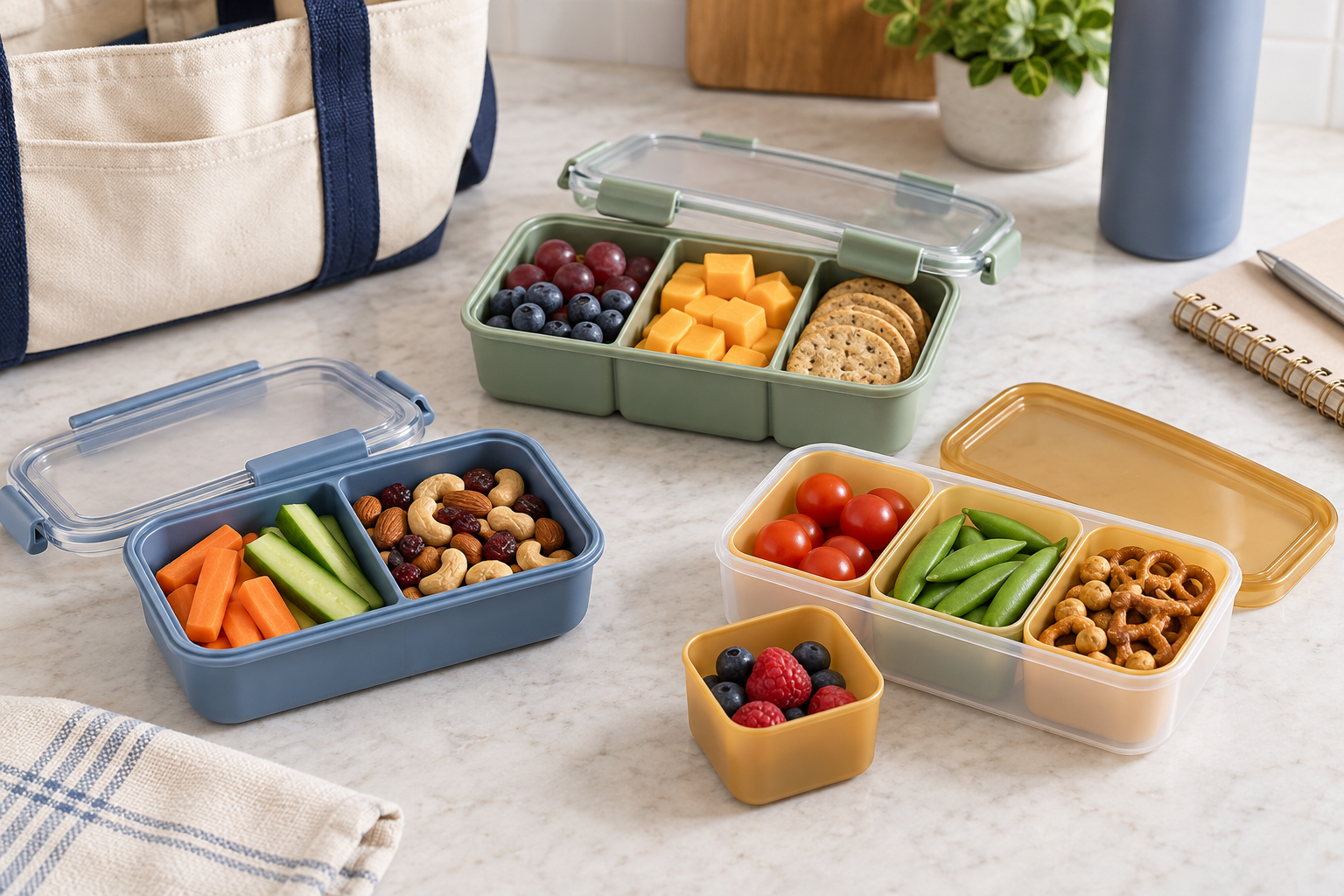
- Fixed three- or four-compartment box: Useful when several small foods recur, provided each compartment has enough usable width and depth for the actual food.
- Removable-cup system: Flexible when the combination changes, but every cup adds a piece to match, wash, dry, and store.
- Nested modular set: Worth comparing only when the exact sizes serve distinct routines and the empty pieces truly nest with lids accounted for.
Selection criteria that matter
- Usable capacity: Look for capacity and inside dimensions for each compartment. A large overall volume can hide narrow sections that do not fit the intended food.
- Between-compartment separation: Inspect whether the lid meets the divider walls. Treat claims that foods will not mix as product claims, especially when liquids or small pieces are involved.
- Whole-container closure: Compare latch placement, gasket access, hinge geometry, and the effort needed to close the box evenly. Do not infer leak resistance from a tight-looking lid.
- Packed dimensions: Measure the container with its lid and any outer shell, then check it against the lunch bag, tote, backpack, or carry-on space it must use.
- Empty and filled weight: A rigid box adds structure and mass. Include the usual food and any cold pack when judging carry comfort.
- Cleaning access: Corners, divider intersections, removable seals, and latch recesses should be reachable under the maker’s current cleaning instructions.
- Drying and storage: Count lids, cups, gaskets, and shells. Confirm where every piece will dry and whether the set nests without trapping moisture.
- Material and use labels: Verify the food-contact material and exact dishwasher, freezer, microwave, and temperature directions for the specific model. Broad category assumptions are not enough.
A five-minute fit check before ordering
- List the two or three foods the container would most often carry; do not choose by a staged listing photo alone.
- Measure the available flat space in the usual bag and note whether the container must stay upright.
- Use cups or small containers already at home to estimate the usable compartment volume you need.
- Decide whether fixed dividers or removable cups create the easier repeated washing routine.
- Check the current product page for exact dimensions, materials, care directions, included pieces, and return terms before buying.
Claims that need a closer look
“Leakproof” can refer to the outer lid without promising that one compartment will not seep into another. “Airtight,” “stain resistant,” “odor resistant,” and “unbreakable” also need conditions and model-specific support. Keep wet foods or dressings in a separately verified container unless the maker clearly documents the intended use.
Food storage safety depends on the food, time, starting temperature, transport conditions, cleanliness, and access to refrigeration—not the number of compartments. Follow current food-safety guidance and the container maker’s directions. Replace a box when damage, warping, a failing latch, a degraded seal, or residue prevents proper closure or cleaning.
Who should skip this purchase
Skip a divided box if an existing small container already protects the food, if the usual snack fits one reusable bag, or if the added partitions create more cleaning than value. A full bento box may be the better format when the container must hold a complete lunch; separate small containers may fit better when foods need different temperatures or handling.
Skip listings that omit usable dimensions, material details, care directions, or the number of included pieces. Also skip oversized sets until one measured format has proved useful in the actual bag and routine.
Bottom line
A good divided snack container is compact enough for the real bag, large enough for the foods it will carry, and simple enough to close, wash, dry, and store repeatedly. Choose the compartment layout from a measured routine, verify every model-specific claim, and keep the no-buy option on the table.