Freezer organization buying guide
Best Freezer Bin Dividers for Upright Meal-Prep Storage
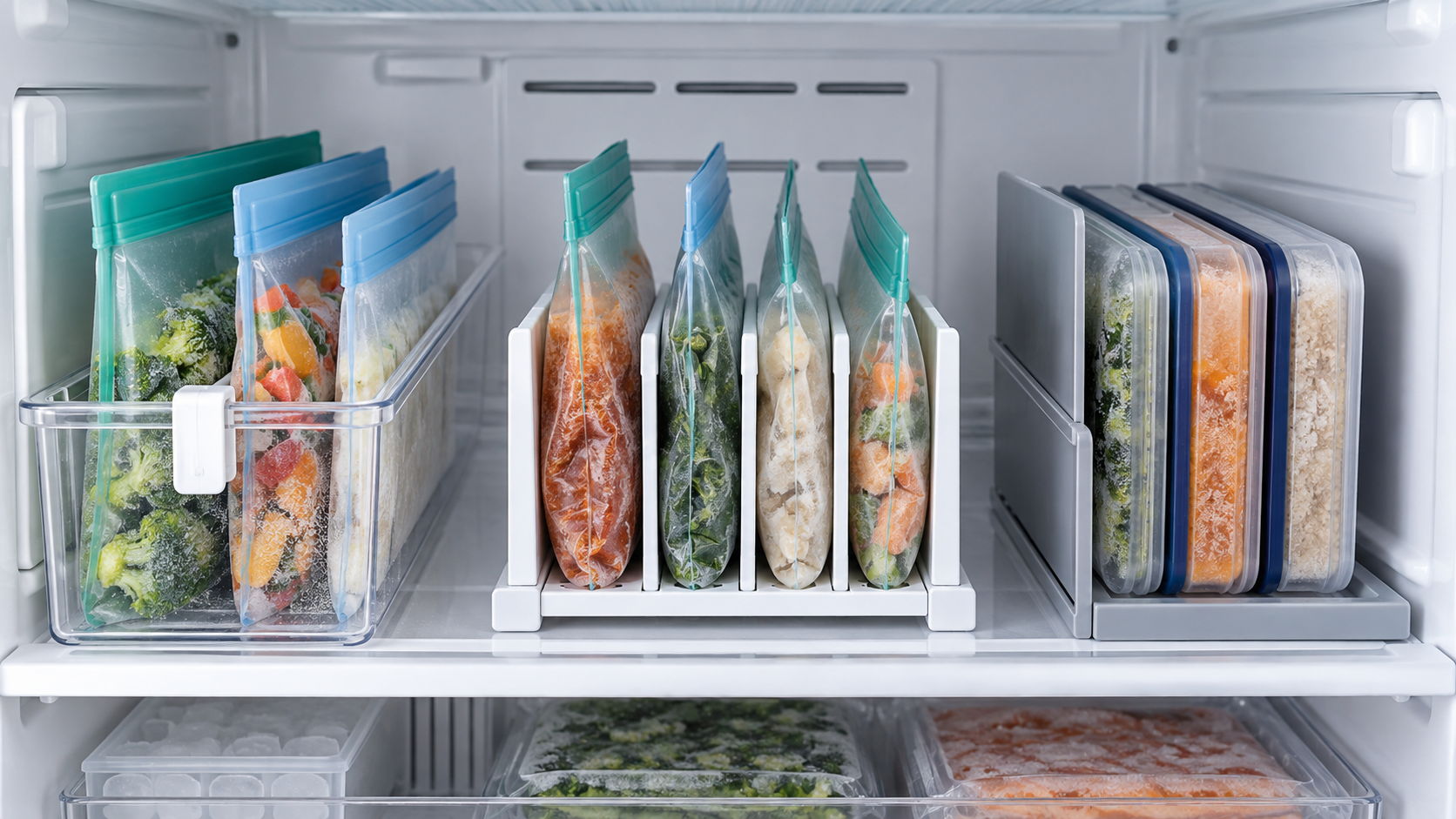
The best freezer divider is the format that fits the exact shelf or bin, supports the package shapes you store repeatedly, and still lets you remove one item without collapsing the lane. Compare the attachment and full footprint—not a seller's promise of “more space.”
As an Amazon Associate, GoodWeighFinds earns from qualifying purchases.
Who this guide is for
This guide is for adults who have already identified a repeat upright-storage problem: reusable freezer bags, slim packets, or narrow containers slump after one item is removed. If you are still deciding whether a divider is useful at all, start with the freezer-divider worth-it test. If you might prefer moving a whole group, compare a divider with a stackable bin.
Quick comparison of divider formats
| Format | Best fit | Main check | Reason to skip |
|---|---|---|---|
| Clip-on panel | A compatible bin or shelf edge | Clip opening, edge thickness, and panel depth | No compatible edge or the clip blocks removal |
| Freestanding adjustable panel | Changing lanes on a flat shelf or bin floor | Full base footprint and adjustment method | The feet consume the narrow lane you need |
| Tension-style divider | A measured span between compatible walls | Adjustment range and maker-approved surfaces | Pressure could flex a bin or appliance part |
| Divided rack or bin insert | Repeat bags or packets of similar width | Slot width, loaded height, and lift-out path | Your package sizes change often |
Measure the freezer before comparing listings
Measure usable width, depth, and height around rails, lips, vents, controls, hinges, drawer paths, and the closed door. Then measure several recurring packages when filled—not an empty bag laid flat. Include the hand clearance needed to lift an item over a panel.
- For clips: record the exact wall or shelf-edge thickness and any rim that changes the grip.
- For freestanding models: count the base and feet in the usable footprint.
- For adjustable formats: check both ends of the listed range against the actual lane widths you need.
- For inserts: compare internal slot width as well as overall exterior dimensions.
- For every format: keep required appliance airflow and door clearance unobstructed.
Selection criteria that matter
Attachment compatibility
A divider is only useful when its mounting method matches the surface the maker names. Do not assume a clip shown on one clear bin fits every shelf, rail, or drawer. Avoid forcing an attachment or using tension against an appliance wall unless both product and appliance instructions allow it.
Support after one package leaves
Look at where the panels contact the package and what happens as the lane empties. A very wide lane may still let bags slump; a narrow fixed slot may reject fuller packages. Compare the range of shapes you actually freeze rather than buying for a staged listing photo.
Low-temperature labeling and care
Use the maker's explicit freezer-use wording and temperature or care limits when provided. “Kitchen organizer” does not automatically mean freezer-suitable. Check whether the divider must return to room temperature before adjustment or washing and whether seams, clips, or feet can be reached for cleaning.
Retrieval and visibility
A tall panel may support a bag but hide a low label or require extra lift clearance. A low panel uses less vertical space but may not support a tall flexible package. Choose around the label position and the motion you use to retrieve food.
Test the layout before buying
Use freezer-safe containers you already own as temporary boundaries for a few normal retrievals. Do not leave cardboard or improvised materials not intended for freezer use in long-term cold storage. If the packages remain visible and upright only while the shelf is full, test what happens after removing the middle item. That empty-lane behavior is more useful than a tidy one-time arrangement.
Who should skip a freezer divider
- Your freezer mostly holds bulky boxes or rigid containers that already stand independently.
- The package mix changes too often for stable lanes.
- Labels, an inventory board, or grouping items you already own fixes the visibility problem.
- The measured divider would obstruct a vent, sensor, drawer, door seal, or removal path.
- The listing does not identify complete dimensions, attachment compatibility, freezer use, or care instructions clearly enough to verify fit.
Claims to treat cautiously
A divider can separate items; it cannot create freezer volume, extend freshness, prevent freezer burn, or verify food safety. “Universal fit,” “unbreakable,” and exact capacity claims need specific dimensions and conditions before they are useful. Customer comments may reveal recurring fit complaints, but they are not proof of durability or suitability for your appliance.
Bottom line
Choose a clip-on panel only when the edge fit is explicit, a freestanding divider when its base leaves enough usable lane space, a tension format only when the permitted surfaces and range match, or a divided insert when recurring package widths are consistent. Measure the entire storage and retrieval sequence, verify current listing details, and skip the purchase when reorganizing solves the problem. This is a practical organization choice within the routine-support tools guide, not a weight-loss or food-preservation method.