Small-freezer storage comparison
Freezer Bin Divider vs Stackable Bin for Small Freezers
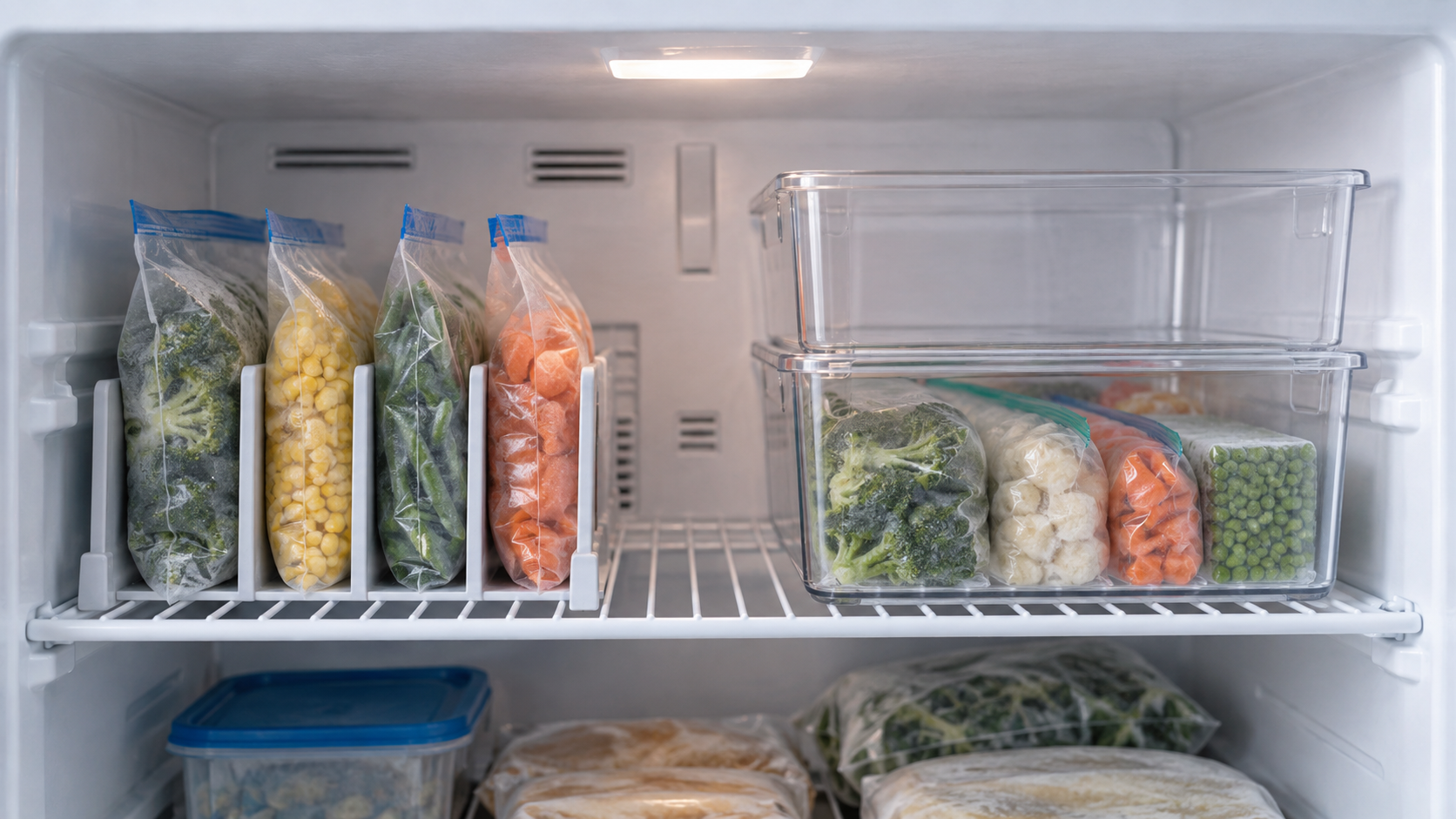
Choose an adjustable divider when slim packages need upright lanes and you want to reach each one in place. Choose a stackable bin when small items need to move as a group or usable vertical space matters more than immediate access to every item.
As an Amazon Associate, GoodWeighFinds earns from qualifying purchases.
The quick comparison
| Decision | Adjustable divider | Stackable bin |
|---|---|---|
| Access | Reach packages directly on the shelf | Lift or slide a grouped bin |
| Best package shape | Slim bags and packets stored upright | Small loose items or repeat categories |
| Vertical space | Usually leaves the area above items open | Can use a second level when listed stacking and clearance allow |
| Layout changes | Move a compatible adjustable divider | Regroup or move the entire container |
| Space used by organizer | Panels, feet, clips, or tension parts | Bin walls, base, handles, and stacking features |
| Main friction | Items may lean when a lane empties | Lower items may require unstacking |
Choose the retrieval motion first
A divider creates lanes on the existing shelf. That works when you want to see labels and pull one upright package without moving a larger group. A bin creates a removable zone. That works when several small items belong together and pulling the group forward is easier than reaching behind other food.
Neither format creates freezer capacity or extends food life. Both consume some interior space, and either can make access worse when it does not match the recurring package mix.
When a divider fits better
- Slim bags keep slumping: the same bag or packet shapes repeatedly need side support.
- Individual access matters: labels can face outward and one item can leave without lifting a loaded container.
- The shelf has little headroom: a tall bin or stacked pair would block removal or the door path.
- The attachment is compatible: the listed clip, foot, or adjustment range matches the exact shelf or existing bin.
- The mix changes gradually: moving one divider is enough to resize a lane.
When a stackable bin fits better
- Small items move together: a removable group prevents loose packages from disappearing at the back.
- Vertical clearance is genuinely unused: the listed stacked height still leaves enough room to grip, lift, and unstack safely.
- The shelf is awkward to divide: rails, lips, or wire spacing do not suit the divider's stated attachment method.
- Spills need containment: a solid bin can be removed for cleaning, though no organizer replaces appropriate food packaging.
- The loaded lift is manageable: you can remove the bin without twisting, overreaching, or unloading the whole freezer.
Measure the full storage sequence
Measure usable width, depth, and height around rails, vents, controls, drawer paths, hinges, and the closed door. Then measure the packages that recur, not a one-off grocery load. For dividers, include the base, clips, panel thickness, adjustment range, and height needed to lift an item out. For bins, include handles, flared rims, stacking feet, lid if used, and the hand clearance needed to remove the lower bin.
Check the appliance manual before placing anything near an airflow opening or sensor. The organizer should not flex a shelf, interfere with a drawer, press against a control, or prevent the door from sealing.
Test both layouts without buying
Use freezer-safe containers you already own to mock up the two motions for a few normal retrievals. First, arrange upright packages between existing rigid items to simulate lanes. Then place one repeat category in an existing shallow bin and practice pulling the group forward. Do not leave improvised cardboard or materials not intended for freezer use in long-term cold storage.
Notice what happens after one item leaves. If the lane collapses, adjustable side support may help. If the remaining small packages still scatter, containment may help. If neither test improves visibility, labels or a simple inventory may address the real problem better than another organizer.
Listing details to verify
- Are complete exterior, interior, and stacked dimensions stated?
- Does the maker identify the product for freezer use and provide temperature or care limits?
- For a divider, what surfaces and thicknesses does the attachment fit?
- For bins, are stacking instructions, maximum load guidance, handles, and removal clearance explained?
- Can the organizer and freezer shelf be cleaned according to their respective directions?
- Are stability, capacity, and durability statements specific enough to check, or merely sales language?
- Do the seller and return terms allow a realistic fit check without assuming current availability?
When to skip both
Skip a new organizer when grouping, labeling, or using an existing container fixes the shelf. A divider is a poor fit for mostly bulky rigid boxes; a stackable bin is a poor fit when every item needs direct access or the loaded lift is awkward. Avoid buying a matched system for a package mix that changes too often to keep its zones useful.
Continue with the narrower guides
If upright lanes won, use the freezer-divider worth-it test to examine attachment, adjustment, and simpler alternatives. If the issue is identifying food rather than containing it, compare freezer labels with an inventory board. For food containers rather than organizer bins, use the freezer-container buying guide.
Bottom line
A divider is the lower-motion choice for upright, individually accessed packages. A stackable bin is the stronger grouping choice when a measured lift-out zone and usable vertical clearance fit the freezer. Test the retrieval motion, measure the complete organizer, and choose only the format that fixes the recurring shelf problem. This is an organization decision within the routine-support tools guide, not a weight-loss method.