Routine-support buying guide
Best Kitchen Scissors for Meal-Prep Tasks
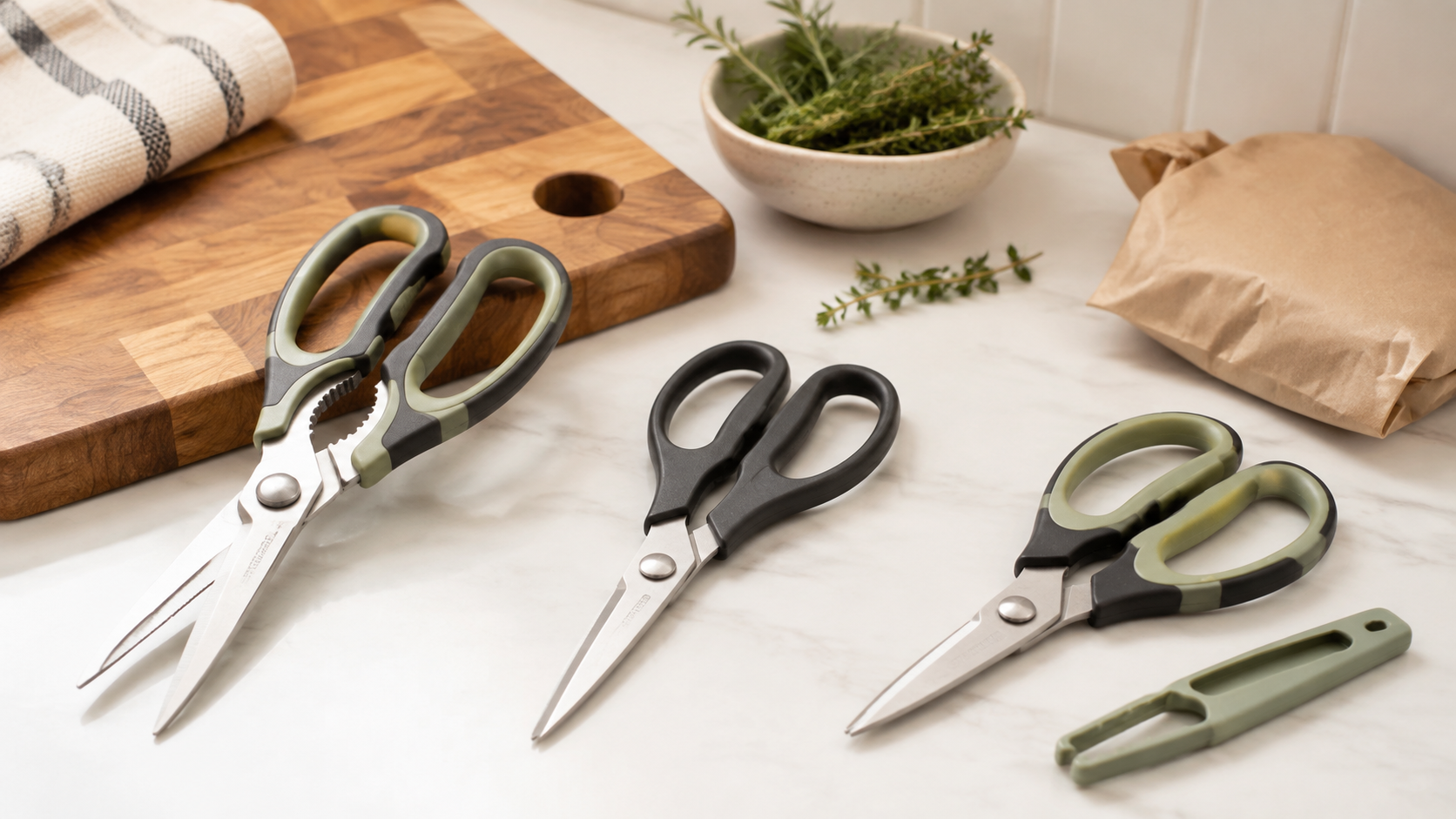
Kitchen scissors can trim herbs, open food packages, and handle other ordinary prep jobs without turning every task into knife work. The useful choice is the pair that fits your recurring jobs, hand position, cleaning routine, and storage—not the one with the longest accessory list.
As an Amazon Associate, GoodWeighFinds earns from qualifying purchases.
Who this guide is for
This guide is for adults who want one washable cutting tool for repeat kitchen tasks such as opening sealed food packages or trimming herbs. Kitchen scissors are a workflow tool; they do not change a meal's nutritional value or create a weight-loss result.
Start with the routine-support tools guide for the broader buy-or-skip framework. If your recurring task is moving chopped food rather than cutting it, compare bench scrapers. For board fit and upkeep, use the small-kitchen cutting-board guide.
Useful formats—not universal winners
- Take-apart shears: The halves separate for access around the pivot. Confirm how they release, whether they remain stable during normal use, and the maker's reassembly and cleaning directions.
- Fixed-pivot scissors: A permanent pivot can feel familiar and avoids loose halves, but residue may be harder to reach. Inspect the pivot area and care instructions.
- Symmetrical handles: Similar loops may suit either orientation, though a listing should explicitly state whether the tool is designed for left- and right-handed use.
- Shaped or offset handles: Larger or angled loops can change leverage and clearance. Use stated dimensions and return terms because photos cannot establish comfort.
- Covered blades: A fitted cover can reduce exposed-edge contact in storage. Check whether it stays attached and can be cleaned and dried separately.
Selection criteria that matter
- Intended tasks: Choose from the maker's stated uses. Do not assume general kitchen scissors are designed for bones, frozen food, wire, thick packaging, or other high-force jobs.
- Blade length and construction: Compare usable cutting length, edge style, blade material, and any serration. “Stainless” does not mean maintenance-free or rustproof.
- Handle fit: Check loop dimensions, orientation, texture, and clearance. Product photos do not show how a grip will fit every hand.
- Take-apart mechanism: Confirm the opening angle or release method and whether separating blades could happen during the motion you use.
- Pivot and seams: Food residue and moisture can collect around joints. Look for clear access and drying instructions.
- Cleaning guidance: Follow the current hand-wash or dishwasher label. A dishwasher claim does not remove the need to dry the pivot and blades as directed.
- Sharpening: Check whether the maker provides sharpening guidance or service. Serrated and micro-serrated edges may need a different method from plain blades.
- Storage: Compare total length, hanging holes, blade cover, and how the closed pair sits in a drawer without hiding an exposed point.
- Returns and warranty: Confirm current terms before use if grip, separation, or blade alignment cannot be evaluated from the listing.
A quick fit check before buying
Name two or three jobs you actually repeat, then check the tool against those jobs rather than buying for hypothetical versatility:
- Does the manufacturer list those uses and exclude any you need?
- Are blade length, handle dimensions, material, and pivot design clearly stated?
- Can the pivot and both blade faces be reached for cleaning?
- Will the scissors dry fully and store with the cutting edges protected?
- Are use, cleaning, sharpening, and warranty directions available?
- Can you return the pair if the grip or orientation is a poor fit?
Claims and practical limits
“Professional,” “heavy duty,” “razor sharp,” “ergonomic,” “rustproof,” and “dishwasher safe” are claims to verify, not proof of fit. Blade geometry, pivot tension, handle dimensions, detergents, moisture, sharpening, and the material being cut all affect real use.
Keep fingers clear of the blades, cut away from the supporting hand, and use the scissors only for documented tasks. Wash them after food contact according to the maker's directions, dry the pivot and blades, and store them closed. Retire a pair that is loose, damaged, misaligned, or cannot be cleaned adequately.
Who should skip this purchase
Skip new kitchen scissors if a clean, sound pair already handles the jobs you repeat. Skip feature-heavy models when the listing omits blade dimensions, task exclusions, cleaning instructions, or replacement and warranty information.
Kitchen scissors are also a poor workaround for a slipping board, cluttered counter, or a task that needs a purpose-built tool. Fix the work setup first; the drawer-divider guide may help when safe storage is the main constraint.
Bottom line
The best-fit kitchen scissors match documented prep tasks, fit your preferred hand orientation, expose the pivot and blades for realistic cleaning, and come with clear care, sharpening, storage, and return guidance. Buy for those details—not “professional” language or an accessory count.