Measured-fit lunch organization guide
Best Lunch-Bag Dividers for Upright Containers
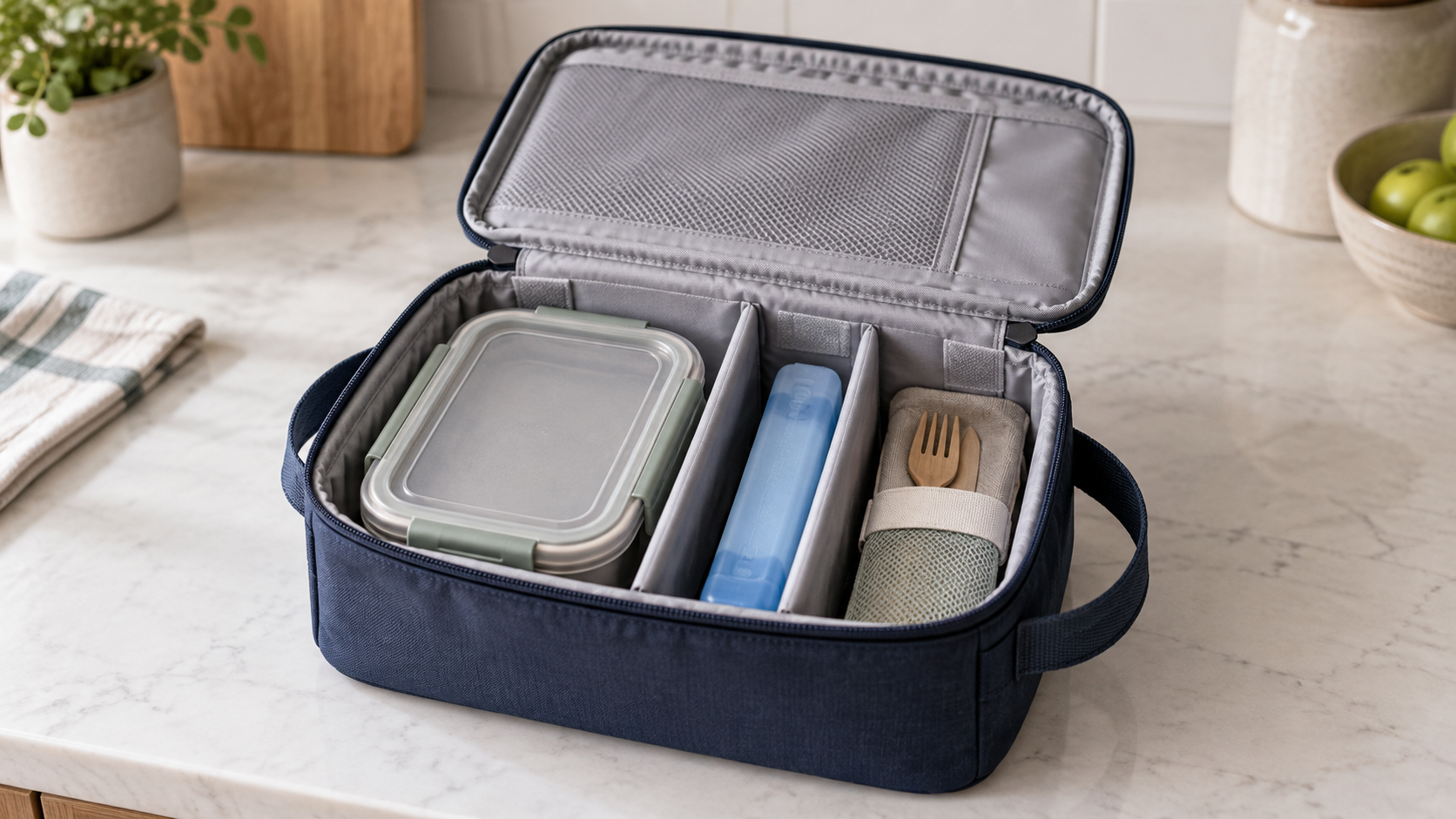
A divider can reserve a lane for an upright container, cold pack, or utensil pouch—but only when its dimensions and attachment match the loaded interior of a bag you already own. This guide compares divider formats, not named winners, and treats “universal,” leakproof, and temperature-control language cautiously.
As an Amazon Associate, GoodWeighFinds earns from qualifying purchases.
Who this guide is for
This page is for adults whose existing lunch bag has enough total room but lets a closed upright container, slim cold pack, and small accessories crowd one another. It begins after you have decided that a divider is the likely format. If you are still deciding whether an organizer earns space at all, use the lunch-bag divider worth-it test. If flexible grouping may suit a changing load, compare a divider with separate pouches.
This support guide maps to the broader insulated lunch-bag pillar.
Useful divider formats—not ranked winners
| Format | Check first | Main tradeoff |
|---|---|---|
| Hook-and-loop panel | Matching attachment surface, panel height, and usable width | Adjustable only where the bag provides compatible anchor points |
| Freestanding rigid panel | Loaded base fit and whether surrounding items hold it in place | Simple to remove, but it may shift or consume useful width |
| Adjustable insert grid | Complete insert dimensions, cell sizes, and closure clearance | Creates several zones but adds the most structure and bulk |
| Soft padded divider | Thickness under load, seam construction, and care label | May fold for storage but offers less consistent separation |
Selection criteria that matter
- Usable interior measurements: Measure inside length, width, and height with lining folds, seams, pockets, and the closed lid accounted for. Exterior bag dimensions and stated volume are not enough.
- Loaded container footprint: Measure the closed container at its widest points, including lid clips. Leave a realistic grip path so it can be removed without unloading the entire bag.
- Attachment compatibility: Check the exact hook-and-loop location, slots, snaps, or pressure-fit range. Do not treat “universal” as proof of fit.
- Divider height and rigidity: A very short or soft panel may not influence a tall item. A tall or stiff panel may meet the lid, pocket, or zipper.
- Lost capacity: Count panel thickness, padded edges, attachment tabs, and unused narrow spaces created by a fixed layout.
- Removal and cleaning: Look for explicit wipe, hand-wash, or machine-wash directions. Check whether a rigid core must stay dry and whether seams remain accessible.
- Current seller terms: Verify the seller, included pieces, dimensions, and return policy on the current listing before ordering.
A practical comparison framework
Draw the bag's usable base to scale or mark its dimensions on paper. Add the closed container, cold pack, bottle, and utensil pouch in their normal orientation. Then score each divider candidate yes, no, or unclear:
- Do the complete divider dimensions fit the loaded interior?
- Does its attachment method match the bag rather than merely its approximate size?
- Does the planned lane fit the upright container without pressing its lid or clips?
- Can the bag close without the divider meeting the lid, zipper, or top pocket?
- Can each item be lifted out without removing everything else?
- Are material and care instructions specific enough to follow?
- Can the divider be removed when the day's load changes?
- Is the seller's return route workable if measured fit is still uncertain?
What a divider does not establish
A divider organizes space. It does not make a container leakproof, keep it upright through every commute, preserve food temperature, repair damaged insulation, or add capacity. Use closed containers intended for the food being packed and appropriate cold packs or workplace refrigeration; follow the directions and food-handling limits for those products separately.
Claims such as “universal fit,” “waterproof,” “antimicrobial,” or “keeps food cold” need product-specific evidence and limits. A divider listing without measurements, attachment details, materials, and care instructions does not provide enough information for a fit-based choice.
Who should skip this purchase
- Skip it when rearranging the containers creates a stable, easy-to-access load.
- Skip it when the bag interior or divider cannot be measured.
- Skip it when the usual load changes so much that fixed lanes will often sit empty.
- Skip it when added panel thickness blocks the zipper, lid, or a useful pocket.
- Skip it when cleaning directions are vague or a rigid core cannot be inspected and dried as directed.
- Replace or repair the bag instead if its lining, zipper, insulation, or structure is damaged; a divider does not restore those functions.
Bottom line
The best-fit lunch-bag divider is the least bulky format whose complete measurements, attachment, height, and care instructions match a repeat loaded layout. Start with the bag and the closed containers, not the “universal” label. If the numbers or attachment do not line up, skip the accessory or choose a flexible pouch layout instead.