Everyday meal-prep buying guide
How to Choose Produce Brushes for Everyday Meal Prep
A dedicated produce brush can be useful when firm vegetables regularly arrive with visible soil and a brush suits the food's current preparation guidance. The best fit is not the brush with the strongest cleaning promise: it is a format whose stated use, bristle feel, grip, head shape, care, drying, and storage match the actual task.
As an Amazon Associate, GoodWeighFinds earns from qualifying purchases.
Who this guide is for
This guide is for adults deciding among simple manual brushes for recurring produce-prep tasks. It does not cover powered scrubbers, chemical washes, peeling tools, or products that claim to disinfect food, remove pesticides, or make food safe.
If holding and draining produce over a compact sink is the actual bottleneck, compare produce wash baskets instead. For the broader choose-by-task approach, use the routine-support tools guide.
Useful formats—not ranked winners
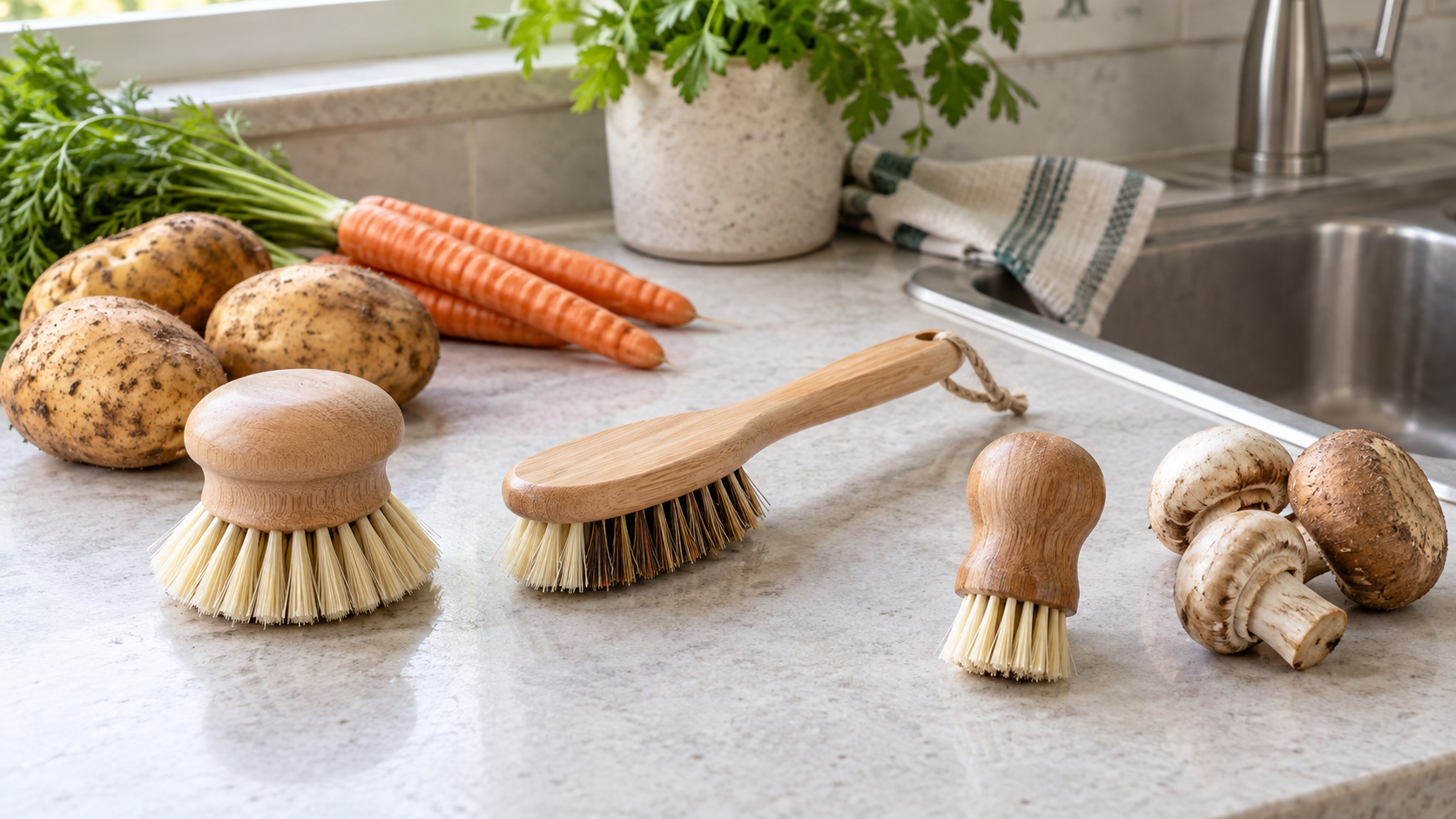
- Palm brush: Keeps the hand close to the food and can suit broad surfaces. Compare the complete diameter, grip shape, finger clearance, and where the wet brush will sit.
- Handled brush: Adds reach and separates the hand from the brush head. Check handle length, wet-hand control, head angle, hanging opening, and drawer or caddy fit.
- Small soft-bristle brush: Offers a smaller contact area when the manufacturer identifies compatible uses. Verify the stated food types rather than assuming soft bristles suit every delicate surface.
- Two-sided brush: May offer different bristle zones, but adds seams and edges to clean. Confirm what each side is intended to do and whether the full head dries accessibly.
Start with the food and current guidance
List the produce prepared during a normal week and note which items arrive with soil, have irregular surfaces, or are usually peeled. Check current preparation guidance for the specific food and follow it. A product category name does not establish that brushing is suitable for every fruit, vegetable, herb, or mushroom.
Reject listings that turn a manual brush into a disinfection or contaminant-removal device. A brush supplies mechanical contact; it does not prove removal of pathogens, pesticides, wax, or other contaminants, and it does not replace food-specific handling guidance.
Selection criteria that matter
- Stated use: Look for clear maker instructions naming intended foods or surfaces and any exclusions. Do not infer compatibility from staged photos alone.
- Bristle information: Compare stated material, arrangement, and firmness language, but treat “gentle,” “deep cleaning,” and similar wording as seller claims rather than measured outcomes.
- Head shape: A wide rounded head covers broad surfaces; a narrower head can reach irregular areas. Check usable bristle area and edges, not just overall length.
- Grip and control: Compare the handle or palm shape with hand position, wet use, and the pressure the instructions call for. Comfort and nonslip claims are individual and model-specific.
- Cleaning access: Inspect the bristle base, seams, grip texture, hanging hole, and any removable parts. Follow the exact care directions rather than assuming dishwasher compatibility.
- Drying and storage: Plan an open drying position before choosing a hanging, upright, or drawer-stored format. Measure the whole wet tool against the sink caddy, hook, or storage space.
- Replacement guidance: Prefer clear maker advice for wear, damage, and replacement. Stop using a brush when bristles shed, the head cracks, or the tool can no longer be cleaned as directed.
- Seller and returns: Confirm the current seller, included quantity, model details, and return terms before ordering.
A no-buy test before ordering
- Count the recurring tasks: Track one week of produce prep and identify the foods for which current guidance and your workflow would actually use a brush.
- Check the existing setup: Decide whether rinsing, rubbing by hand, peeling, or a tool already owned handles those tasks according to the relevant guidance.
- Mock up the tool: Use the listed dimensions to test hand space at the sink and the intended drying or storage location.
- Choose one format: Compare only brushes whose stated use and care match the recurring task; more bristle zones do not automatically add value.
Who should skip a produce brush
Skip one when the task is rare, an existing method already fits current guidance, or the listing does not provide clear intended uses, materials, dimensions, and care. Also skip a brush whose head cannot be reached for cleaning, whose wet storage would crowd the sink, or whose marketing depends on disinfection, pesticide-removal, food-safety, nutrition, or weight-loss promises.
If the brush is useful but wet tools have nowhere to dry, compare sink caddies for brushes and scrapers by loaded fit and drainage before adding another holder.
Bottom line
The best produce brush is the simplest format whose documented use matches the foods you prepare, whose head and grip fit the task, and whose cleaning, drying, and storage fit the kitchen. Start with current food guidance and a week of real use; treat broad cleaning claims as claims, not proof.