Routine-support buying guide
Best Sink Caddies for Meal-Prep Brushes and Scrapers
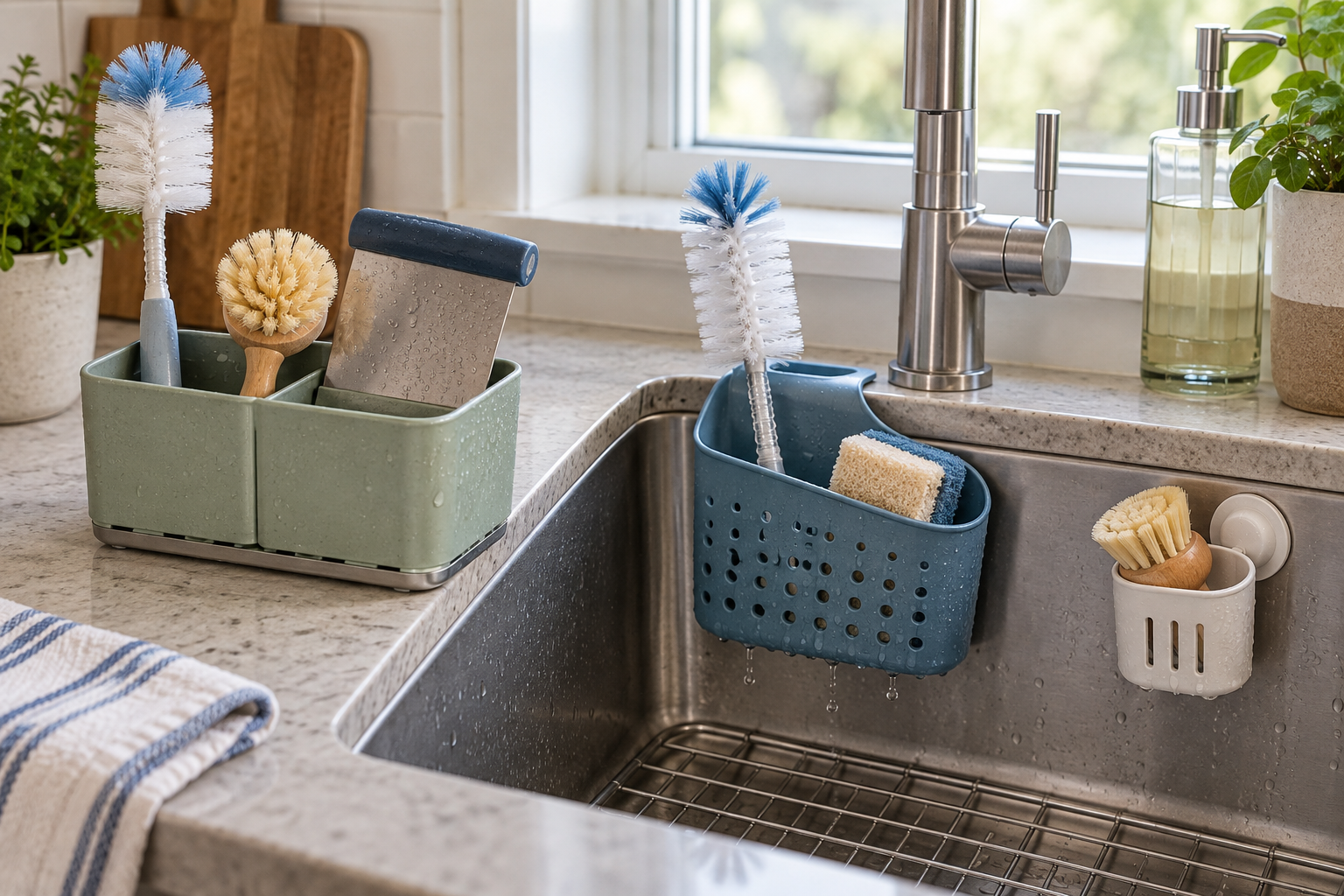
A sink caddy can give damp bottle brushes, dish brushes, and small scrapers a defined place to drain. The best fit is not the holder with the most slots: it is the smallest format that fits the actual tools, drains toward the sink or a removable tray, stays compatible with the mounting surface, and can be fully cleaned.
As an Amazon Associate, GoodWeighFinds earns from qualifying purchases.
Who this guide is for
This guide is for adults who have already decided that wet bottle brushes, dish brushes, and small prep scrapers need a dedicated draining holder. If you are still deciding whether another object belongs beside the sink, start with the sink-caddy buy-or-skip test. If the main decision is counter space versus wall mounting, use the countertop caddy versus suction-holder comparison.
For the broader measure-first approach to practical kitchen tools, see the routine-support tools guide. This page does not cover bottle drying racks, soap dispensers, knife storage, or claims that a holder prevents mold or makes tools sanitary.
Useful formats—not ranked winners
- Countertop caddy with drip tray: Works without a compatible sink wall, but uses counter space. Check whether the tray removes easily and where collected water goes.
- Sink-saddle or rim caddy: Keeps tools over the basin. Measure divider thickness, rim width, faucet clearance, basin space, and whether the caddy interferes with washing.
- Suction-mounted holder: Frees the counter when the sink wall is smooth and compatible. Verify the maker’s surface requirements, loaded limits, removal method, and reattachment instructions.
- Rail or faucet-neck holder: Suspends from a defined support. Confirm diameter or rail compatibility, swing clearance, tool weight, and whether the mount crowds faucet controls.
Inventory the tools before comparing caddies
Set out only the wet tools used in an ordinary week. Measure the tallest brush, widest scraper, thickest handle, and the space needed between brush heads. A tall bottle brush can make a shallow caddy unstable, while a narrow scraper may vanish into a deep undivided compartment.
Trace where water would move from every opening. “Ventilated” does not tell you whether water drains into the sink, collects in a tray, or reaches the counter. Do not infer drainage speed, cleanliness, or mold prevention from listing photos.
Selection criteria that matter
- Loaded dimensions: Compare the complete setup with the sink rim, faucet motion, window ledge, backsplash, outlets, and usable washing area.
- Compartment fit: Count real tools and compare usable compartment width and depth. Look for separation that does not trap a scraper or bend bristles.
- Drainage route: Identify every opening, tray, seam, and low point. Choose a route you can see, empty, and clean.
- Mount compatibility: Check surface type, rim or rail measurements, installation directions, loaded guidance, and removal requirements.
- Cleaning access: Prefer reachable corners and removable pieces when those suit your routine. Follow current care instructions for every part.
- Material wording: Treat rustproof, antimicrobial, odor-resistant, stain-resistant, nonslip, and dishwasher-safe wording as claims requiring current maker documentation.
- Seller and returns: Confirm what is included, who sells it, and whether a fit mismatch can be returned before ordering.
A practical comparison framework
- Reduce the tool set: Remove duplicates and rarely used tools; store sharp tools somewhere designed for them.
- Test the zone: Use a stable washable cup or existing dish-rack section for a week to learn whether a holder solves the problem.
- Measure tool and sink fit: Record the loaded width, depth, height, basin or counter clearance, and mounting geometry.
- Choose the drainage route: Decide whether water should reach the sink directly or collect in a tray you will empty.
- Choose a format: Compare countertop, saddle, suction, and rail-mounted designs only after the location is settled.
- Check upkeep and terms: Read current assembly, care, mounting, seller, and return details before buying.
Who should skip a sink caddy
Skip one when an existing dish rack, washable cup on a tray, hook approved for the surface, or drawer for fully dried tools already works. Also skip a model when the maker omits usable dimensions, drainage details, compatible surfaces, or care instructions; when the loaded caddy would obstruct faucet controls or shrink safe basin access; or when the setup relies on suction against an unsuitable or damaged surface.
A small caddy is also the wrong tool for drying bottles, lids, straws, and seals as a batch. For that job, decide whether a bottle drying rack earns its space.
Bottom line
The best sink caddy is the format that fits a measured set of wet brushes and scrapers, sends water somewhere intentional, stays compatible with the real sink zone, and comes apart enough for the upkeep you will actually do. Settle location and drainage first; slot count and styling come later.