Routine-support buying guide
Best Produce Hammocks for Freeing Small-Kitchen Counter Space
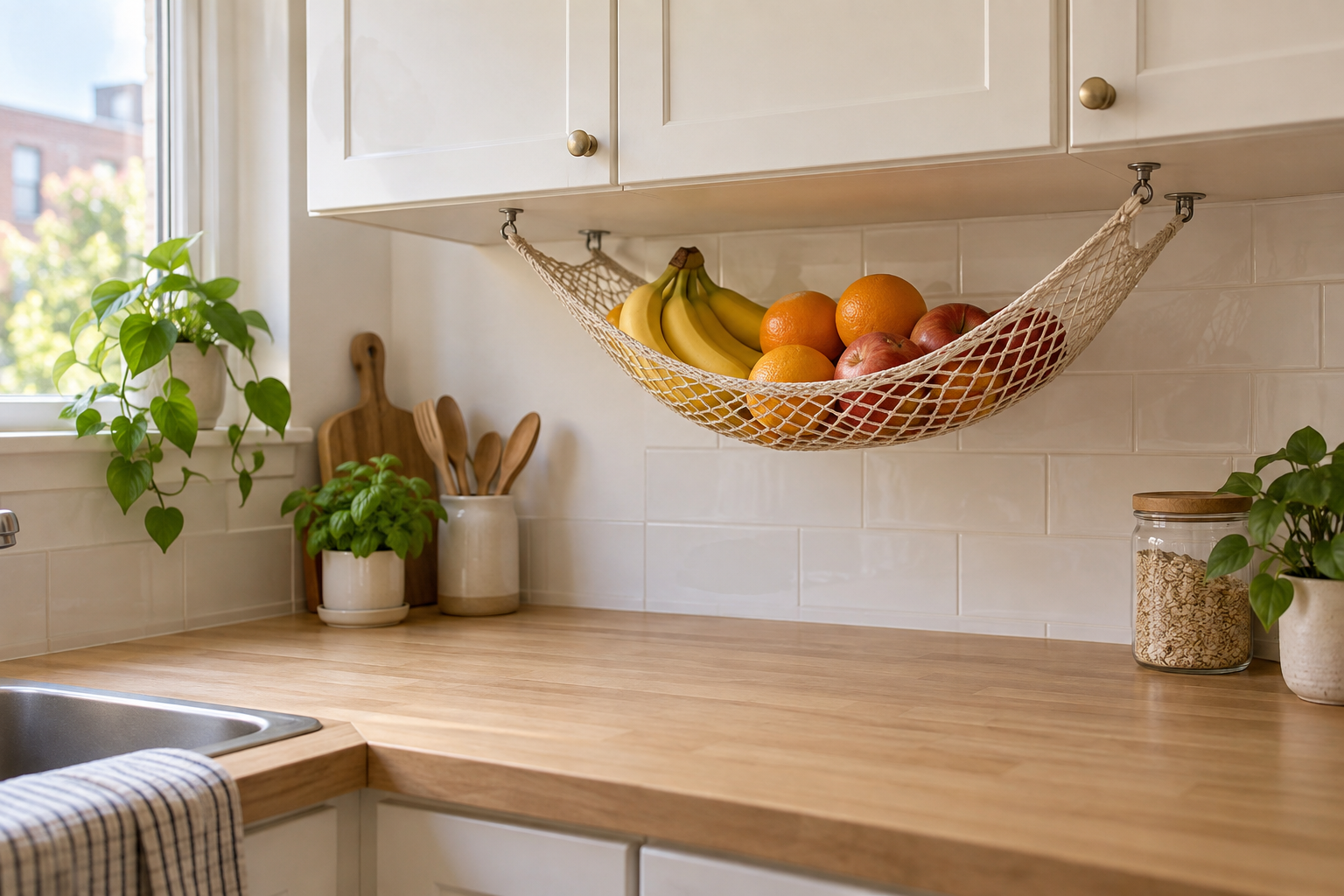
A produce hammock can move some room-temperature produce off a crowded counter, but it only earns that space when the mounting zone, loaded depth, reach, and cleaning routine all work in the actual kitchen. This guide compares formats and fit criteria—not named winners or freshness promises.
As an Amazon Associate, GoodWeighFinds earns from qualifying purchases.
Who this guide is for
This guide is for adults who repeatedly lose useful counter space to a small amount of room-temperature produce and have a permitted, reachable mounting location below a cabinet or shelf. Start with the produce-hammock worth-it test if you have not yet confirmed that suspended storage fits the kitchen. Compare a produce hammock with a countertop basket if installation effort is still the main decision.
This page supports the broader routine-support tools guide. A produce hammock is storage hardware, not a weight-loss product, and this guide does not claim that suspended storage keeps produce fresh longer, prevents waste, or makes food safer.
Best-fit formats, not unsupported rankings
- Compact single-tier hammock: Best fit when the mounting span and loaded drop are tight and the usual produce amount is modest.
- Wider sling: Worth comparing when cabinet width is available, but only after checking that the filled center will not sag into the work area.
- Two-tier format: Can separate produce types, but adds total drop, more attachment points, and more surfaces to clean.
- Removable sling: Useful when the fabric or mesh detaches for washing without removing all mounting hardware.
- Rigid hanging basket: Holds its shape more predictably than a soft sling, but may take more visual and vertical space and is a different fit for cabinet doors and backsplashes.
Selection criteria that matter
- Mounting span: Measure the distance between permitted attachment points. Do not infer fit from a staged listing photo.
- Loaded clearance: Add the organizer’s stated drop to the sag expected from the usual produce load, then check faucets, appliances, outlets, cabinet doors, and prep movements.
- Attachment method: Follow the exact hardware instructions and supported-surface wording. Adhesive, screw-mounted, and hook-based designs create different permission and removal questions.
- Stated load: Treat the maker’s limit as a ceiling under its specified installation conditions, not a target and not proof that every cabinet or adhesive surface can support it.
- Access: Confirm that household members can see and retrieve items without pulling down on the sling or reaching across a hot or wet work zone.
- Produce contact: Look for a surface that does not create obvious pressure points for the produce normally stored there. Avoid overfilling.
- Cleaning and drying: Verify whether the sling detaches, how it should be washed, and whether seams, cords, hooks, and the cabinet underside remain accessible.
- Seller and returns: Re-check the exact included hardware, installation requirements, seller, and return terms before buying.
A practical comparison framework
Measure first, then record yes, no, or unclear for each candidate:
- Does the stated mounting span fit the permitted attachment area?
- Are the unloaded dimensions, attachment spacing, and stated load provided for the exact model?
- Will the hammock’s loaded center remain clear of the counter task, faucet, appliance, outlet, and cabinet-door path?
- Does the attachment method match the surface and any rental or household restrictions?
- Can everyone who needs it reach the contents without tugging on the organizer?
- Can the sling, hardware, and mounting surface be inspected, cleaned, and fully dried?
- Will the usual amount fit without stacking delicate produce under heavier items?
- Would an existing bowl, wall basket, pantry shelf, or refrigerator bin solve the problem without installation?
Run a no-buy fit test
Mark the proposed attachment points with removable tape, then hang an empty paper or cloth mock-up with the listed width and depth. Add a lightweight representation of the usual volume without relying on the mock-up to test structural support. Open every nearby door, use the faucet and main prep area, and check the sight line and reach from normal standing positions.
This test is for geometry only. It does not verify adhesive strength, hardware capacity, cabinet construction, or a product’s stated load. Installation should follow the exact maker’s directions and any property rules.
Who should skip this purchase
Skip a produce hammock when mounting is not permitted, the cabinet material or underside is unsuitable, the loaded sling would hang over heat, water, outlets, or a primary prep path, or the usual produce amount would be crowded. Skip it when anyone would need to pull on the hammock to reach its contents.
A countertop basket may be the better choice when easy removal and cleaning matter more than counter space. A refrigerator bin or pantry location may fit produce that should not be stored in the selected room-temperature spot; follow produce-specific storage guidance rather than assuming one organizer suits everything.
Bottom line
The best produce hammock is the simplest format that fits a measured, permitted mounting zone while loaded—not the one that appears to hold the most in a listing photo. Compare attachment, span, drop, access, care, and return terms, and keep the current container if the suspended option merely moves clutter into the work path.