Small-kitchen produce storage comparison
Produce Hammock vs Countertop Basket for Small Kitchens
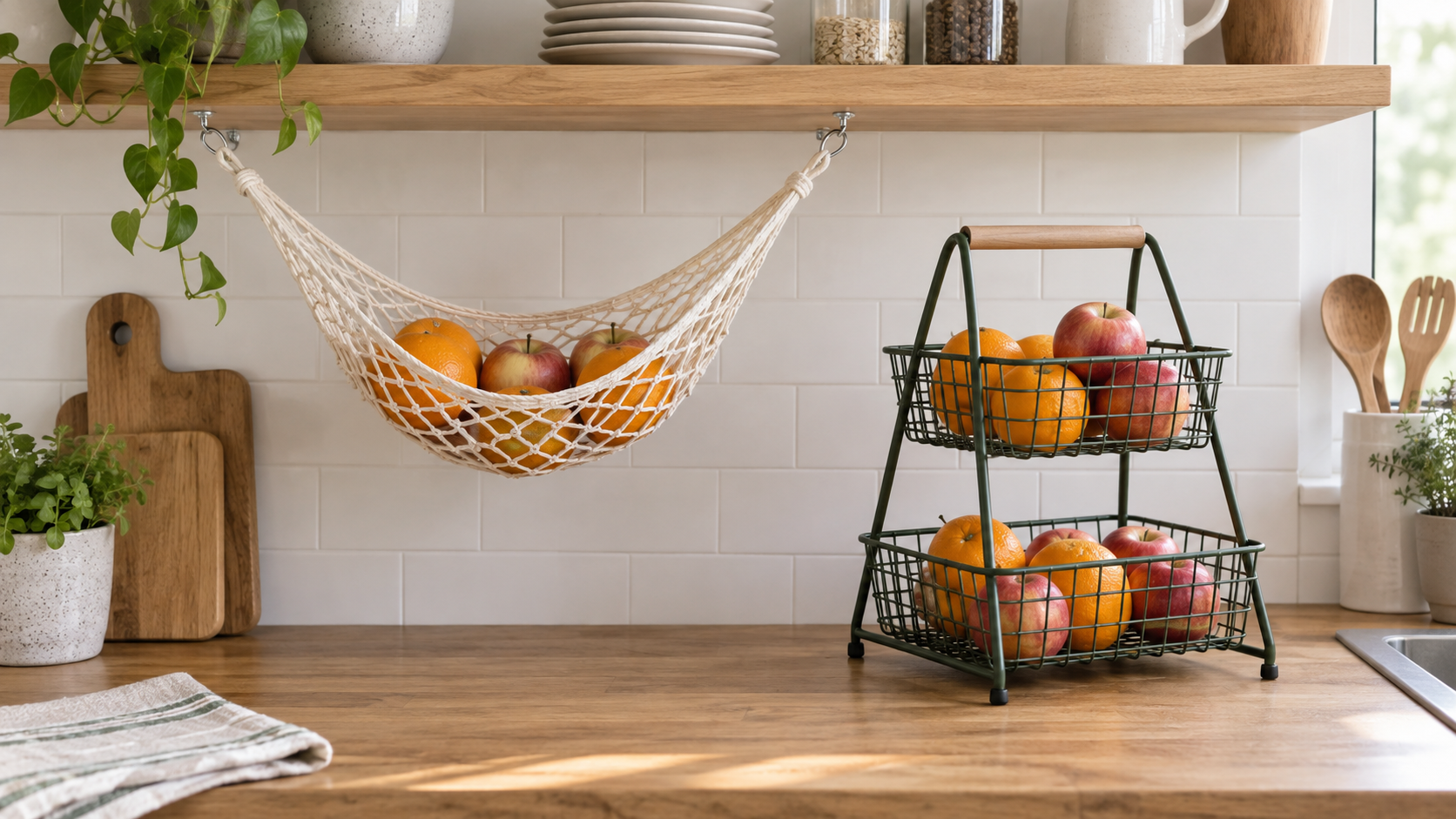
A produce hammock can reclaim counter space but needs a sound mounting location and clear space below. A countertop basket is simpler to place and move but permanently occupies work surface. Choose by the produce that can appropriately stay at room temperature, your kitchen geometry, and the cleaning work—not by promises that an organizer will keep every item fresh longer.
As an Amazon Associate, GoodWeighFinds earns from qualifying purchases.
The quick comparison
| Decision | Produce hammock | Countertop basket |
|---|---|---|
| Best fit | A permitted, structurally suitable mounting zone above otherwise useful space | A stable patch of counter with no safe or convenient mounting point |
| Space used | Wall, shelf, or cabinet underside plus loaded hanging clearance | Measured counter footprint plus reach space above and around it |
| Setup | Hardware, attachment compatibility, level placement, and load check | Assembly if required, then a level and dry placement |
| Access | Contents may settle toward the center and swing when handled | Contents remain on a fixed surface; tiers may limit visibility |
| Cleaning | Remove and clean the sling plus mounting area as directed | Lift or empty the basket to clean wires, feet, and counter below |
| Flexibility | Location is relatively fixed after installation | Easier to move, if its loaded weight and handles allow |
Decide what belongs there first
Storage format comes after produce-specific guidance. Some items are better refrigerated, some should not be crowded together, and ripeness changes where an item belongs. Follow reliable storage guidance for the actual produce rather than assuming that airflow, a mesh sling, or an open wire basket makes one location universally correct. Neither organizer controls temperature or establishes a food-safety timeline.
List only the room-temperature produce your household regularly keeps, then measure its typical—not aspirational—load. A large organizer filled for a photo can encourage stacking, bruising, and forgotten items. If the usual load is two onions and a few pieces of fruit, a bowl already owned may be the calmer answer.
Who a produce hammock fits
A hammock fits a small kitchen when the counter is genuinely constrained and a safe mounting zone is available. Measure the sling empty and estimate its loaded sag, not just its advertised width. Confirm that cabinet doors, task lighting, outlets, faucets, appliance lids, and normal prep movements remain clear.
- Confirm permission: renters and shared households may need approval before drilling or applying hardware.
- Match the surface: use only hardware intended for the specific shelf, cabinet, or wall material and follow its installation directions.
- Check the full load: treat stated capacity as a claim to verify and keep well below any uncertain limit.
- Test access: the lowest loaded point should remain easy to see and reach without bumping hot, sharp, or frequently moved equipment.
- Plan removal: the fabric or mesh should be removable for cleaning without dismantling nearby storage.
Who a countertop basket fits
A freestanding basket suits kitchens with adequate counter depth, households that rearrange storage, and readers who want setup without wall or cabinet hardware. Measure the outside footprint, feet, handle, and full height. For tiered designs, also measure the opening above the lower tier; the nominal basket dimensions do not show whether larger produce is easy to place and remove.
- Check stability: test the basket empty and loaded on a level surface, following the maker's assembly and loading directions.
- Protect work space: leave room for cutting boards, small appliances, and safe cleaning rather than squeezing the basket into an active prep zone.
- Inspect contact points: feet should sit securely and should not trap moisture or scratch the surface when moved.
- Keep it visible: deep or stacked baskets can hide items at the bottom; a shallower single tier may fit a small routine better.
Setup and maintenance tradeoffs
The hammock asks for more work up front: surface evaluation, accurate spacing, compatible hardware, and a cautious load test. After installation, check attachment points and fabric for loosening, stretching, or wear. Stop using it if the mount, sling, knots, or surrounding material shows damage.
The basket has less installation risk, but it consumes counter space every day. Crumbs and moisture collect beneath feet and between wires, so empty it regularly and clean both the organizer and the counter according to their care requirements. A basket that is awkward to lift when loaded may require unloading before every cleanup.
Run a no-buy space test
Mark the basket footprint on the counter with removable painter's tape, including clearance needed to reach into it. For the hammock, hang a lightweight empty cloth or paper template without using it to hold food. Mark its expected loaded depth and lowest point. Live with both outlines for several days while opening cabinets, using appliances, and preparing food.
This test does not validate a mount or load capacity. It reveals whether either format obstructs normal work. If a bowl, shallow tray, or existing basket fits the typical load and remains visible, skip both purchases.
Skip criteria
- Skip the hammock when the mounting surface, permission, hardware compatibility, or loaded clearance is uncertain.
- Skip the basket when its measured footprint displaces needed prep space or blocks an outlet, appliance, or cleaning path.
- Skip tiered storage when the lower level hides produce or is awkward to reach.
- Skip either format if the usual contents belong in the refrigerator or need different storage conditions.
- Skip both when an existing bowl or basket already holds the normal load without crowding or creating friction.
Bottom line
Choose a produce hammock only when reclaiming counter area justifies a verified mount, fixed location, and loaded-clearance checks. Choose a countertop basket when simpler placement and mobility matter more than the counter footprint. Start with the narrower produce-hammock buy-or-skip test, compare countertop and wall-mounted produce baskets when rigid vertical storage is the alternative, or use the countertop basket vs fridge-bin guide for a location decision. The routine-support tools guide covers broader low-hype buying criteria.