Chest-freezer organization buying guide
How to Choose Removable Baskets for Chest-Freezer Meal Prep
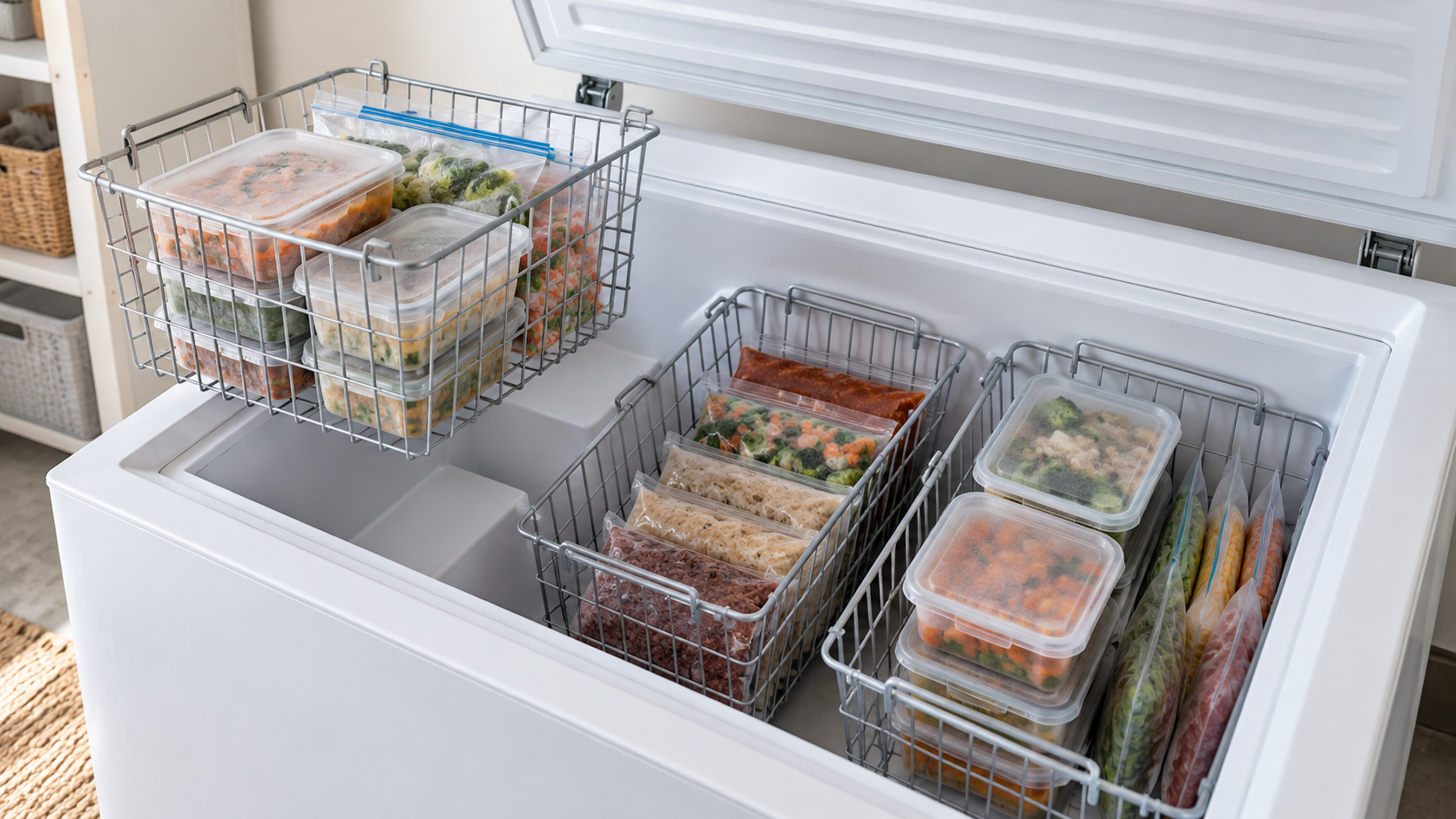
A removable basket can keep a recurring group of frozen meals or ingredients within reach, but only when its rim, depth, handles, and loaded lift path match the exact chest freezer. Compare the full geometry—not a seller's promise of “more space.”
As an Amazon Associate, GoodWeighFinds earns from qualifying purchases.
Who this guide is for
This guide is for adults who use a top-opening chest freezer and repeatedly lift the same group of frozen meal-prep items. It is not an upright-freezer divider guide: a chest-freezer basket must clear the rim, lid, walls, and any raised compressor step while supporting a comfortable lift-out motion.
Quick comparison of basket formats
| Format | Potential fit | Main measurement | Reason to skip |
|---|---|---|---|
| Rim-hanging wire basket | Frequently reached items near the top | Hook span, rim thickness, basket depth, and lid clearance | The hooks do not match the rim or block the seal |
| Lift-out wire basket | A grouped load resting inside the compartment | Exterior base, handle position, and loaded lift path | The base rocks on the compressor step or contents slip through the grid |
| Open-grid plastic basket | Smaller packages needing a finer opening pattern | Usable interior size, handle clearance, and maker freezer wording | The material or care instructions do not identify freezer use |
| Nested basket set | Two measured zones with separate lift paths | Combined footprint and access to the lower group | Reaching the bottom requires moving several heavy layers |
Measure the freezer, not just the opening
Record the usable interior width and depth at the height where the basket will sit. Chest freezers may narrow below the rim or include a raised compressor housing, controls, drains, hinges, or interior ledges. Measure those obstructions and follow the appliance manual for required clearance and loading guidance.
Then measure the path upward. Include the basket handles, your hand position, the open lid, nearby shelves, and enough room to keep the basket level. A basket that technically fits can still be frustrating if it must tilt sharply to clear the rim.
Selection criteria that matter
Rim and support geometry
For hanging formats, compare the complete hook shape and span with the freezer rim. Do not assume “universal” means compatible with a particular liner, gasket, or lid. The basket must not pinch the seal or interfere with closing.
Exterior size versus usable space
Listing dimensions may describe the widest hooks or handles rather than the usable basket floor. Look for both sets of measurements. Tapered sides, rounded corners, and inward handles can reduce the package shapes that fit even when the exterior dimensions look generous.
Mesh or opening size
Compare the grid with the smallest recurring package when frozen and filled. Fine openings may support small bags better; wider wire spacing can be easier to see through. Neither format guarantees better airflow, food safety, or freshness.
Handles and a realistic loaded lift
Check whether handles fold, project above the rim, or disappear behind the load. Treat stated load limits as maker claims with conditions, not a target. A basket can be rated for more than a person can comfortably lift from a deep freezer; plan smaller groups when that makes retrieval calmer.
Material, freezer wording, and care
Verify explicit freezer-use language for the exact basket, including any coating or plastic parts. Read cleaning and drying instructions before buying. If a listing omits the material, coating, care, or cold-use wording, skip it rather than assuming.
Do a no-buy layout test first
Group the recurring packages in a freezer-safe container you already own, without obstructing required appliance clearance, and observe the next few retrievals. Note the group's loaded footprint, height, and weight. A cardboard template outside the freezer can help test basket dimensions, but do not leave materials in cold storage unless the appliance and material instructions allow it.
If labels or an inventory overview solve the real problem, compare freezer inventory boards. If the freezer is upright and the problem is flexible packages slumping on a shelf, use the upright-freezer divider guide instead.
Who should skip a removable basket
- Your current built-in basket already gives the needed grouping and access.
- The unresolved problem is inventory tracking rather than physical retrieval.
- The basket would obstruct the lid, gasket, drain, vent, control, or appliance-required clearance.
- The recurring load would be awkward to lift from the freezer depth.
- The listing omits full dimensions, freezer-use wording, material, handles, care, seller, or return terms.
- Rearranging rigid containers you already own solves the problem without another accessory.
Claims to treat cautiously
A basket groups and lifts items; it does not create freezer volume, extend storage time, prevent freezer burn, make food safer, or cause weight loss. “Space-saving,” “heavy duty,” “rustproof,” “unbreakable,” and “universal fit” are not useful without exact dimensions, materials, conditions, and care instructions. Customer comments may reveal fit questions, but they do not verify durability or compatibility with your appliance.
Bottom line
Choose a removable chest-freezer basket only after measuring its resting position and complete loaded lift path. Match the rim or base geometry, usable interior size, grid spacing, handles, material, maker-stated freezer use, and care to a recurring group of food. Skip the purchase when the listing is vague or a simpler grouping method works. This is a practical organization decision within the routine-support tools guide, not a preservation or weight-loss method.