Shared grocery-list buying guide
Best Reusable Fridge Boards for Shared Grocery Lists
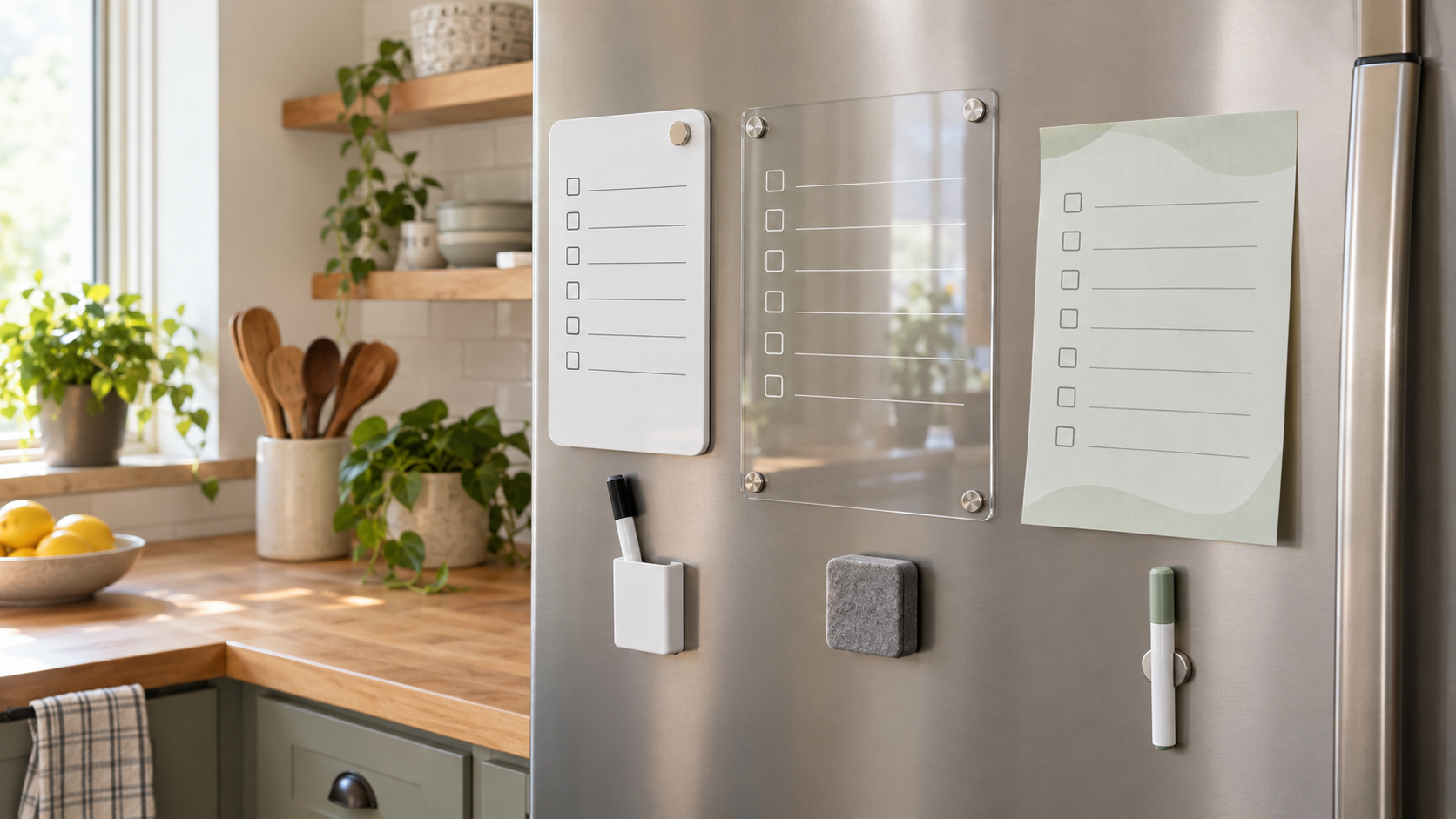
The useful board is not necessarily the largest or most elaborate. It fits the exact appliance surface, gives regular users enough writing room, keeps a compatible marker nearby, and has a simple way to transfer the finished list to the store.
As an Amazon Associate, GoodWeighFinds earns from qualifying purchases.
Choose the format after choosing the workflow
This guide begins after a household has decided that a fixed reusable list makes sense. If that decision is still uncertain, run the paper test in our reusable fridge-board buy-or-skip guide. If the real choice is between a list that stays put and a sheet that travels, compare a magnetic notepad with a dry-erase board.
Keep the board's job narrow: capture grocery items as they run out. A meal calendar, chore chart, personal tracker, and grocery list can demand different privacy, layout, and portability. Combining them may leave too little usable space for any one task.
How the main formats compare
| Decision point | Rigid whiteboard | Clear board | Flexible sheet |
|---|---|---|---|
| Writing support | Firm, flat surface | Firm when correctly mounted | Depends on the appliance panel beneath it |
| Visual footprint | Defined frame and edge | Background remains visible, but glare may interfere | Usually thin, with edges that need checking |
| Mounting | Often magnets or adhesive; verify exact model | May use standoffs, magnets, or adhesive | Often magnetic or static-style; verify the stated surface |
| Cleaning | Check frame seams and maker directions | Check both faces, edges, and approved cleaner | Check whether removal is required and how it dries flat |
| Best reason to compare | Stable writing and clear boundaries | Lower visual obstruction | Thin profile and broad layout choices |
Seven selection checks
- Exact surface compatibility: Test the intended refrigerator panel with a magnet you own and follow appliance guidance. Stainless-looking surfaces are not universally magnetic.
- Exterior dimensions: Make a paper template and open doors, drawers, and nearby cabinets. Keep handles, seals, hinges, vents, controls, and dispensers clear.
- Usable writing area: Subtract frames, printed headings, marker docks, and decorative space from the advertised size.
- Readable placement: Check reach, handwriting size, contrast, reflections, and viewing angle for every regular user.
- Marker system: Verify the required marker type, holder, cap, eraser, replacement availability, and the maker's cleaning directions.
- Shopping handoff: Decide whether the shopper will photograph, copy, or rewrite the list. Test that step before buying.
- Exit path: Review current return terms and removal instructions. Do not assume magnets, adhesive, or hardware are damage-free on every finish.
Run a no-buy fit test
Cut paper to the candidate's complete outside dimensions and tape it temporarily in the proposed location using a method allowed for the surface. Draw the listed usable writing area inside it. For one ordinary week, keep a pen beside it, add only grocery items, and use the planned transfer method before shopping.
At week's end, check whether the list was updated, readable, reachable, and remembered. Also open the appliance and everything around it. If the paper blocks movement, stays blank, or never reaches the store, changing board material will not repair the workflow.
Claims to treat cautiously
- “Works on every fridge”: use the exact appliance panel and stated mounting requirements instead.
- “Stain-proof” or “ghost-free”: treat these as product claims; marker type, delay before erasing, and cleaning method can matter.
- “Extra strong” magnets: look for defined mounting and load details, not an adjective.
- “Damage-free”: verify permitted surfaces and removal instructions; finish condition and installation can differ.
- “Saves money” or “reduces waste”: a board only records information. Those outcomes depend on the household workflow and are not guaranteed by the product.
Who should skip a dedicated board
Skip it when one person manages the list successfully, household members add items away from home, a phone note already works, or the final list must travel without a copying step. A magnetic paper pad can be simpler when the shopper wants to tear off the original list.
Also skip when the appliance surface is incompatible, the board would obstruct controls or movement, public notes create privacy or household tension, or marker cleaning is unlikely to happen. An ordinary sheet of paper is a valid long-term tool. For broader low-pressure routine aids, see the routine-support tools guide.
Bottom line
Compare reusable fridge boards by the complete mounted footprint, actual writing area, surface fit, readability, marker upkeep, and list-to-store handoff. Choose a rigid board for firm writing support, a clear board when visual obstruction matters and glare is manageable, or a flexible sheet when its stated surface fit and edges work on the exact appliance. If the one-week paper test fails, choose no board.