Short-trip grocery carrier guide
Best Rolling Grocery Baskets for Short Car-Free Trips
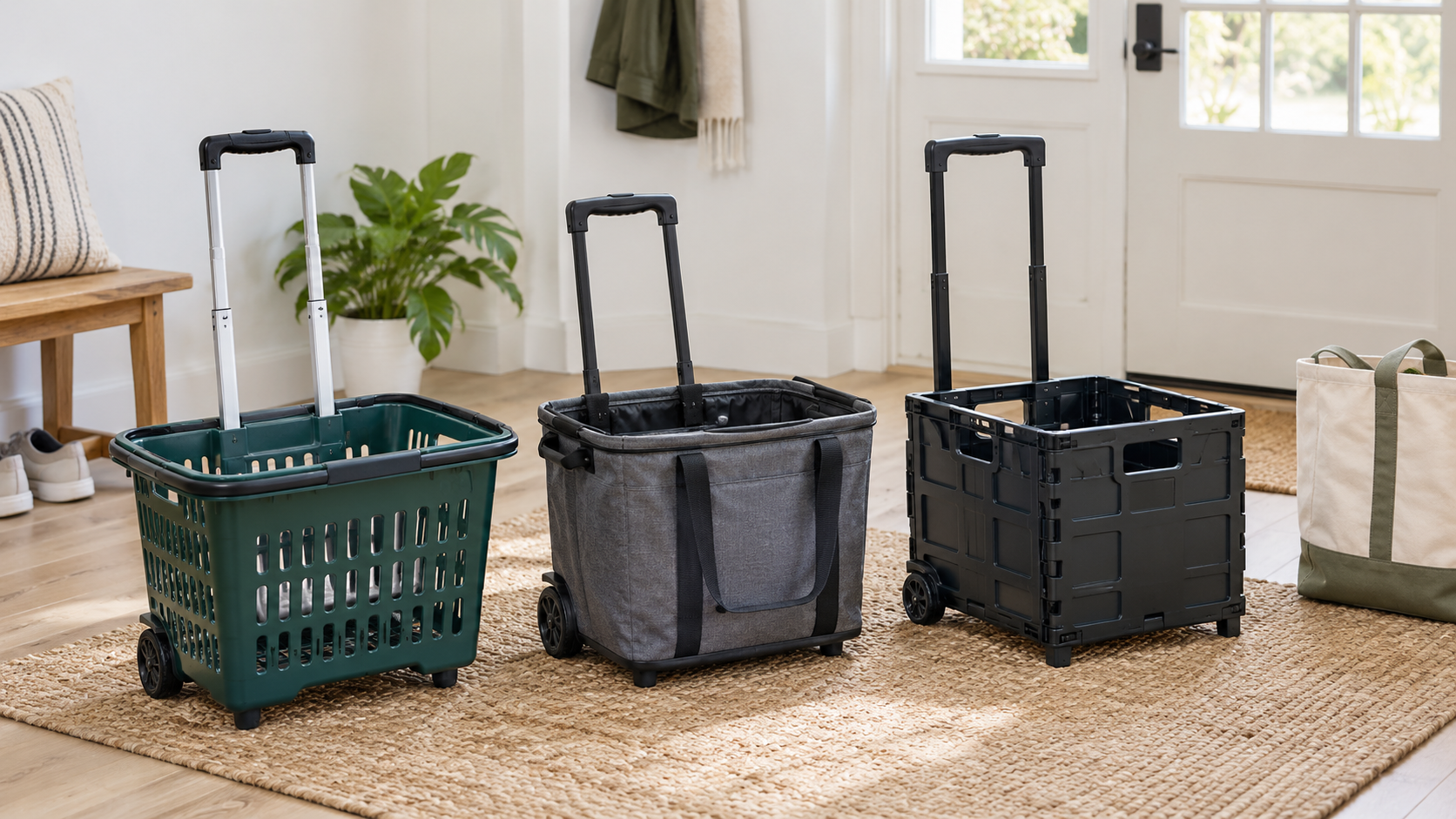
The useful rolling basket is not the one with the biggest capacity claim. It is the low carrier that fits an ordinary grocery load, keeps the handle in a workable position, clears the complete route, and has a real storage spot at home. This guide compares formats and criteria, not named winners or tested models.
As an Amazon Associate, GoodWeighFinds earns from qualifying purchases.
Start with the basket format
| Format | What may fit | What to verify | Reason to skip |
|---|---|---|---|
| Rigid ventilated basket | A modest load that benefits from an open, structured shape. | Usable base and opening, wall height, handle lock, wheel attachment, cleaning. | The fixed shell will not fit the storage location or transit space. |
| Soft-sided structured basket | Irregular packages that fit without pushing above the rim or closure. | Internal frame, liner attachment, closure, base support, care instructions. | The sides or base do not remain usable for the normal load. |
| Folding crate-style basket | A box-shaped load when compact storage is genuinely useful. | Open and folded dimensions, hinge and latch instructions, pinch points, base. | Setup adds friction or the folded wheels and handle still exceed the space. |
| Basket already owned | A light shop that can be safely carried or placed on an existing suitable carrier. | Complete route, lifting, handles, and how the existing setup behaves. | Do not improvise an unstable attachment to unrelated wheeled equipment. |
Measure the ordinary shop before browsing
Record two or three normal short trips. Note the largest package, the base area needed for items that should stay upright, and which foods need crush protection. Measure the usable inside base, top opening, and wall height of any candidate; a liter figure or staged grocery photo does not establish that the normal load fits.
Include the basket's empty weight in every required lift. Treat the maker's stated load as a limit to follow, not proof that the carrier will track steadily or feel manageable at that load. A smaller basket that fits the repeated trip can be more practical than capacity bought for an occasional stock-up.
Audit the whole route
- Rolling segments: note smooth pavement, rough patches, slopes, thresholds, tight turns, checkout lanes, elevators, and doorways.
- Lifts: count every stair, curb, vehicle step, and storage lift in both directions, including the combined carrier and groceries.
- Transit and store fit: check operator and store rules plus the full footprint with the handle extended; do not block doors or aisles.
- Wheel information: verify wheel count, diameter, spacing, attachment, and maker instructions without converting them into unsupported “all-terrain” or stability claims.
- Parking: confirm the intended resting position. A listing photo does not prove an empty or loaded basket will stand unattended.
Check handle, access, and storage fit
Compare the documented handle height or range with a workable pulling position while wearing ordinary shoes and outerwear. Check the lock and extension instructions, where the wheels sit relative to your stride, and whether the basket can be controlled through the narrowest turn. A telescoping handle does not guarantee fit.
Then measure the complete stored shape, including wheels, axle ends, handle hardware, and anything that projects when folded. Practice the documented folding sequence before the return window closes. “Collapsible” is not useful if setup is fiddly or the basket still occupies a walkway.
Cleaning, upkeep, and ownership costs
Read separate care directions for the shell or liner, base, frame, handle, and wheels. Removable fabric is not automatically machine washable, and water-resistant wording does not prove leak containment. Check how wet or dirty wheels will be isolated indoors and where every part can dry.
Compare the complete price with expected trip frequency, return shipping, warranty details, and whether wheels or fasteners have documented replacements. Inspect the handle lock, wheels, frame, base, hinges, fasteners, fabric, and closure before each use, and stop using damaged equipment.
Listing red flags
- “Heavy duty,” “stair climbing,” “all terrain,” or “effortless” without model-specific construction, limits, surfaces, and instructions.
- Capacity shown only as liters, item counts, or a staged pile without usable interior dimensions and a stated load.
- No empty weight, extended handle measurement, complete open footprint, or complete folded dimensions.
- Photos that hide the wheel attachment, base, frame joints, handle lock, or stored shape.
- Pain-relief, balance, accessibility, load-safety, exercise, calorie-burning, or weight-loss promises for an ordinary grocery carrier.
- Unclear seller identity, assembly and care directions, warranty, or return conditions for a bulky item.
Who should skip a rolling basket
Skip this category when the route requires more carrying than rolling, the usual shop exceeds the documented fit or load, the handle range is unsuitable, transit or store rules conflict with the footprint, or the carrier cannot be stored outside a travel path. A reusable bag, backpack, smaller shop, delivery, or shared trip may solve the actual problem with less equipment.
If balance, pain, grip, mobility, or another health concern affects pulling or lifting, a qualified healthcare or accessibility professional can help assess the activity and equipment. Do not use an ordinary rolling grocery basket as a mobility aid unless it was specifically designed and approved for that purpose.
Use the adjacent guides for the earlier decision
If you have not decided whether to buy at all, start with the rolling grocery basket worth-it test. If a taller carrier may suit the load better, compare a low basket with a compact grocery cart. For a carried option, compare reusable grocery bags for public-transit shopping. The broader routine-support tools guide keeps the no-buy option and non-weight-loss framing visible.
Bottom line
The best rolling grocery basket is the format whose usable interior, empty weight, handle position, wheel layout, full route, setup, cleaning, and stored footprint fit a repeated short trip. Verify those facts on the current listing and keep simpler alternatives in the comparison. Wheels can change how groceries are transported; they do not establish comfort, safety, accessibility, or weight-loss results.