Low basket or taller cart
Rolling Grocery Basket vs Compact Cart for Short Trips
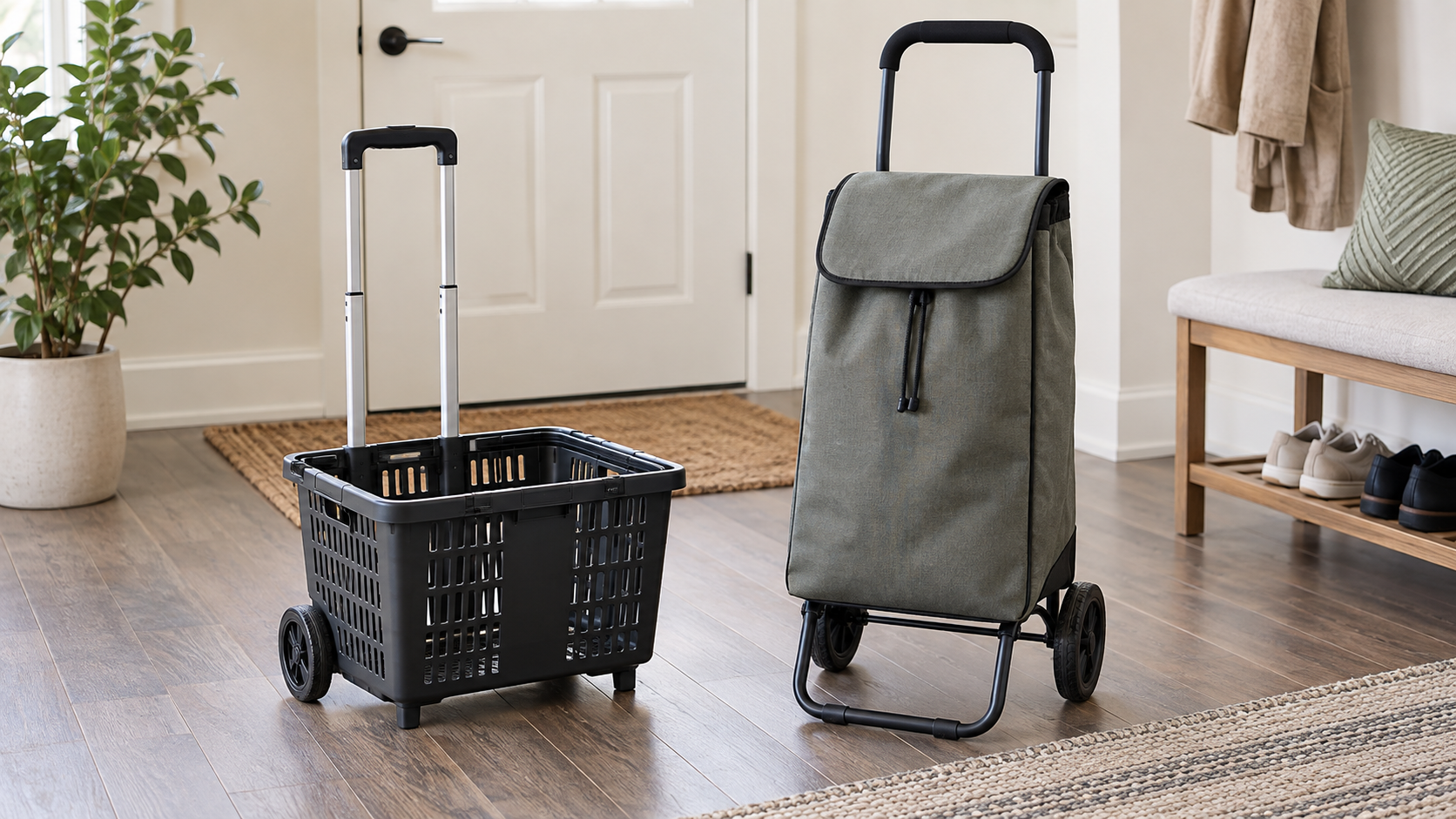
A low rolling grocery basket keeps a modest shop in a shallow, open container, while a compact grocery cart usually carries the load in a taller frame or bag. Both add wheels, a handle, and something to store. The useful choice comes from load shape, pulling position, every obstacle on the route, unloading reach, and the complete stored footprint—not a maximum-capacity headline.
As an Amazon Associate, GoodWeighFinds earns from qualifying purchases.
The quick comparison
- Rolling grocery basket: may fit a smaller, lower-profile shop when shallow access matters and the basket can remain on a mostly smooth route.
- Compact grocery cart: may fit a taller or more varied load when the frame, bag, wheel layout, handle, and folded size suit the complete route and home.
- Use what you already own: if a backpack, tote, delivery plan, or existing cart handles the ordinary trip, neither new format earns space.
- Skip both: when the route requires repeated lifting, neither carrier fits transit or storage, or the purchase would address only a rare stock-up trip.
Who a rolling grocery basket fits
A low basket may suit a frequent short shop with a modest number of items that fit its usable interior without being stacked far above the rim. Its shallow opening can make items visible and reachable, but the same low position can require more bending during loading and unloading. Measure the inside base, top opening, and wall height rather than relying on a volume label.
Check the extended handle against the intended pulling position while wearing ordinary shoes and outerwear. Confirm how the handle locks, whether its length is adjustable, and where the wheels sit relative to the basket. A telescoping handle or stated load limit does not prove that a carrier will track steadily, clear a curb, or feel suitable for a particular person.
Who a compact grocery cart fits
A taller cart may suit a shop that includes varied package heights or benefits from a deeper bag and more vertical loading. The frame may keep the opening higher, but a deep bag can also make small items harder to reach. Compare usable bag dimensions, opening and closure, frame geometry, wheel position, and whether the bag can be removed for cleaning under the maker's directions.
Compact does not mean small in every state. Measure the open footprint at the wheels and handle, then the complete folded footprint including axles, wheel hubs, hooks, and any handle that remains exposed. Include the cart's empty weight whenever stairs, curbs, vehicle boarding, or storage require lifting the frame and groceries together.
Tradeoffs that decide the format
- Load shape: a shallow basket favors a spread-out modest load; a tall cart may accept more vertical stacking but can hide small items at the bottom.
- Loading and unloading: compare opening height, wall or bag depth, closure, and whether ordinary items can be reached without rearranging the entire shop.
- Handle fit: record the usable handle height and range, not just whether the handle telescopes. Verify the locking instructions before loading.
- Wheel layout: note wheel count, diameter, spacing, axle width, and maker instructions. Do not translate those details into unsupported terrain or stability promises.
- Route obstacles: count every threshold, curb, stair, slope, tight turn, rough patch, checkout lane, elevator, bus, train, and doorway on the whole trip.
- Standing and parking: check how the empty and loaded carrier is intended to rest at checkout or at home; do not assume it will stand unattended.
- Storage: compare the complete stored footprint and folding sequence with the exact closet, entryway, or cabinet space available.
Measure an ordinary trip before shopping
List the groceries from two or three normal short trips and note the largest package dimensions, not just the item count. Mark fragile or crushable items that need a separate position. Then measure the narrowest doorway, the available transit or elevator space, and the storage location. A rare bulk purchase should not set the size for every routine trip.
Walk the route without a loaded carrier and record where rolling stops and lifting begins. If possible, test the job with equipment already owned and a light, manageable load rather than improvising a heavy trial. Follow local transit and store rules, and do not use a shopping carrier as a mobility aid unless it was specifically designed and approved for that purpose.
Setup, care, and return terms
Before first use, follow the exact assembly and unfolding instructions. Confirm wheel attachment, axle or fastener placement, handle locks, frame joints, bag or basket attachment, closure, and intended standing position. Inspect those parts before later trips and stop using the carrier if a wheel, handle, frame, fastener, fabric panel, or closure is damaged.
Follow model-specific cleaning and drying directions; “wipe clean,” removable fabric, and washable components are not interchangeable claims. Check replacement-part information and the return window before taking the carrier outdoors. A fit problem discovered only after loading or street use may be harder to resolve under the seller's terms.
Skip criteria
- Skip a rolling basket when its handle range, interior dimensions, wheel layout, or low unloading position does not fit the user and ordinary shop.
- Skip a compact cart when the deep bag, frame, folded shape, or combined lift creates a new access or storage problem.
- Skip either listing when open and folded dimensions, empty weight, handle details, wheel information, assembly, care, or return terms are unclear.
- Skip a wheeled purchase when the route contains more carrying than rolling or neither format fits the narrowest transition.
- Skip upsizing for an occasional stock-up trip if a smaller shop, delivery, shared trip, or current bag solves the regular need.
- Skip any listing that turns an ordinary carrier into a weight-loss, pain-relief, accessibility, fall-prevention, or load-safety promise.
Continue from the format decision
If the low format fits, first decide whether a rolling grocery basket earns its cost and storage space; a dedicated model guide is not yet published. If the taller format fits, use the compact grocery cart guide to compare folded size, wheel layout, handle position, storage, and model-specific claims. If carrying rather than rolling is still viable, compare a compact cart with reusable bags. Return to the routine-support tools guide for the broader test, reuse, buy, or skip framework.
Bottom line
Choose a rolling grocery basket when a repeated modest load fits its shallow interior and its low access, handle, wheels, route, and stored footprint all work. Choose a compact grocery cart when a taller frame or deeper bag better fits the normal shop without creating problems at lifts, tight transitions, unloading, or storage. Neither is a universal upgrade: measure the routine, verify the current listing, and keep the no-buy option visible.