Reusable sheet-pan liner guide
Best Silicone Baking Mats for Repeat Batch-Cooking Prep
The best silicone baking mat is not a universal winner. It is a mat that lies flat inside a sheet pan you already use, is explicitly permitted for your appliance and cooking conditions, and fits your washing, drying, and storage routine.
As an Amazon Associate, GoodWeighFinds earns from qualifying purchases.
Start with the pan you actually use
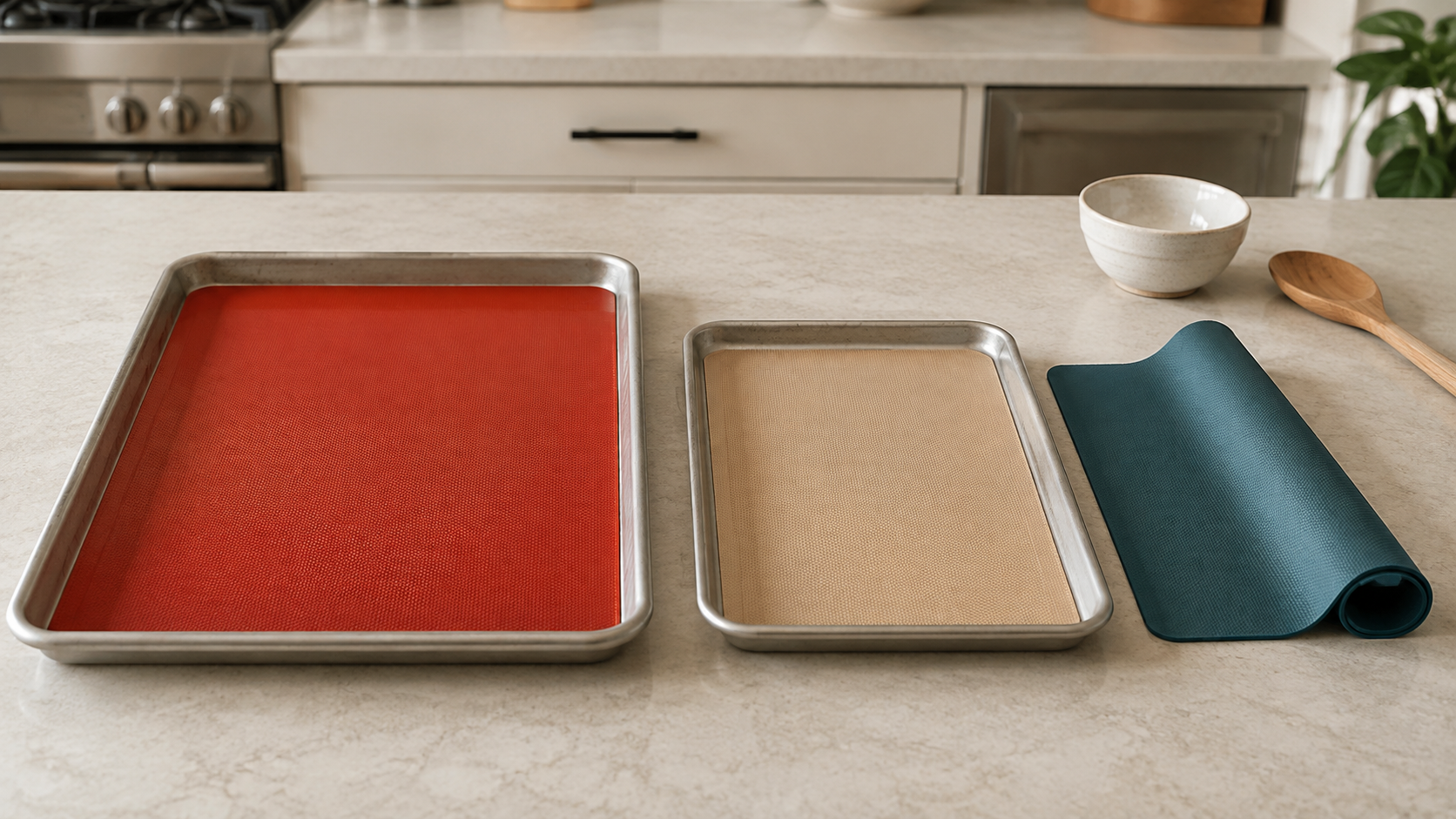
Measure the flat interior cooking surface of the pan, not its outside rim. Record length and width at the usable base and note rounded corners, channels, embossing, or handles that reduce the flat area. A mat that rides up a wall, buckles, or overlaps an edge is the wrong size even if the listing uses a familiar pan label.
Terms such as half sheet and quarter sheet are useful search labels, but they do not replace measurements. Do not plan to trim a mat unless the maker explicitly permits cutting; exposed internal reinforcement or damaged edges may put the mat outside its intended use.
Which format fits the job?
| Format | Useful when | Check before buying |
|---|---|---|
| Full-pan rectangular mat | One frequently used rimmed pan has a large, uninterrupted flat base. | Exact base dimensions, corner shape, rim clearance, and storage space. |
| Smaller mat | You use a compact pan or want a liner dedicated to a smaller repeat task. | Usable area after accounting for any border and whether the mat can lie fully flat. |
| Marked or patterned mat | Visible guides serve a task you already perform. | Whether markings are relevant and legible without accepting accuracy or outcome claims. |
| Multi-size set | Each included size maps to a pan you regularly use. | Individual dimensions and whether unused pieces make the set poor value. |
Read the use limits as instructions
“Oven safe” and “heat resistant” are incomplete on their own. Check the exact maximum temperature, permitted appliance types, rack or pan placement, preheating instructions, distance from heating elements, and restrictions involving broilers, direct flame, stovetops, toaster ovens, or air fryers. The lowest applicable limit among the mat, pan, appliance, and recipe governs the setup.
A temperature label does not establish that the mat suits every food or cooking method below that number. Follow the current manufacturer directions for the exact model. Skip listings that replace specific instructions with vague safety language.
Edges and surfaces deserve a close look
- Flatness: Product photos should show the mat lying flat without needing a pan rim to force it down. Treat “non-slip” as a claim to verify, not a guarantee.
- Border: Measure usable cooking area inside any thicker border. A broad border can make the working surface smaller than the overall dimensions suggest.
- Corners: Rounded corners may fit some pans better, but the radius must match your pan rather than merely look tidy in a listing.
- Texture: Smooth and patterned surfaces have different cleaning access. Do not assume texture improves release or cooking results.
- Odor and discoloration claims: Avoid promises that a material will never retain odors, stain, or change appearance. Read care and replacement guidance instead.
Plan the full wash, dry, and store cycle
Check whether the mat is hand-wash only or labeled for a dishwasher, and whether the instructions name a rack position, detergent restriction, or drying method. A large flexible mat can be awkward in a small sink even when the wash steps sound simple. Look for both sides and edges that remain accessible during cleaning.
Drying is a separate step. Decide where a wet mat can lie, hang, or drain without folding onto itself. For storage, follow the maker's instructions about flat or rolled placement. Do not crease a mat or stack sharp tools on it merely to fit a drawer.
Compare value without inventing a lifespan
Divide the purchase by the number of included mats that fit pans you truly use—not the advertised set count. Then weigh realistic use frequency, cleaning effort, storage, and the current replacement guidance. Avoid break-even calculations based on an unsourced number of reuses.
A single correctly sized mat may be better value than a larger assortment with pieces that remain unused. Parchment may still be the lower-friction option for occasional use, varied pan shapes, or recipes that specifically call for it. The silicone mat versus parchment comparison covers that format decision before you shop.
Replacement and skip signs
- Skip the mat when the listing omits exact dimensions, appliance restrictions, temperature limits, or complete care directions.
- Skip it when it does not lie fully inside the pan's flat base or would need cutting against instructions.
- Skip a set when only one size fits and the extras have no defined job.
- Replace or stop using a mat according to maker guidance when it is cut, torn, deeply creased, separating, or otherwise damaged.
- Use another pan preparation when the recipe, cookware, or appliance directions call for it.
A simple pre-purchase test
Trace the listed mat dimensions on paper and place the template inside the intended pan. Confirm that it sits flat with clearance from the sides and leaves the usable area you expect. Then identify where you would wash, fully dry, and store it. If any one step lacks space, solve that problem before ordering.
Keep the tool in perspective
A silicone mat is a reusable kitchen liner, not a weight-loss tool, and it does not make a meal healthier or a routine effective by itself. The routine-support tools guide helps separate ordinary task fit from body-result marketing. If the actual need is to separate foods on one compatible pan, compare sheet-pan dividers instead.
Bottom line
Choose by exact pan fit first, then by explicit use limits, cleanable edges, realistic wash-and-dry effort, protected storage, and clear replacement directions. A no-name category promise cannot answer those questions; the exact current mat documentation must.