Routine-support buying guide
Best Sheet-Pan Dividers for Flexible Batch Cooking
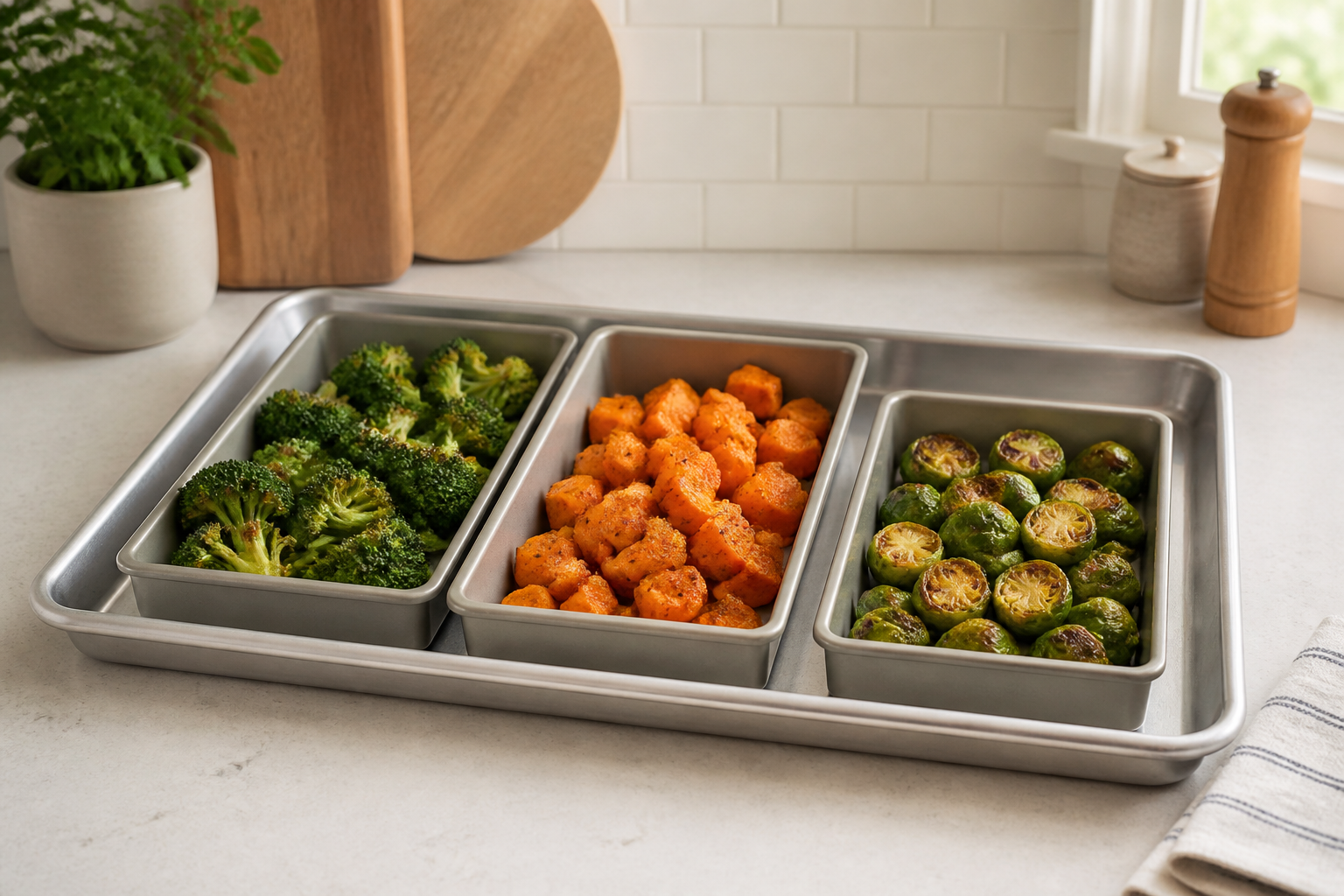
Sheet-pan dividers can keep several foods in separate removable inserts while one compatible pan is in use. The useful choice starts with measured fit and manufacturer directions—not a promise that every insert works with every pan, food, or oven setup.
As an Amazon Associate, GoodWeighFinds earns from qualifying purchases.
Who this guide is for
This guide is for adults who already use a rimmed sheet pan and want to vary batch sizes or keep foods physically separate during cooking. It covers removable inserts and divider trays, not recipes, nutrition plans, portion prescriptions, or claims that separation changes health outcomes.
For the broader approach, start with the routine-support tools guide. If preparation space is the larger problem, compare cutting boards for small-kitchen batch cooking; if storage after cooking is the bottleneck, use the meal-prep versus freezer-container comparison.
Useful formats—not unsupported winners
- Multiple small inserts: Flexible when foods need different amounts of space, but several rims reduce the pan's usable area and create more pieces to wash.
- Two larger half-pan inserts: Simpler to arrange and handle, provided both exterior dimensions fit together within the actual sheet-pan floor.
- Adjustable divider walls: Use pan space efficiently only when the maker clearly states how the divider attaches, which pans it supports, and how gaps are controlled.
- Standalone mini roasting trays: May also work without a larger sheet pan if the manufacturer permits it; verify stability, oven-rack support, and handling instructions.
Selection criteria that matter
- Measure the pan floor: Record the flat interior length and width inside the sloped sides—not the sheet pan's advertised outside dimensions.
- Check the complete layout: Add exterior widths, rims, handles, and required gaps. A set can match a named pan size yet still waste space or sit unevenly.
- Compare usable capacity: Interior dimensions and wall height show more than the number of inserts. Deep walls may suit some foods but complicate turning or removal.
- Read material labels precisely: Verify the exact material or coating, intended use, and maker's maximum temperature. Do not transfer instructions from a similar-looking item.
- Plan handling: Check whether each insert has a graspable rim and whether directions call for removing the outer pan, individual inserts, or both together.
- Account for food differences: Separate trays do not make foods with incompatible cooking temperatures or times compatible. Plan how an insert can be added or removed safely if timings differ.
- Inspect cleaning details: Look for seams, rolled edges, corners, coatings, and specific dishwasher or hand-wash instructions.
- Measure stored size: Confirm whether inserts nest without jamming and whether their total stack fits the planned cabinet or drawer.
- Verify returns: Because fit is exact, check the seller and return window before heating or washing an item.
A practical comparison framework
Mark each candidate yes, no, or unclear:
- Do the complete exterior dimensions fit the flat interior of the sheet pan?
- Is enough usable interior space left after accounting for every rim and wall?
- Are the intended oven use, material, and maximum temperature clearly stated?
- Can foods with different timings be added or removed using the stated handling method?
- Can each hot insert be grasped without reaching across another full tray?
- Are coating, utensil, cleaning, and cooling directions specific?
- Will the set nest or store within the measured space?
- Are the seller, limitations, and return terms clear?
Claims and use limits
Treat “universal,” “nonstick,” “oven safe,” and “easy clean” as claims that need details. Pan geometry, insert dimensions, coating care, temperature, food residue, and dishwasher guidance can change whether a set fits the task.
Follow the instructions for the sheet pan, divider inserts, oven, and utensils. Keep every piece stable and fully supported, use appropriate heat protection, and do not exceed the lowest stated temperature limit among the components in use. Separation also does not prevent drips, splatter, allergen contact, or cross-contact unless the exact setup is designed and managed for that purpose.
Who should skip this purchase
Skip dividers when one ordinary pan already handles the batch, when the inserts would leave too little usable area, or when different foods need incompatible cooking conditions. Separate sheet pans, a smaller roasting dish, or cooking in sequence may be simpler.
Skip listings that omit complete dimensions, material and temperature labels, handling directions, or clear care instructions. Also skip any layout that rocks, overhangs the pan floor, blocks safe grasping, or requires improvised support.
If the cooking setup works but finished batches compete for counter space, compare stackable cooling racks by usable area, tier clearance, stability, pan fit, care, and folded storage. When storage between sessions is the problem, compare sheet-pan organizers for narrow cabinets by measured bakeware fit, slot width, loaded clearance, access, and mounting.
Bottom line
The best-fit sheet-pan dividers are the inserts whose complete layout fits the measured pan floor, leaves enough usable space, and comes with clear temperature, handling, cleaning, and storage directions. Compare compatibility and workflow—not “universal” language—and skip the purchase when a pan already in the kitchen solves the same problem.