Routine-support buying guide
Best Stackable Cooling Racks for Small-Kitchen Batch Cooking
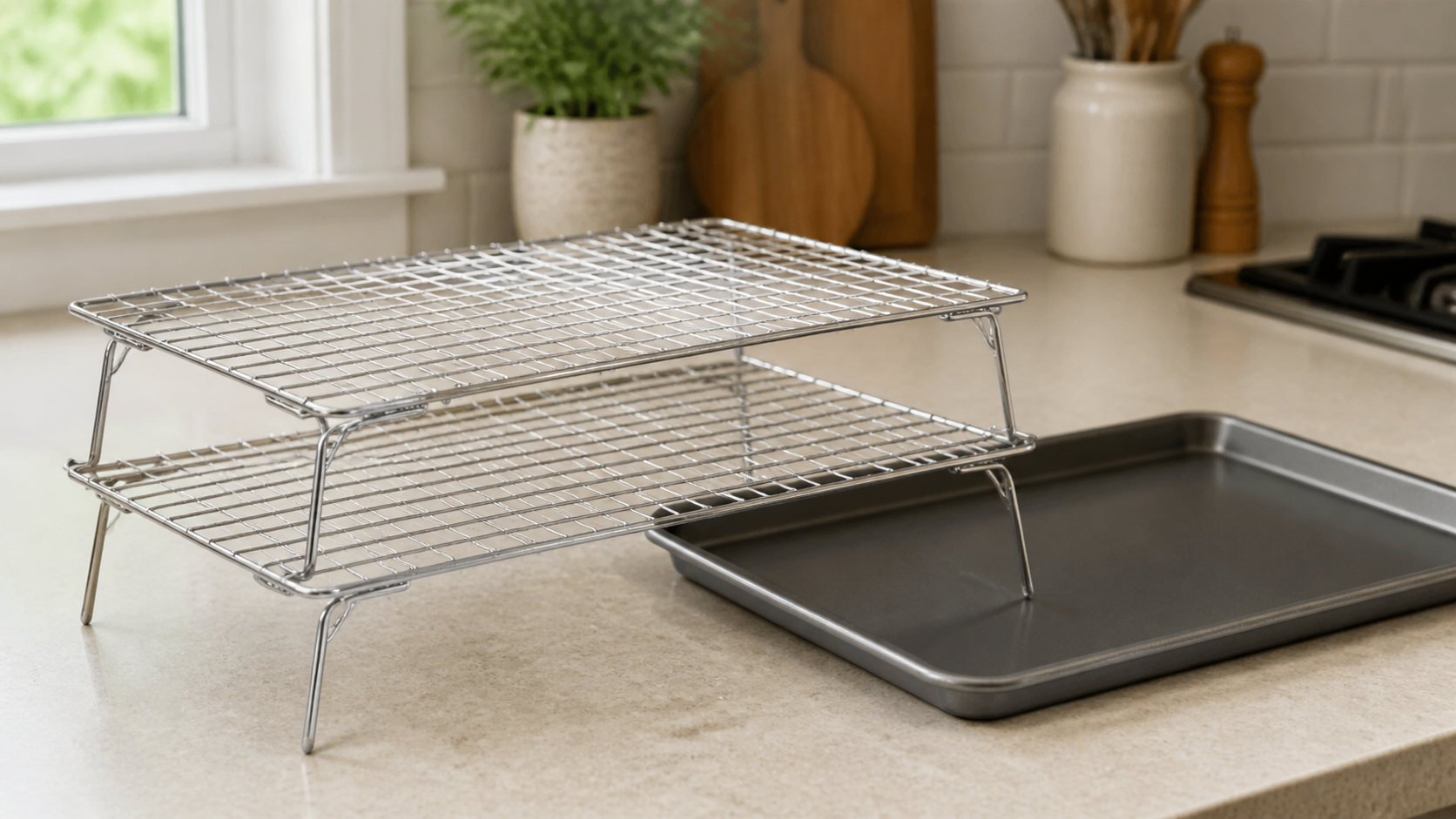
A stackable cooling rack can turn one patch of counter into two or three usable levels, but only when it is stable, food fits between tiers, and the setup matches your pans and storage. This guide compares formats and verifiable fit—not untested products or cooking-result promises.
As an Amazon Associate, GoodWeighFinds earns from qualifying purchases.
Who this guide is for
This guide is for adults who cool multiple pans of baked or batch-cooked food and regularly run out of counter space. It covers food-cooling racks, not dish racks, appliance shelves, roasting racks, or claims that a rack changes nutrition or weight-loss outcomes.
Start with the routine-support tools guide. If dividing one pan is the actual need, compare sheet-pan dividers; if pan lining is the friction point, compare silicone mats and parchment.
Useful formats, not universal winners
- Hinged multi-tier racks: Tiers stay together and may fold flat, but hinges add cleaning points and fix the spacing.
- Separate interlocking racks: Each level can work alone when the maker clearly shows how legs lock and which arrangements are supported.
- Expandable systems: Adjustable width can suit several pans, but open footprint and locked stability matter more than range alone.
- Rack-and-pan sets: A matched pan reduces fit guesswork, though replacement parts and independent rack use still need checking.
Selection criteria that matter
- Usable surface: Compare flat wire area inside frames, supports, and hinges—not only outside dimensions.
- Tier clearance: Measure from one surface to the structure above it; flat cookies and tall muffins need different space.
- Complete footprint: Include angled legs, braces, handles, and opening space. Every foot needs a secure landing.
- Stability: Require a documented stacking method and maker load guidance. Do not improvise tiers.
- Pan fit: For use inside a rimmed pan, compare rack size with the flat interior. Verify any use supporting a pan.
- Wire spacing: Match the grid to usual food or cookware; small items can fall through wide gaps.
- Material labels: Verify metal or coating, intended food contact, and explicit oven permission. “Cooling rack” does not mean oven safe.
- Cleaning: Inspect crosswires, feet, hinges, and joints, then follow exact wash directions.
- Storage: Measure the fully folded or nested stack, including raised legs.
- Returns: Check seller and return terms before washing or use.
A five-minute fit check
Mark each candidate yes, no, or unclear:
- Does the loaded footprint fit a flat counter area?
- Is usable surface large enough for the usual batch?
- Does every tier have enough vertical clearance?
- Is the stacking or locking method documented?
- Are load guidance and allowed arrangements stated?
- Will it fit the exact sheet pan, if needed?
- Are material, oven-use, and care directions specific?
- Does the folded set fit storage?
Setup, maintenance, and claim limits
Use a level, heat-tolerant surface and assemble the rack exactly as directed. Keep feet supported, distribute items within maker guidance, and avoid reaching through a loaded tier. Follow cookware and food handling directions.
Treat “heavy duty,” “nonstick,” “rust resistant,” “oven safe,” “dishwasher safe,” and “space saving” as claims needing details. They do not establish load, temperature, care, or folded size. A rack does not guarantee faster cooling, safe holding time, or a food result.
Who should skip this purchase
Skip a stackable set when one rack handles the batch, tall foods eliminate most tiers, or every foot cannot sit securely. Two ordinary racks, a cleared sheet pan, or cooling in sequence may be simpler.
Skip listings without complete dimensions, usable area, tier clearance, supported arrangements, material details, or care instructions. Also skip setups that rock, bow, overhang, or depend on improvised clips.
Bottom line
The best-fit set is not the one with the most tiers. Choose usable area and clearance that match what you use, stable feet and locks within measured counter space, and clear material, load, care, and storage details. If those facts are missing, keep shopping—or use the rack you own.